 Advertise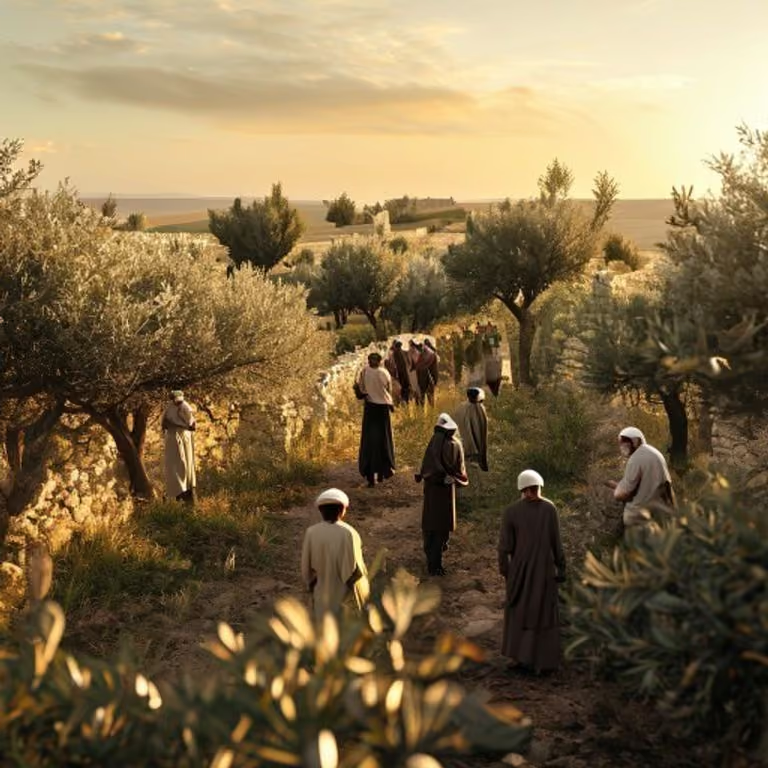
Thousands of tonnes of Palestinian olive oil are conspicuously absent from global supermarket shelves, impacting markets from the Gulf and Europe to the United States and Malaysia. This significant shortage is deeply felt by farmers in Palestine, where the olive tree, with its centuries-old roots, is a cherished national symbol.
Kamal Mukarker, whose family owns numerous olive trees in Beit Jala, south of Jerusalem in the occupied West Bank, highlights the devastating impact. For much of the 21st century, his family sustained itself by selling large jars of olive oil bi-weekly. The deep connection to olive cultivation is even suggested by his surname, which he told The National could derive from the Arabic word for pruning olive trees.
However, this year presents a grim picture: a scarcity of olives to prune and few reasons for joy. A severe lack of rainfall combined with disruptive settler violence has led to the worst olive harvest since 2009. The ongoing Gaza war and Israel’s occupation of the West Bank have already severely damaged the economy, making this a particularly devastating period for farmers grappling with both human-made and natural disasters. Mr. Mukarker noted, 'Since the Gaza war, many people went back to agriculture, especially workers that used to work in Israel. Many people ended up cultivating their land because there’s no other source of income in the West Bank.' He added that the previous two years were marked by 'disastrous' weather and rainy seasons, resulting in a production drop of 'more than 70 per cent.'
While adverse weather is a primary factor, Israeli actions exacerbate the crisis. Mr. Mukarker's family lost 30 per cent of their land when the nearby separation barrier between Israel and the West Bank was constructed. Furthermore, settler activities have intensified. Getty Images Info has captured scenes of burnt leaves picked from trees instead of olives in the occupied West Bank, illustrating the scale of the problem. Decades-old settlements have expanded, and new outposts have proliferated, a common issue under Prime Minister Benjamin Netanyahu’s latest government, which prioritizes settlement expansion on Palestinian land.
'The harvest of last year was affected also because of settler violence. We lost twice,' Mr. Mukarker stated. 'The quality of the crop and the risk that harvesting such a bad crop entailed.' These combined factors led many farmers to forgo harvesting altogether in 2025.
Fayyad Fayyad, Chairman of the Palestinian Olive Oil Council, informed The National that olive oil production across Palestine stands at a mere 33 per cent of the annual average, with only 7,000 tonnes produced last year. This is critically insufficient, as the West Bank market alone requires at least 13,000 tonnes. Typically, about 4,000 tonnes are exported to the Gulf, 1,000 tonnes to Jordan, and 2,000 tonnes to other international markets. Currently, there is simply not enough for export.
This shortage poses a significant threat to the Palestinian economy. Mr. Fayyad explained that olive oil accounts for approximately 15 per cent of the agricultural sector's annual revenue in Palestine. 'About 100,000 families benefit from the olive oil trade, each family is on average about 5.5 people so the effects are very significant,' he elaborated. 'There are about 70,000 grove-owning farmers, then there are about 30,000 families who benefit from the trade indirectly, whether by being transporters, workers or other roles.'
Like Mr. Mukarker, Mr. Fayyad attributes much of the problem to weather patterns but emphasizes the exacerbating role of Israeli violence. EPA Info shows hope with good rainfall this year, which might lead to a better season. Mr. Fayyad stated, 'For 20 per cent of the season, settlers prevented farmers from picking, whether through violence or by preventing landowners from getting to their groves. More than 31,000 acres of land cannot be accessed by owners because of proximity to settlements.'
Despite the challenges, there is a glimmer of hope. Both Mr. Fayyad and Mr. Mukarker are cautiously optimistic about the upcoming season, expected to commence around October, thanks to excellent rainfall this year. Mr. Fayyad remarked, 'Winter was excellent and the level of rain has been excellent. We’re hoping for a good to very good season.' Mr. Mukarker added, 'This year is the question. We’ve noticed fruit on the trees but it’s still not time to harvest. The hope is that we’ll be able to harvest properly this year.'
However, in the current climate of unprecedented violence and settlement expansion in the West Bank since the Gaza war, good weather alone may not be enough. Mr. Mukarker appealed for international solidarity, stating, 'We hope that many solidarity organisations will bring international volunteers,' referring to the increasingly perilous work of activists who accompany Palestinian farmers to their land for harvest, often facing settler violence and military detention. He concluded with concern, 'We’re worried that with the war happening, many people will not come.'
Source: The National News