 Advertise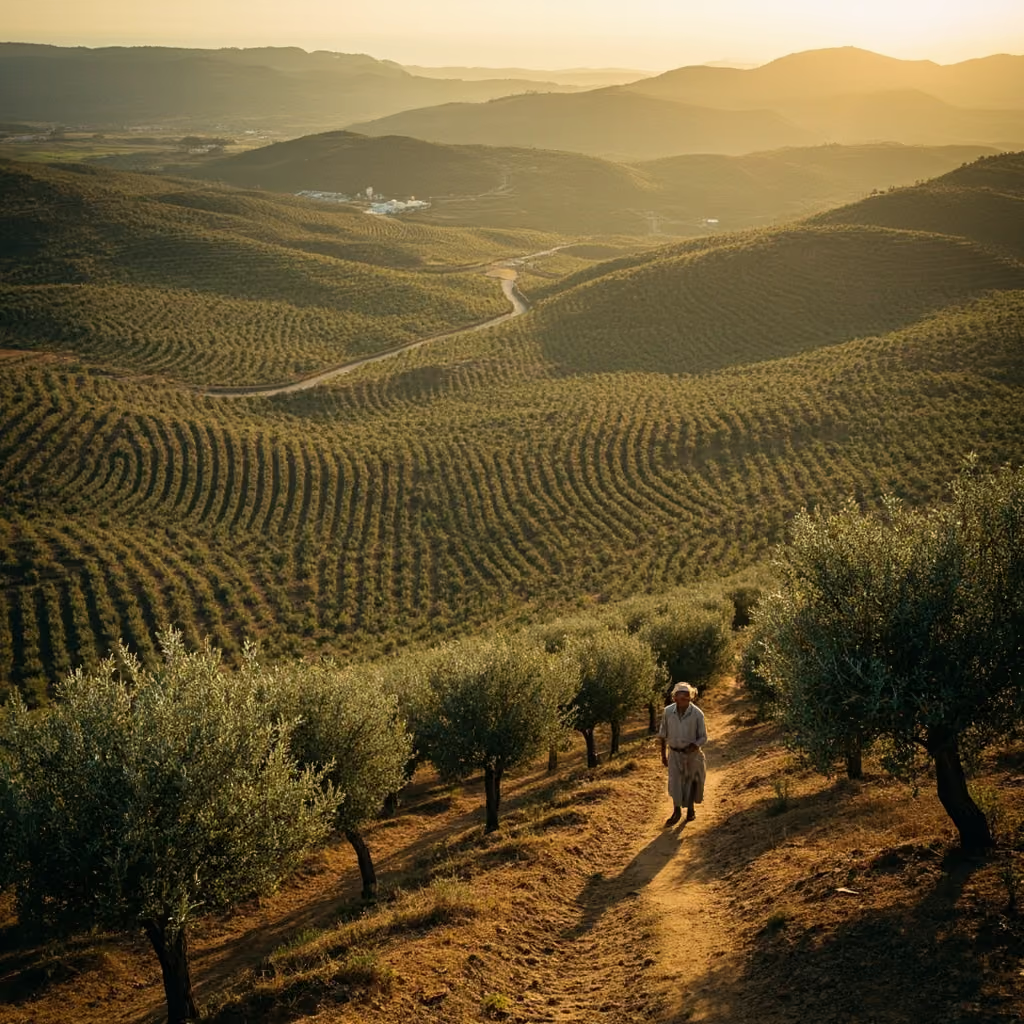
Pakistan's Prime Minister Shehbaz Sharif on Monday launched the country's National Olive Value Chain Policy, aiming to transform the rapidly expanding olive sector into a major agricultural industry capable of reducing the multi-billion-dollar edible oil import bill.
Addressing farmers, growers, diplomats, entrepreneurs and officials at the launch ceremony, the prime minister described the growth of olive cultivation as a rare success story in Pakistan's agriculture sector. He said sustained expansion could help the country move toward self-sufficiency in edible oils.
Shehbaz noted that Pakistan currently spends around $4 billion annually on crude edible oil imports, stressing that even a partial substitution through domestic production would provide significant relief to the national economy.
'Olive oil is among the healthiest fruits available, and if we produce it ourselves, even saving a fraction of that import bill would be an enormous service to the nation,' he said.
The prime minister expressed confidence that Pakistan could become self-sufficient in edible oil within a few years if federal and provincial governments, farmers and private-sector investors continue to work together.
The new policy provides a roadmap for expanding olive cultivation while developing processing, quality control, packaging, branding and marketing facilities, with the goal of positioning Pakistan as a regional hub for olive oil across South, Central and Eastern Asia.
According to officials, the number of olive trees in Pakistan has increased from approximately 500,000 in 2016 to more than seven million, with plantations now spread across Punjab, Khyber Pakhtunkhwa, Balochistan and Sindh. Olive orchards currently cover around 60,000 acres.
Minister for National Food Security and Research Rana Tanveer Hussain said the government was seeking to take the sector beyond cultivation and raw production by developing an integrated value chain based on processing, packaging, branding, quality and exports.
'The real competition in agriculture today lies in quality, value addition, packaging, branding and market access,' he said.
Secretary National Food Security and Research Amir Ali Ahmed said the policy was designed to establish Pakistan as an important centre of olive oil production in the wider region. He added that the prime minister had directed that the initiative should not remain confined to plantation programmes but should encompass the complete chain from production to processing, value addition and marketing.
The prime minister acknowledged Italy's longstanding contribution to Pakistan's olive sector and announced that the government would sponsor the training of 100 young agriculture graduates in Italy. The graduates will receive training in olive cultivation, processing and marketing before returning to Pakistan to contribute to the development of the domestic value chain.
Shehbaz thanked Italy for its decades-long cooperation in agriculture, archaeology, trade and industry, recalling the two countries' seven-decade partnership. Italian Ambassador Ugo Ciarlatani described the new policy as the product of a longstanding partnership between the two countries, noting that Italian cooperation had contributed to the establishment of sensor and phytosanitary laboratories, training of plant pathologists and chemists, seven notified nurseries and 36 business development groups led by women and young people.
The ambassador cited the €20 million Professional Capacity Building and Extension Agriculture Programme as a recent example of bilateral cooperation and expressed confidence that Pakistan could develop a competitive olive industry.
Officials also confirmed that Pakistan has secured a permanent seat at the International Olive Council, while the country's first Olive Sensory Evaluation Lab has been established in Islamabad.
The prime minister praised farmers who persisted with olive cultivation despite scepticism from their families and communities, particularly highlighting growers from Balochistan and Khyber Pakhtunkhwa whose produce has received recognition at international competitions in New York, London and Dubai.
Among those honoured were growers who developed successful orchards in regions previously considered unlikely to support a commercially viable olive industry. Abdul Jabbar, an olive farmer from Loralai, began cultivation in 2011 despite opposition from his family. His orchard began producing in 2017 with support from the Olive Culture project and local authorities and has since expanded substantially.
Dr Qurat-ul-Ain Irfan, one of the country's prominent female olive farmers, established more than 14,000 olive trees on over 600 kanals of land in Mardan after an Italian survey identified the area's potential for olive cultivation. Yaqub Izhar, who operates what was described as Pakistan's largest private-sector olive nursery, said his interest in the crop developed after visiting an agricultural exhibition in Istanbul around 2007-08.
The prime minister also called for greater attention to other edible-oil crops, including palm and sunflower, saying the government's objective should be to reduce dependence on imported edible oil through diversified domestic production.
Separately, Prime Minister Shehbaz Sharif met Sheikh Nayef bin Eid Al Thani, chairman of Retaj Group and Tamim Holdings, and discussed matters of mutual interest and investment cooperation. Federal Minister for Petroleum Ali Pervaiz Malik, Prime Minister's Adviser Haroon Akhtar, Minister of State Bilal Azhar Kayani, Special Assistant Tariq Fatemi and senior officials attended the meeting.
Welcoming the Qatari delegation, Shehbaz emphasised the longstanding and brotherly relationship between Pakistan and Qatar. He recalled his recent visit to Qatar to offer condolences following the death of the Emir's father and said Pakistan was looking forward to the upcoming visit of Qatari Emir Sheikh Tamim bin Hamad Al Thani.
The Qatari delegation expressed appreciation for Pakistan's hospitality and conveyed a strong interest in expanding investment in the country. The engagement comes as Islamabad seeks to attract greater foreign investment and broaden economic cooperation with Gulf partners.
Officials stressed that investment in processing, packaging, branding, quality certification and market access would be crucial if Pakistan is to compete in international markets. The government's approach also seeks to involve young people and women in the emerging industry, while greater technical cooperation with Italy is expected to strengthen expertise across the sector.
In the longer term, officials see the sector as a potential export industry capable of positioning the country as a supplier to markets across South, Central and Eastern Asia. The prime minister urged farmers and government officials to ensure that the policy translated into practical activity in the field rather than remaining confined to official documents.
'If you are determined and have passion in your heart, such revolutions can be brought about,' Shehbaz said, describing the development of Pakistan's olive sector as evidence of what sustained cooperation between farmers, governments and international partners can achieve.
Source: Pakistan Today