 Advertise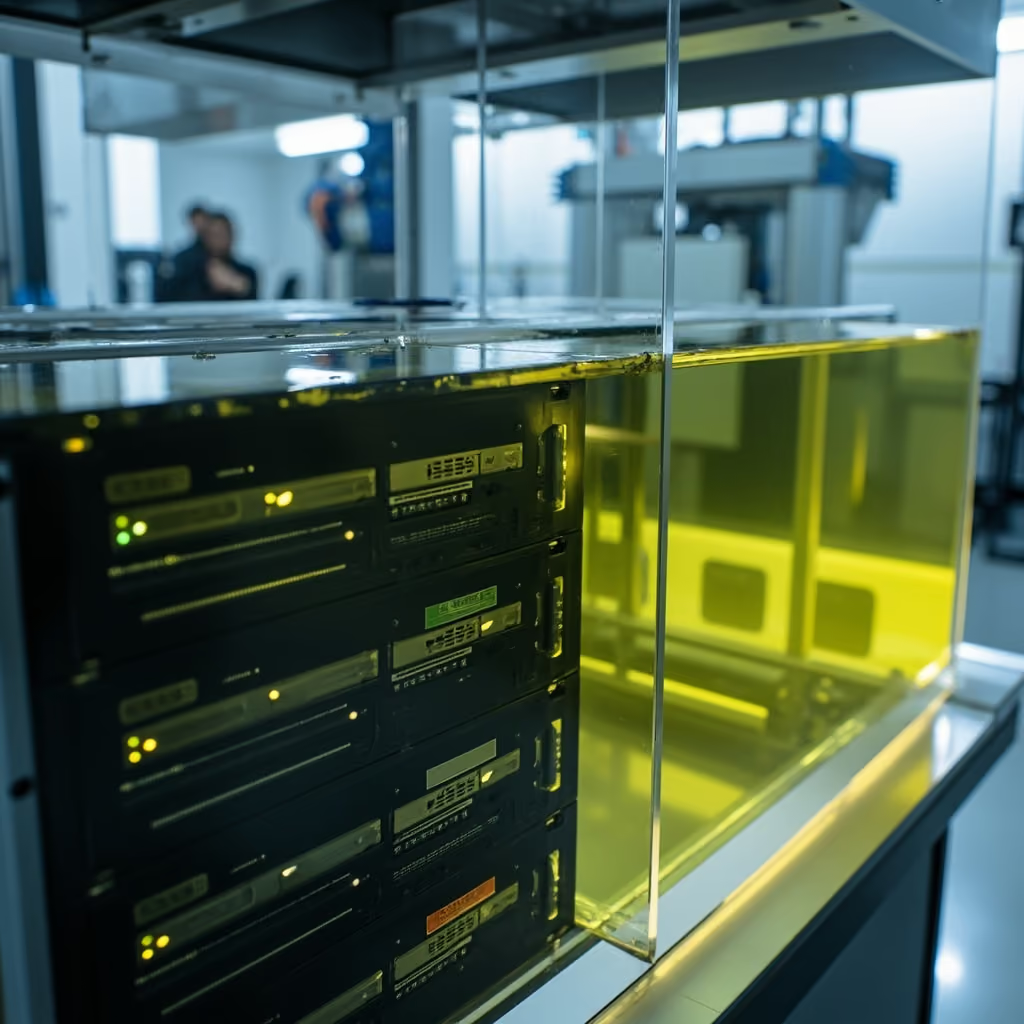
KUALA LUMPUR – The Malaysian Palm Oil Board (MPOB) has introduced Sawit EcoTherm, an innovative palm-based immersion cooling fluid designed to significantly reduce both water and energy consumption in data centres, thereby fostering more sustainable digital infrastructure.
According to Dr. Noor Khairin Mohd, a senior research officer within MPOB's Advanced Oleochemical Technology Division, Sawit EcoTherm transforms traditional water-intensive data centre cooling into an entirely water-free solution. This development is crucial for safeguarding Malaysia's vital water resources while simultaneously supporting the growth of the nation's digital economy. She highlighted that conventional water-cooling systems for data centres in Malaysia are projected to consume an alarming 876 million litres of water daily, an amount equivalent to the daily water needs of nearly four million people.
'This technology replaces conventional air- and water-based cooling systems,' Dr. Noor Khairin explained to Bernama. 'Instead of relying on cooling towers that deplete substantial amounts of water through evaporation, server components are fully immersed in a non-conductive dielectric fluid that continuously removes heat within a closed-loop system.' She added that widespread adoption of immersion cooling with Sawit EcoTherm could drastically lower the data centre industry's water demand.
Sawit EcoTherm distinguishes itself by combining locally sourced renewable raw materials with water-free operation, superior energy efficiency, and high-performance cooling capabilities. This makes it a highly promising solution for the demands of next-generation artificial intelligence (AI) and hyperscale data centres. Dr. Noor Khairin emphasized, 'Sawit EcoTherm stands out because it combines high-performance cooling with sustainability and local resource advantages, using a palm oil-based, non-conductive immersion cooling fluid produced from locally sourced Malaysian palm oil.'
She further elaborated on the benefits for high-density computing environments: 'AI servers generate three to five times more heat than conventional servers. Therefore, immersion cooling can handle much higher heat loads than conventional air cooling, enabling higher computing density, improved energy efficiency, and more reliable operation for next-generation AI infrastructure.'
From a sustainability perspective, Sawit EcoTherm aids data centre operators in achieving their environmental, social, and governance (ESG) objectives. It addresses four critical priorities: water conservation, energy efficiency, carbon emissions reduction, and environmental protection. Dr. Noor Khairin noted that 'The technology improves energy efficiency by cooling server components directly, eliminating server fans and substantially reducing energy consumption by around 30-50 per cent, contributing to improved power usage effectiveness (PUE).' Furthermore, she pointed out that 'It also helps reduce carbon emissions, as lower electricity consumption translates directly into lower indirect (Scope 2) greenhouse gas emissions.'
The fluid itself is produced from up to 95 per cent renewable, bio-based palm-derived materials, significantly decreasing reliance on petroleum-based cooling fluids and enhancing overall environmental performance. Dr. Noor Khairin highlighted its safety features, stating, 'It is PFAS-free (free from 'forever chemicals'), readily biodegradable, and has low ecological toxicity, reducing environmental risks associated with accidental leaks or disposal compared with conventional synthetic cooling fluids.'
Accelerating the adoption of Sawit EcoTherm will require robust government support to build the necessary ecosystem, leveraging Malaysia's rapidly expanding data centre industry. This will necessitate strong collaborative efforts among MPOB, technology providers, data centre developers, server manufacturers, and immersion cooling system integrators.
'The priority is to build confidence among data centre operators through pilot projects, technical validation, and demonstrations of the technology's performance, reliability, and long-term cost benefits,' Dr. Noor Khairin stated. She concluded that by merging government backing, industrial partnerships, and Malaysia's strong oleochemical expertise, Sawit EcoTherm has the potential to establish Malaysia as a global leader in sustainable immersion cooling technology for advanced AI data centres.
Source: Bernama