 Advertise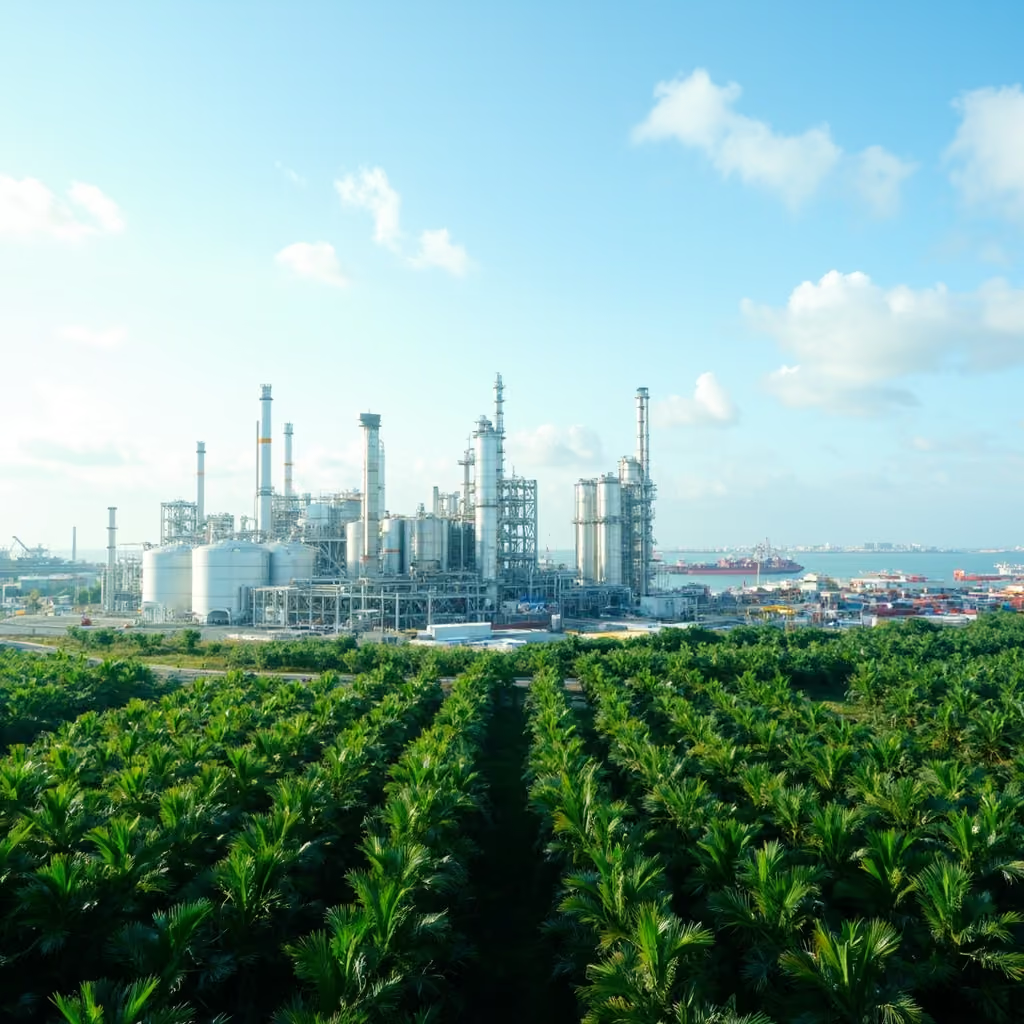
Kenya is making significant strides towards establishing a domestic palm oil industry with ambitious plans for a refinery and commercial plantations in Lamu County. This strategic move aims to drastically reduce the nation's annual import bill, which currently sees billions spent on foreign palm oil. The proposed investment is slated for development within the LAPSSET Special Economic Zone (SEZ).
Discussions for the project are actively underway between Kenyan authorities, CPF Investment, and Malaysian consultants. Recent meetings involved LAPSSET regional manager Salim Bunu and Kenya Ports Authority (KPA) manager for terminal engineering Albert Owino, who hosted the CPF Investment delegation, led by John Mwaniki from CPF Investment Nairobi, along with their Malaysian consultants. Earlier, the delegation had also met with Investment Promotion Principal Secretary Abubakar Hassan.
CPF Investment has identified land in Witu, Lamu County, for the establishment of palm plantations. This marks a pivotal shift from Kenya's long-standing reliance on imported crude palm oil towards fostering a robust domestic supply chain. Kenya currently imports approximately one million tonnes of palm oil each year, valued at nearly $1 billion (equivalent to Sh129.4 billion), making it one of the country's primary import expenditures. Palm oil is a vital commodity, extensively used in cooking oils, food processing, soap manufacturing, and cosmetics. About 90 percent of these imports consist of crude palm oil, predominantly sourced from Malaysia and Indonesia, which is then refined locally.
The proposed Lamu refinery is expected to significantly boost Kenya's economy by retaining more value domestically and establishing an industrial base for supplying both local and regional markets. Beyond economic retention, the project is forecast to generate employment, stimulate agro-processing activities, and attract further investments into the LAPSSET SEZ, an area strategically positioned as a key industrial and logistics hub along Kenya's coast.
This palm oil initiative underscores strengthening economic ties between Kenya and Malaysia. Malaysia is keen on expanding its footprint in Kenya's edible oil sector and has taken steps to establish Nairobi as a regional base for its palm oil trade and re-export operations across Sub-Saharan Africa. This presents Kenya with a significant opportunity to position itself as a regional processing and distribution hub.
During a recent visit to Kenya, Malaysia's Minister for Plantation and Commodities, Johari Ghani, affirmed his country's readiness to provide technical expertise and palm oil seedlings. This collaboration aims to help both nations develop the edible oil value chain. Ghani stated, 'We will be setting up a trade support office in Nairobi to address any challenges being faced by Kenyan imports and equally to support exporters to trade with Malaysia.' He further expressed Malaysia's willingness to assist Kenyan farmers and manufacturers in scaling up production for both the domestic market and exports to the East African region.
The partnership holds the potential to address a critical vulnerability in Kenya's edible oil industry: the severe shortage of locally produced raw materials. The Kenya Association of Manufacturers (KAM) reports that while Kenya possesses an annual edible oil refining capacity of about 2.1 million tonnes, factories currently operate at only around 40 percent capacity due to insufficient access to raw materials. KAM chief executive Tobias Alando highlighted this, noting, 'There is opportunity to enhance capacity utilisation and scale up production to meet national demand.' Kenya's annual edible oil demand exceeds 900,000 tonnes, with imports fulfilling the majority. The Lamu investment is thus poised to tackle both underutilised refining capacity and the heavy reliance on imported raw materials simultaneously.
Both the Kenyan government and industry stakeholders are increasingly advocating for the localisation of the edible oil value chain, which includes promoting greater cultivation of oilseed crops, improving access to finance, and developing out-grower schemes. Malaysia's involvement would furnish Kenya with invaluable technical knowledge, honed over decades in commercial palm cultivation, processing, and value addition.
For Lamu, this project will integrate a crucial agro-industrial component into the LAPSSET development strategy. It aims to forge a direct link between farming and processing activities with the Port of Lamu, thereby opening new avenues for exports to the broader East African market. The existing commercial relationship between Kenya and Malaysia is substantial, with Kenya's imports from Malaysia rising to Sh135.9 billion last year, up from Sh120.5 billion the previous year. The palm oil project offers a chance to transform the nature of this relationship, shifting it from one primarily defined by raw material and manufactured goods imports to one increasingly centered on local production, processing, investment, and regional exports. If successfully implemented, the Lamu refinery and plantation project could serve as a litmus test for Kenya's ambition to curtail its edible oil import bill and establish its coastal region as a new hub for agricultural processing and manufacturing.
Source: the-star.co.ke