 Advertise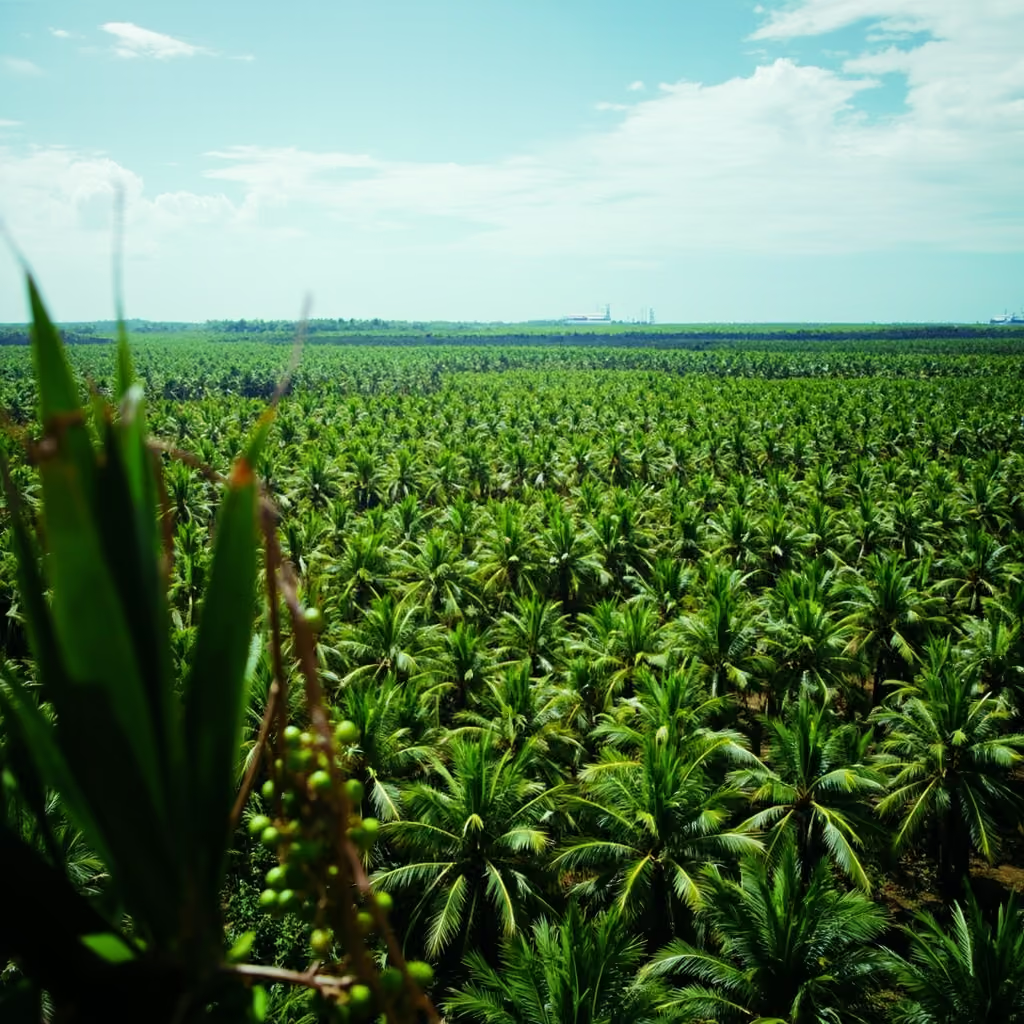
JAKARTA - Indonesia is strategically positioned to play a pivotal role in meeting the world's burgeoning vegetable oil requirements in the coming decades.
Palm oil is projected to contribute approximately 60 percent to fulfilling global vegetable oil needs by the year 2050.
Tungkot Sipayung, Founder and Executive Director of the Palm Oil Agribusiness Strategic Policy Institute (PASPI), highlighted that worldwide demand for vegetable oil is consistently increasing year-on-year. This surge is attributed to population growth, rising incomes, and the expansion of global industrialization.
Vegetable oil's utility extends beyond food ingredients; it is increasingly employed as a biomaterial, a substitute for petrochemicals, and an alternative energy source to replace fossil fuels.
Sipayung detailed that by 2050, global vegetable oil demand is estimated to reach 300 million tons, coinciding with a projected world population of around 10 billion people. This demand level represents nearly 1.4 times the world's vegetable oil production rate in 2025, which stands at 215.6 million tons.
'As the world's population grows, palm oil consumption also increases. Towards 2050, the world's population will reach more than 10 billion people, so the world's palm oil needs will also increase,' he stated in Jakarta on Monday, August 24.
He estimated that the production capacity of other vegetable oils, such as soybean oil, rapeseed, and sunflower oil, will face significant limitations in the future. This constraint stems from restricted productivity and finite land availability.
Consequently, Sipayung asserted that the fulfillment of global vegetable oil needs will increasingly rely on palm oil.
To illustrate, by 2025, soybean cultivation areas are expected to cover around 143.8 million hectares, contributing 32.8 percent to global vegetable oil production. Rapeseed cultivation spans 43.8 million hectares with a 16.5 percent contribution, while sunflowers occupy about 29.5 million hectares, accounting for 9.3 percent.
In contrast, oil palm cultivation covers only approximately 29 million hectares, a relatively smaller area compared to other major vegetable oil crops globally. Despite this, palm oil manages to contribute around 41.4 percent to the world's primary vegetable oil production.
'It is estimated that by 2050, about 60 percent of the world's vegetable oil needs will come from palm oil,' Sipayung affirmed.
He underscored palm oil's distinct advantages in terms of productivity and sustainability when juxtaposed with other major vegetable oil sources. According to Sipayung, palm oil productivity can be eight to ten times higher.
Furthermore, the potential to enhance palm oil productivity remains substantial, with scope for a 50-100 percent increase from current levels through improved plantation practices and technological innovation.
'Meanwhile, the potential for other vegetable oils has almost stagnated, except for rapeseed or canola, which can still increase slightly, although much lower than palm,' he added.
Sipayung elaborated on other benefits of palm oil, including its relatively stable year-round supply, competitive pricing, and the significant involvement of approximately 42 percent smallholder palm oil farmers.
Moreover, the palm oil industry supports millions of micro, small, and medium enterprises (MSMEs) across its entire supply chain, from upstream to downstream sectors.
Thanks to its competitive pricing, the palm oil industry plays a vital role in providing affordable vegetable oil to the global population, including low-income groups in numerous countries.
'So, palm oil is more sustainable economically, socially, and ecologically compared to other vegetable oils,' he concluded.
Sipayung urged that increasing palm oil productivity should be a key agenda, recognizing the future global dependence on this commodity for vegetable oil needs.
He outlined two primary strategies for boosting palm oil productivity:
First, comprehensive productivity improvement through replanting with superior varieties, coupled with advancements and innovations in best plantation practices.
Second, targeted productivity enhancement in existing oil palm plantations by applying good agricultural practices (GAP), innovating cultivation and harvesting technologies, and increasing processing efficiency at palm oil mills.
'The combination of these two productivity improvement strategies will lead to a two-fold increase in palm oil productivity,' he stated.
The Indonesian government, via the Plantation Fund Management Agency (BPDP), consistently promotes the rejuvenation of oil palm plants through the People's Oil Palm Rejuvenation Program (PSR). This initiative is crucial for boosting productivity while ensuring the long-term sustainability of the national palm oil industry.
'With such increased productivity, Indonesia and other world palm oil producers can provide palm oil for the needs of the world's people,' Sipayung concluded.
Source: VOI.ID