 Advertise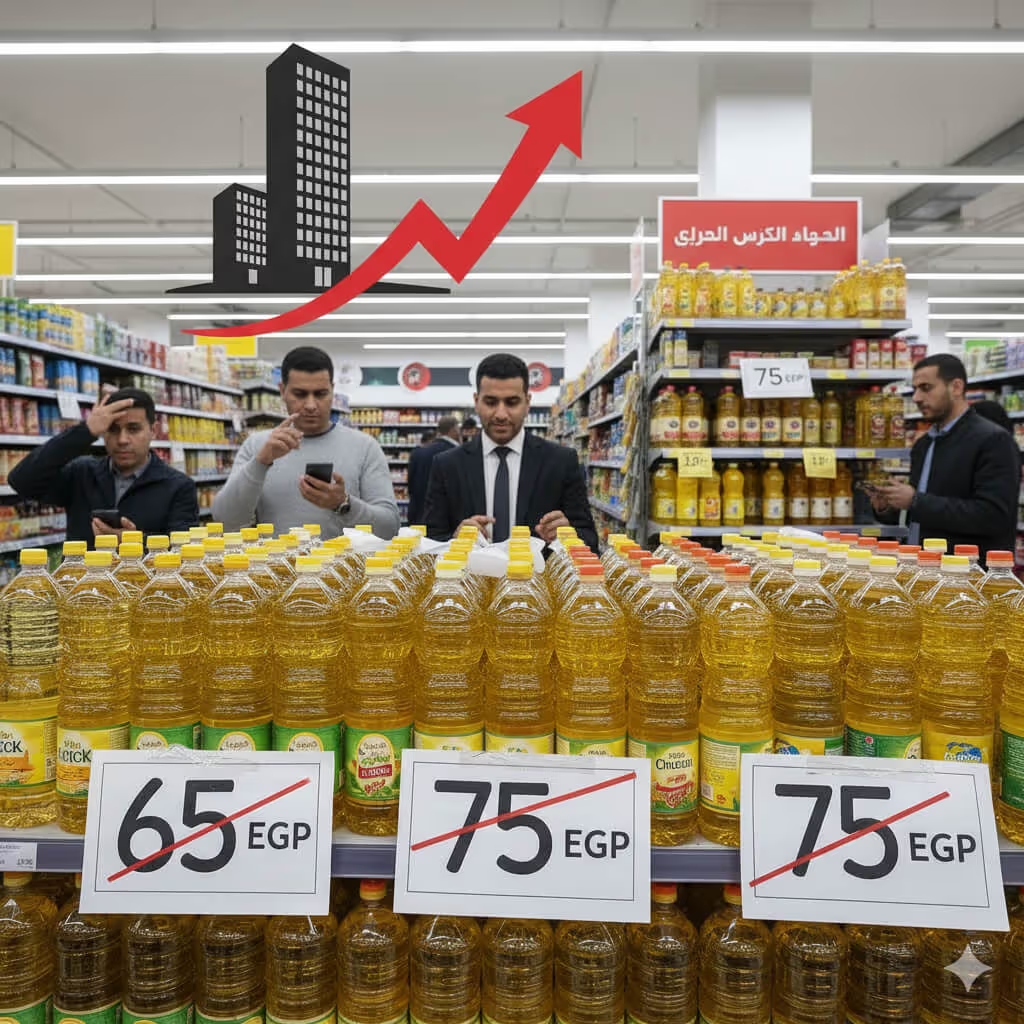
Egypt's largest cooking oil companies have withdrawn from the prime minister's initiative aimed at reducing food commodity prices, reverting to their usual, higher prices. The initiative, launched last July, had succeeded in cutting prices by around 15%.
According to price lists sent to traders, major local oil companies raised the price of a one-litre bottle by 10 Egyptian pounds this week, bringing it to 75 pounds, up from 65 pounds in October.
The companies had reportedly adopted these price increases even before the government initiative began in July. However, they recently halted their participation in the scheme and started supplying markets based on the new price lists, which reflect a 10-pound increase per litre.
The price lists, seen by Al-Shorouk, showed that 700-gramme bottles have risen to 55 pounds (compared with 47 pounds last month), while the price of a kilogramme of ghee has increased by 9 pounds, now ranging between 100 and 105 pounds.
In this context, Ahmed El-Manoufi, an organiser of government initiatives and commodity exhibitions, said what has happened is not a new price increase, but rather a withdrawal from the prime minister's initiative and a return to the price lists that were in place before last July.
Speaking to Al-Shorouk, El-Manoufi said the companies had responded to government calls at the end of July by cutting prices by 15% in line with lower production costs. He voiced his objection to prices rising again now, especially amid the recession the domestic market is experiencing.
El-Manoufi added that the companies had not only raised the prices of their packaged products, but had also increased the price of bulk oil by around 15% over the past month, pushing the price per tonne from 54,000 pounds in September to 62,000 pounds.
As a result of the rise in bulk oil prices, small and micro companies were forced to raise their own product prices to around 70 pounds per litre (up from 64 pounds). El-Manoufi explained the market mechanism, noting that major companies import crude oil and refine it, packaging part of it under their own brands and selling the rest in bulk to smaller companies.
It is worth noting that Prime Minister Mostafa Madbouly launched a government initiative at the end of July, in cooperation with producers and traders, for an immediate price cut in line with positive economic indicators and an improved exchange rate. The dollar has fallen by around 7% since the start of the year, stabilising at 47.40 pounds on the selling side — its lowest level since June 2024 — compared with 50.90 pounds at the start of 2025.
For his part, an official source at the Federation of Egyptian Chambers of Commerce said that the major companies' complete dominance of the domestic market is what has allowed them to raise prices without justification. The source affirmed the availability of a strategic stock covering several months, in addition to the decline in the dollar's price and falling global oil prices.
The source, who requested anonymity, stressed the need for the government to establish mechanisms to control the prices of strategic commodities, without direct intervention in the market. "It is unacceptable for companies to raise their prices while the government is calling for them to be cut," the source added.
In a related development, the Ministry of Supply and Internal Trade announced last Tuesday that a new 1.5-litre blended oil pack will be made available through the ration card system at 56 pounds, starting from 1 December 2025.
In a statement, Sherif Farouk, Minister of Supply and Internal Trade, confirmed that the reductions on the prices of "free-market" (non-subsidised) oils — including blended, sunflower and corn oils — will remain in effect at consumer complexes affiliated with the Holding Company for Food Industries, in order to ease the burden on citizens.
Meanwhile, Islam Metwally, who heads one of the small oil companies, believes that the major companies deliberately raised the price of bulk oil to force smaller companies to raise their retail packaging prices to around 70 pounds.
In remarks to Al-Shorouk, Metwally said these companies used the rise in the global price of soybean oil (by around $100 per tonne) as a pretext to immediately raise domestic prices, ignoring the fact that they hold strategic stocks sufficient for more than six months.
He added that the true cost of bulk oil domestically, based on the global price and the current exchange rate, should not exceed 52,000 pounds per tonne, whereas the major companies are selling it at 62,000 pounds.
Egypt relies on imports to cover more than 95% of its consumption of vegetable oils, according to previous statements by Zakaria El-Shafei, head of the oils division at the Federation of Industries.
On the international level, soybean oil prices rose during November, with the price per tonne reaching $1,109, up from $1,025 in October. Soybean oil is the main component (85%) of the blended oil most commonly used in the domestic market.
Source: Al-Shorouk