 Advertise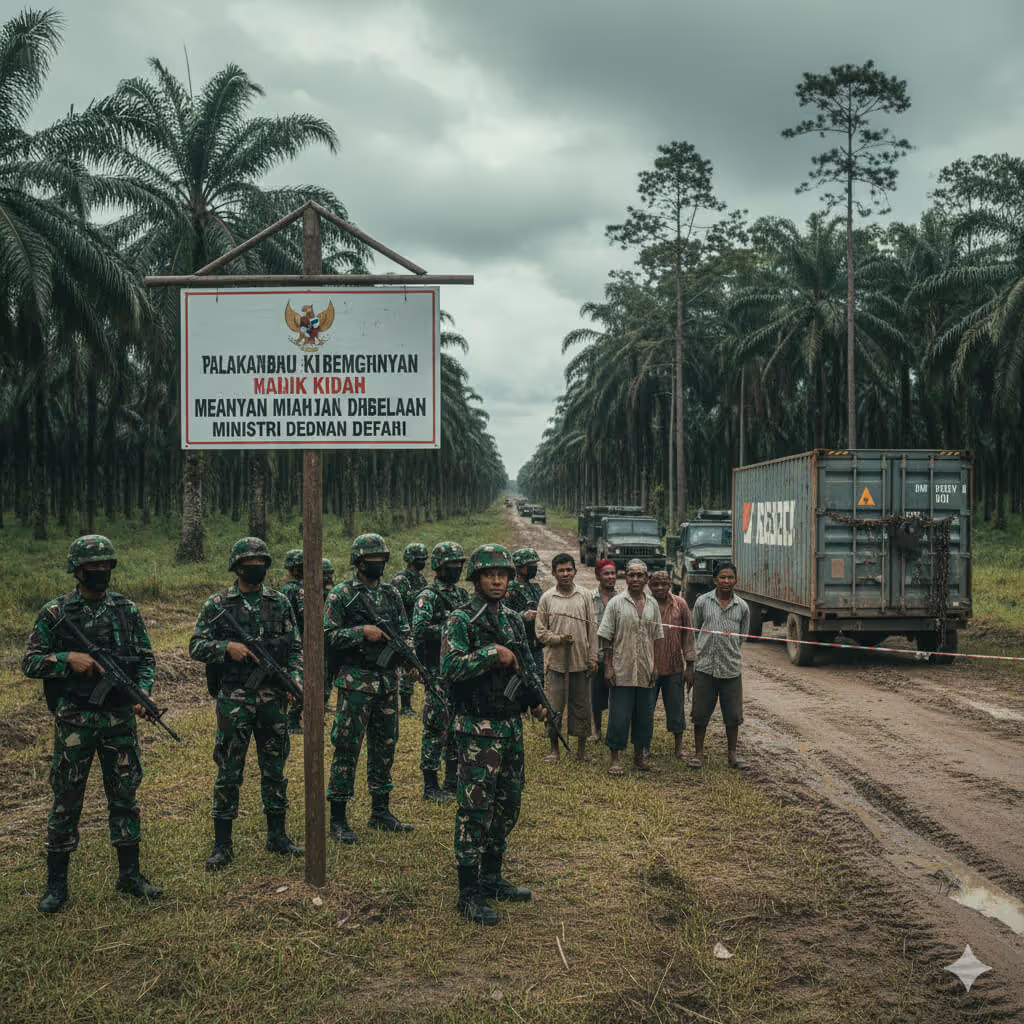
The campaign ordered by President Prabowo Subianto is the biggest structural shake-up in the sector
In late June, Indonesian soldiers in military uniform marched onto a private palm oil plantation on the island of Borneo and put up a sign declaring the property now under government control, its managers said.
The scene at the Melati Hanggilipan plantation is emblematic of a sweeping, military-backed seizure campaign that has sent a chill through the world's largest palm oil producer and its 16-million-strong workforce. Around 3.7 million hectares of plantations have been seized, with nearly half transferred to state-owned start-up Agrinas Palma Nusantara, propelling it to become the world's largest palm oil company by land area.
The campaign ordered by President Prabowo Subianto is the biggest structural shake-up in Indonesia's palm oil industry and has put a total of 5 million hectares under military scrutiny. That amounts to about 30% of the country's total palm oil acreage — an area larger than the Netherlands.
This land could ultimately be handed over to Agrinas, a company that industry experts say is ill-equipped to manage it.
The president's office and Agrinas did not respond to Reuters' requests for comment.
Speaking to his cabinet on Monday (20 October) while listing the seizures as one of his standout achievements since taking office in October 2024, Prabowo said: "We are determined that there will be no more corruption cases that cannot be investigated — no one is above accountability."
Companies Under Siege
Prabowo, a former special forces commander, has expanded the military's role in civilian affairs, reviving fears of a return to authoritarian rule reminiscent of the Suharto era in Indonesia. He has appointed retired generals to Agrinas's board and formed a task force of soldiers, police and prosecutors to target plantations operating within areas classified as forest, according to a presidential decree issued in January and the company's website.
The task force, Indonesia's defence ministry and the military did not respond to questions about the seizures.
Reuters interviews with ten executives and farmers across Indonesia and five industry observers, including some of the sector's most closely followed analysts, revealed widespread fear about the future of their operations and the campaign's impact on global supply.
For the first time, sources at three of Indonesia's largest palm oil producers said they had cut back on fertiliser use and routine maintenance in areas at risk of seizure — steps that could lower yields in coming seasons.
No company has publicly questioned the seizures or the formation of Agrinas, and executives requested anonymity for fear of government retaliation.
"If the government uses the military and police, what can a company do? Who would we appeal to? Do you think we would dare?" one executive said. The stakes are high for Indonesia, which produces more than half the world's palm oil and exports nearly US$30 billion worth of the commodity annually, used in everything from snacks and cosmetics to fuel and cooking oil.
Before the campaign, industry group Gapki had forecast a modest rise in 2025 output to 53.63 million tonnes, but chairman Eddy Martono said "uncertainty could lead to a decline," as early as late this year.
"King Of Thieves"
The drive to Melati Hanggilipan takes two hours from the town of Sampit through remote terrain where mobile phone coverage fades and clouds of red dust trail passing trucks. The 106-hectare plantation faces an uncertain future under state control, with monthly fresh fruit bunch output already dropping to 23 tonnes from a typical 80-100 tonnes, cooperative chairman Saparani told Reuters.
He explained that their caretaker partner had been reluctant to maintain the land given its disputed legal status.
"Why should the state become the king of thieves?" he asked.
Saparani acknowledged managing the land — originally cleared for timber by a Dutch company — for two decades without formal paperwork. His cooperative once held a local government permit that expired, and when the central government reclassified the area as forest, they failed to obtain a new licence to use forest land.
This mirrors the experience of many smallholders who initially began farming on ancestral land before being told they were encroaching on forests.
The seizures have also affected tens of thousands of smallholdings run by migrant farmers who were resettled under the government of former strongman Suharto, according to an association representing them.
"We don't want to join Agrinas without legitimacy. We don't want to be used as a tool to work for them while remaining illegal," Saparani said.
Military-Run Plantations
Prabowo has portrayed the push as necessary to achieve food and energy self-sufficiency within five years.
Agrinas has been tasked with realising his ambition of producing biodiesel made entirely from palm oil and capturing at least 30% of the domestic cooking oil market.
Agrinas was established in January and is headed by Agus Sutomo, a former special forces commander who campaigned for Prabowo and was handed the palm oil portfolio in March without prior experience. That month, armed forces arrived at plantations run by the Duta Palma Group, the target of an ongoing money-laundering case, according to the company's lawyer, who presented photos and video footage.
The land was transferred to Agrinas. By September, it was overseeing 1.5 million hectares, and Sutomo said it aims to manage 3 million by 2029. "My job used to involve running and hiding, but now I've been ordered to look after palm oil," he told parliament in September.
"This is a mandate, an honour, even if I know nothing about it."
Industry's Biggest Names
The task force has also set its sights on some of the industry's biggest names. Subsidiaries of Singapore's Wilmar, SD Guthrie, the Sinar Mas Group, the Musim Mas Group, First Resources and Cargill have been listed by the forestry ministry as conducting illegal operations in forest areas.
Wilmar reported a 5% rise in fresh fruit bunch output in the first half despite the difficulties, but said full-year results depend on "resolving various issues" with Indonesian authorities.
The company told Reuters it is engaging with Agrinas on some plantations and supports the legalisation of illegal plantations.
Cargill said it is aware of the ongoing reviews and is engaged in constructive dialogue with the authorities. SD Guthrie did not respond to requests for comment, but said in August that 3% of its planted area had been affected. First Resources and Musim Mas declined to comment. Golden Agri, the parent company of Sinar Mas, did not respond.
A Complex Legal Maze
The seizures highlight decades of legal ambiguity over land. Since the boom of the 1990s, Indonesia's palm oil sector has been plagued by deforestation, unclear land rights, shifting rules and inconsistent enforcement.
Three senior executives said many farmers hold documents disputed by Jakarta and face unclear processes for regularising permits.
Even sustainability-certified companies are facing scrutiny, deepening investor concern.
The result could be a multi-year production slowdown, particularly as growth has already been slowing due to ageing trees and a moratorium on new permits in primary forests.
Global Risks
A significant production shortfall would reverberate through global edible oil markets, which are already tight as Jakarta diverts more palm oil to biodiesel.
Defence Minister Sjafrie Sjamsoeddin, who heads the task force, said Agrinas "must be ready to ensure production does not fall, but rather increases."
But at an industry conference in Mumbai, leading analysts warned of declines if the seizures continue.
"We assume Indonesian output will rise by 0.7 million tonnes next year, but I would not be surprised if the expansion turns out to be much smaller, given the cutback in investment," said Thomas Mielke of forecaster Oil World.
Industry analyst Dorab Mistry echoed these concerns: "The spectre of nationalisation immediately threatens lower yields."
Source: Reuters