 Advertise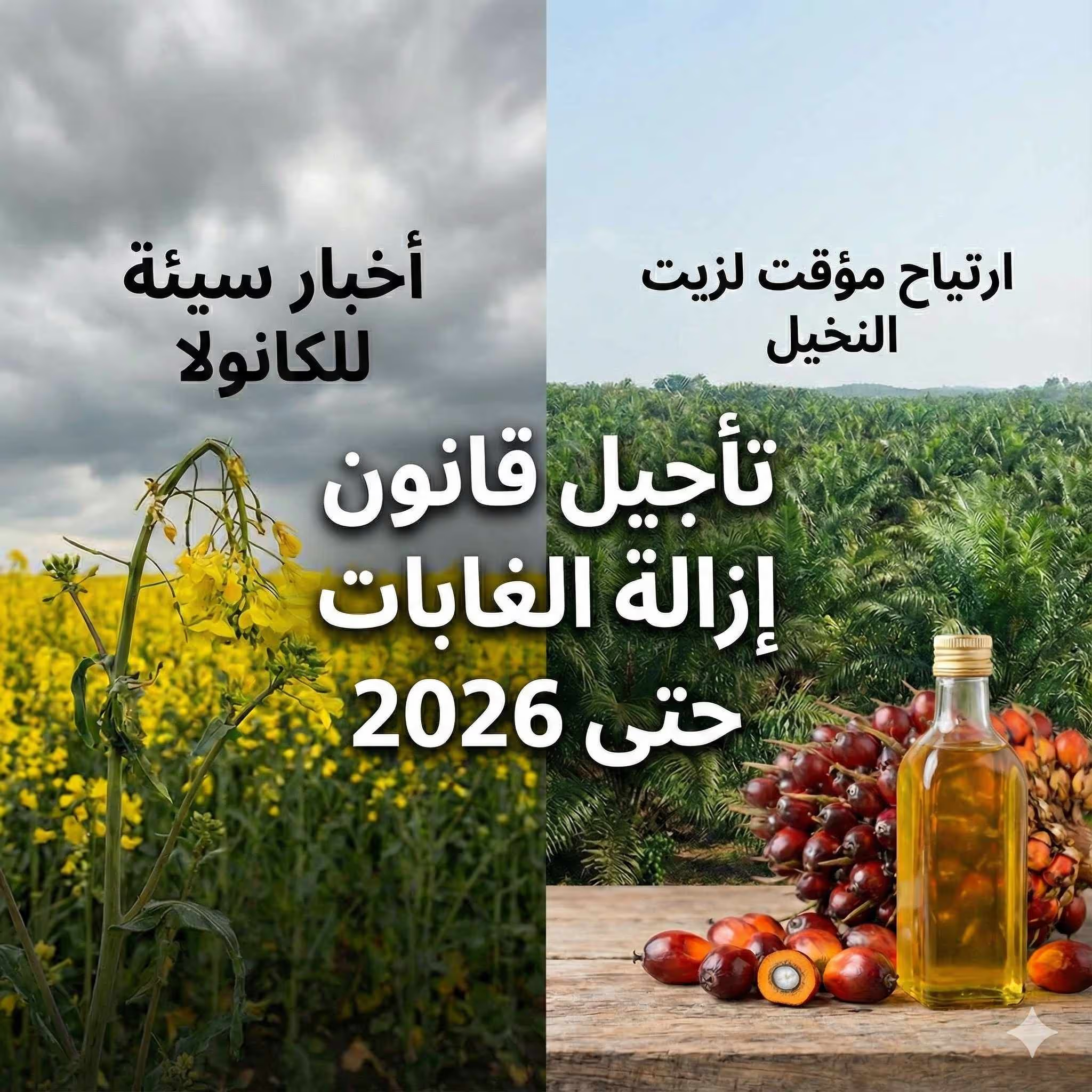
The fate of a regulation that would have boosted demand for canola oil in the European Union will be decided before the end of 2025.
The European Council recently agreed to delay implementation of the EU's deforestation regulation by another year.
The Council will now begin negotiations with the European Parliament to reach a final agreement on the regulation, which had been due to take effect on 30 December 2025.
Why it matters: The regulation has the potential to boost EU consumption of canola oil, since it imposes restrictions and penalties on palm oil.
The Council said the aim of the one-year delay is to simplify implementation of the regulation and allow operators, traders and authorities to prepare adequately.
If the European Parliament accepts the proposal, the regulation's provisions would apply from 30 December 2026 for medium and large operators, and from 30 June 2026 for small and micro operators.
The regulation aims to ensure that commodities such as cattle, cocoa, coffee, palm oil, rubber, soybeans and timber, along with their derived products, have not caused deforestation or forest degradation.
This would be the second time the regulation has been delayed by a year, drawing sharp criticism from environmental groups.
Anke Schulmeister-Oldenhove, forest policy manager at WWF's European Policy Office, said in a press statement: "Member states' claims that 'fighting deforestation remains a priority' are a blatant distortion of the facts: they have just agreed to weaken and delay the deforestation regulation."
She added: "With this vote, the regulation has come dangerously close to becoming a theoretical thought exercise rather than a concrete step towards eliminating deforestation."
For its part, the Malaysian Palm Oil Council (MPOC) welcomed the proposed delay but voiced continuing concerns about the regulation.
The group said in a press statement: "MPOC reaffirms that the Malaysian palm oil industry has worked tirelessly to transform itself in recent years, by implementing robust sustainability frameworks and achieving tangible reductions in deforestation rates."
The statement added: "Despite these efforts, the current framework of the EU regulation contains numerous operational shortcomings that fail to reward responsible leadership in sustainable practices."
The EU is Malaysia's third-largest export market for palm oil, after India and China, having imported 2.66 million tonnes of the product in 2023.
Malaysian palm oil producers say the regulation "will significantly affect" the use of palm oil in that market.
Marlene Boersch, managing partner at Mercantile Consulting Venture, said the regulation would have given canola a much-needed boost.
She added: "I have no doubt it would have supported canola oil use to some extent."
The proposed delay could hardly have come at a worse time, given China's closure of its market to Canada and record rapeseed/canola production in both the northern and southern hemispheres.
Boersch said: "We're just thirsty for anything positive."
Boersch speculates that vegetable oil users lobbied EU member states for the delay, and that there now appears to be greater political appetite to accept such proposals at the moment.
She said: "We've lost some of the momentum to move forward with some of these environmental issues for budgetary reasons."
The good news is that there is still plenty of long-term optimism for canola oil and other vegetable oils.
According to the German Agricultural Society's Agrarticker newsletter, David Milkie, managing director of Oil World, offered some encouraging remarks in a recent presentation at the Rapool conference.
Milkie noted that global vegetable oil consumption exceeded production in the 2023-2024 season, leading to a decline in global oils and fats stocks — a trend that will become even more pronounced in the 2024-2025 season, according to the Agrarticker article's translation.
This trend is likely to continue.
Milkie said: "We have to look ahead to the next five to ten years."
He added: "During this time, markets are heading towards a structural deficit in oils and fats production."
Boersch said there is also some positive news regarding the trade standoff between Canada and China, following two encouraging visits by federal and provincial government officials.
She hopes this could mark the beginning of a thaw in the tariff war between the two countries.
She said: "That would be very positive."
However, she noted that Canada would likely need to make the first move by implementing a modest reduction in its tariffs on Chinese electric vehicles.
Not helping Canada's case is the fact that China has recently resumed purchases of American soybeans, even though there is no real urgent need for the commodity. The pace of those shipments could pick up once the United States and China finalise their trade agreement.
It also doesn't help that Australia recently sent its first canola shipment to China in five years, meaning Canada could face competition in that market going forward.
Source: The Western Producer