 Advertise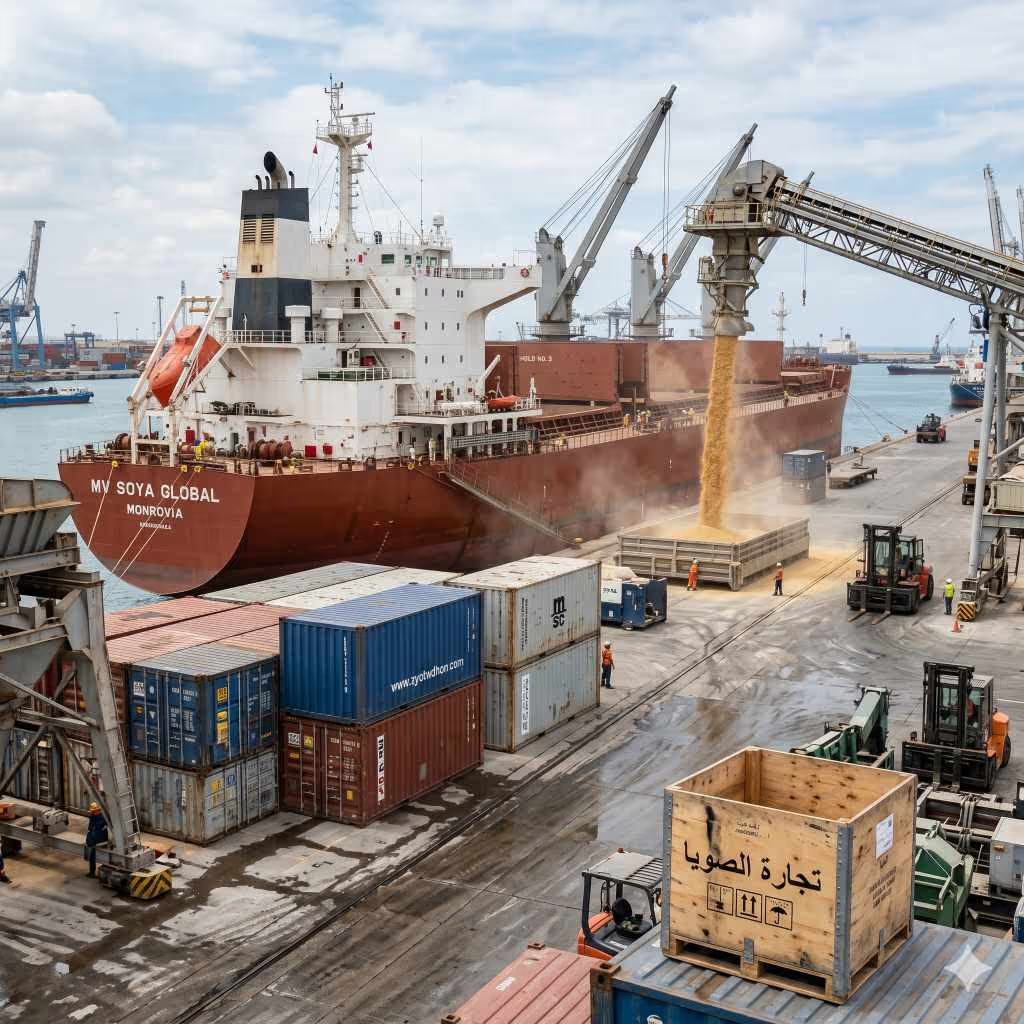
The new free trade agreement between the European Union and Mercosur introduces zero tariffs on soybeans and soybean meal, promising lower costs and more reliable supplies for Europe’s feed and crushing industries. However, industry leaders warn that new environmental rules and legal uncertainty could reduce these gains and create risks for Europe’s protein supply.
The EU-Mercosur free trade agreement provisionally entered into force on May 1, confirming zero tariffs on European imports of soybeans and soybean meal from the South American bloc. The treaty also provides for a gradual reduction of tariffs on soybean oil, which in theory should bring greater predictability and stability to European supply chains.
Under the tariff phase-out schedule, duties on crude soybean oil will gradually fall from 3.2% to zero over four years. Refined soybean oil, currently subject to a 9.6% tariff, will face a longer seven-year phase-out period.
In practice, however, Europe’s soybean crushing and animal feed industries may face the opposite effect because of accumulating regulatory requirements and legal uncertainty. These concerns are being raised by industry associations, trading companies, and representatives of the global grain supply chain as the EU tightens environmental, health, and agricultural import rules.
According to André Nassar, the simultaneous advance of environmental and health regulations could reduce imports and weaken Europe’s soybean processing capacity. The EU depends heavily on soybean and soybean meal imports to supply its animal protein chains.
Eurostat data show that in 2025 Brazil exported 6.1 million tonnes of soybeans to the EU, worth around €2.3 billion. Brazil is Europe’s main supplier. The dependence is even clearer in soybean meal, with the EU importing 10.9 million tonnes of Brazilian soybean meal in 2025, worth around €3.5 billion. Argentina ranked second, supplying 6.9 million tonnes.
Nassar said the issue goes far beyond agricultural trade and directly affects the security of supply for European industry. If soybean use declines, the EU will produce less meal, creating problems for the European livestock industry. Alternative crops such as rapeseed and sunflower produce less meal than soybeans, adding pressure to the feed sector.
Although delayed twice, the EU Deforestation Regulation continues to worry both South American exporters and European importers. The regulation requires companies to prove that products such as soy, beef and coffee imported into or sold within the EU are not linked to deforestation after 2020. From next year, the rule is expected to become mandatory for soybean imports and derived products.
The requirements include detailed traceability and proof that production areas have not been deforested. Although Brazil already has traceability programs, market operators believe the regulation’s practical implementation remains uncertain and is likely to raise logistics costs. Physical segregation of traceable soybeans is one of the most sensitive points.
Nassar said certified soybeans cannot be mixed with non-traceable product, directly affecting logistics and making soybean meal more expensive. He added that no system of this complexity has been applied before at a global scale.
Another concern is the EU’s indirect land-use change, or ILUC, rule. If soybeans are classified as a high-risk environmental product, they could be placed in a similar position to palm oil under European biofuel policies.
According to Nassar, this could make imports practically unworkable in some areas. The potential impact may extend beyond biodiesel by lowering local meal production and increasing Europe’s dependence on external sources for livestock feed. However, the direct impact on soybean meal remains uncertain because the EU cannot easily replace soybean meal in the same way it can replace oil.
Another sensitive issue for the European market is HB4 soybeans, a genetically modified variety with greater tolerance to heat and water stress. The technology has been introduced experimentally in agricultural areas across South America and is viewed by the sector as an important tool in dealing with climate change.
The challenge is that the EU has not yet approved the technology commercially. Industry sources are concerned about the possible mixing of HB4 soybeans with conventional commodity shipments. Shipments of HB4 soybeans exported from Brazil and Argentina were reportedly rejected at ports in the Netherlands in April.
The European tolerance threshold for unauthorized presence is currently only 0.01%. The international grain sector is calling for this threshold to be raised to 0.1%, but no regulatory consensus has yet been reached. Market participants say the lack of regulatory alignment increases commercial and logistics risks.
Source: All About Feed