 Advertise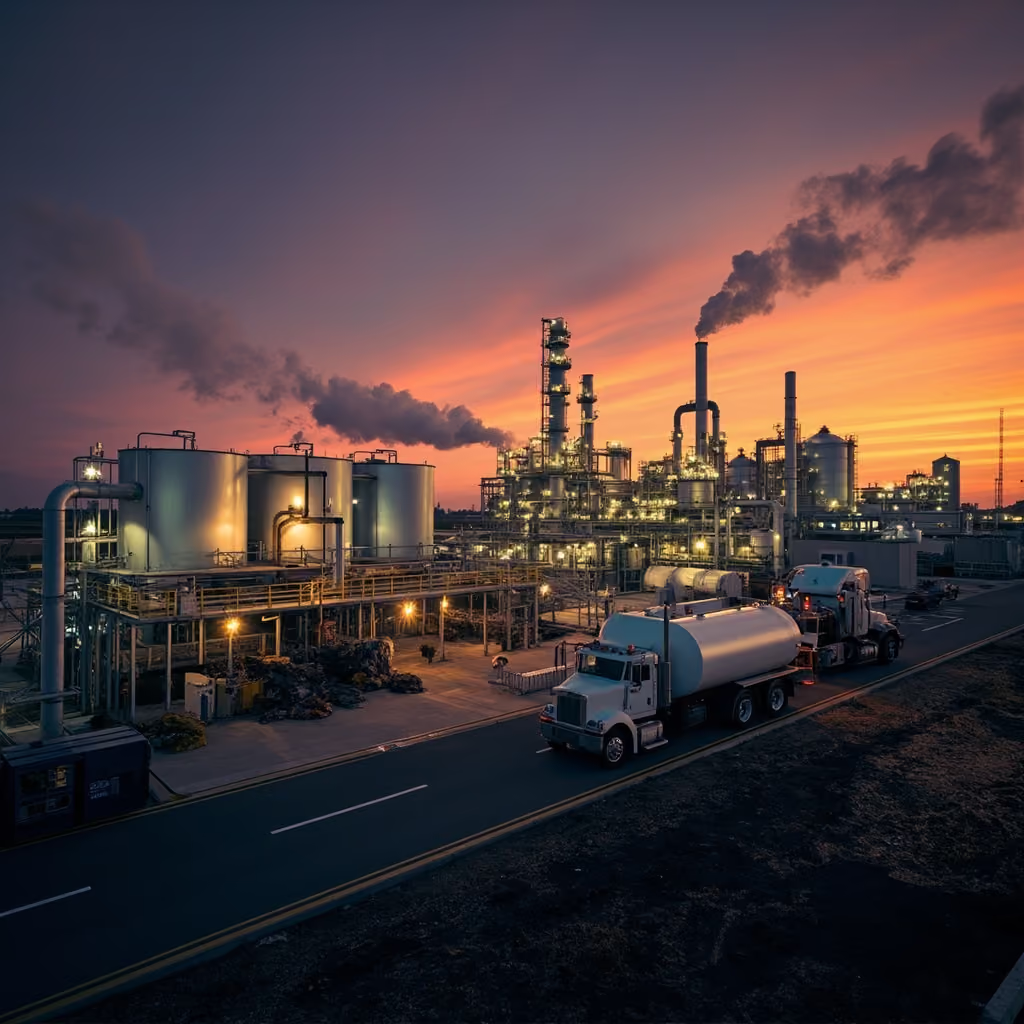
Egypt is steadily progressing in its pursuit of biofuel production from waste, with three major projects underway that utilize a portion of the approximately 100 million tons of waste the country generates annually. These initiatives aim to produce Sustainable Aviation Fuel (SAF) and biogas, addressing global aviation sector mandates for reducing carbon emissions.
Global aviation regulations oblige companies to use SAF despite its higher cost. SAF is manufactured from renewable sources like used cooking oil (UCO), agricultural waste, or animal fats. Biogas, a component of biofuel, is produced through the anaerobic digestion of organic waste. SAF can be blended with or replace conventional jet fuel without engine modifications, making it a critical near-term solution for decarbonizing aviation.
One of Egypt's projects specializes in biogas production from agricultural waste, while the other two focus on UCO to produce SAF. Although Egypt possesses abundant agricultural waste, the prohibitively high transport costs hinder its collection at centralized plants. Consequently, most processing units are deployed directly at raw material production sites.
In this context, the Ministry of Environment's Bioenergy for Sustainable Development Foundation manages a rural development program, operating approximately 2,000 small-scale biogas units across several governorates. These units process materials such as tree pruning waste, rice straw, sugarcane by-products, and other agricultural residues, according to a Ministry of Environment official.
Biogas production has seen significant expansion in 2024, with medium-sized units added in Beni Suef, Beheira, Assiut, and Alexandria governorates, boasting a combined annual production capacity of 162,000 cubic meters. Expansion also extends to household use, with the Foundation completing 22 units in villages in collaboration with Orman Association, and planning an additional 50 units in Aswan.
A substantial portion of agricultural waste is also directed towards producing organic fertilizers and animal feed. The Foundation itself produces 50,000 tons of bio-fertilizers annually, which reduces the need for imported feed and lessens reliance on chemical fertilizers. The Foundation's biogas production reached approximately 2.2 million cubic meters in 2024, equivalent to about 86,000 butane cylinders. This figure represents only a fraction of Egypt's total agricultural waste (35-40 million tons annually), indicating vast growth potential for the biogas sector.
Regarding UCO, the Egyptian Sustainable Aviation Fuel Company (EASAF) is collaborating with Honeywell UOP to establish a plant in Alexandria with a capacity of 120,000 tons of SAF per year. Ibrahim Farouk, CEO of Bio Rotterdam Clean Tech and Biofuel Operations Manager at Power Green, stated that this project, initiated by the Egyptian Petrochemicals Holding Company (ECHEM), has reached advanced development stages in 2024 and is currently securing its $570 million financing. Operations are targeted to commence in 2029, aiming to reduce carbon emissions by 400,000 tons annually.
In another venture, Qatar's Green Sky Capital secured $200 million in funding for its SafFly Egypt facility in Ain Sokhna, supported by Qatar's Almana Holding and Saudi Arabia's Ru'ya Saudi Investment. Shell has committed to purchasing the plant's entire output starting in late 2027. The facility boasts an annual production capacity of 200,000 tons, encompassing SAF, renewable diesel, and industrial bio-products. Almana Holding had previously invested $15.6 million in a second biofuel plant in 10th of Ramadan City, designed to process 100 tons of UCO daily. The Ministry of Environment estimates that Egypt consumes about 2.8 million tons of edible oils annually, generating approximately 2.6 million tons of UCO.
With increasing investments, suppliers are intensifying UCO collection efforts, which have recently risen by 10%, driven by stable prices. Farouk noted that the cost to collect one liter of UCO is currently around EGP 50, selling for EGP 70—a significant increase compared to last November's prices of EGP 35 for collection and EGP 48 for sale. Ongoing local biofuel subsidies keep domestic prices high, leading most companies to export their production. Local use is primarily limited to clients with export contracts or those requiring environmental certifications. The Suez Canal Authority has also begun sourcing its biofuel needs locally from some of the current seven plants converting UCO to fuel.
Egypt's Ministry of Environment aims to double collected UCO quantities to one million tons annually, from the 2.5 million tons consumed by Egyptians each year. This is twice the previous 2030 target of 500,000 tons. The government is also seeking substantial Gulf investments to build an integrated waste-to-energy industry, mirroring the Alexandria and Ain Sokhna plants, with efforts already underway in governorates like Kafr El Sheikh and the Canal cities.
Despite the influx of investments into biofuel refineries, a major challenge remains the lack of formal and organized supply chains for waste collection, whether agricultural or UCO. These operations largely depend on informal individual efforts rather than structured companies. This underfunding and informality of supply networks threaten the effectiveness of the two aviation fuel plants, with their combined annual production capacity of 320,000 tons, unless this fundamental issue is addressed.
Source: Enterprise Egypt