 Advertise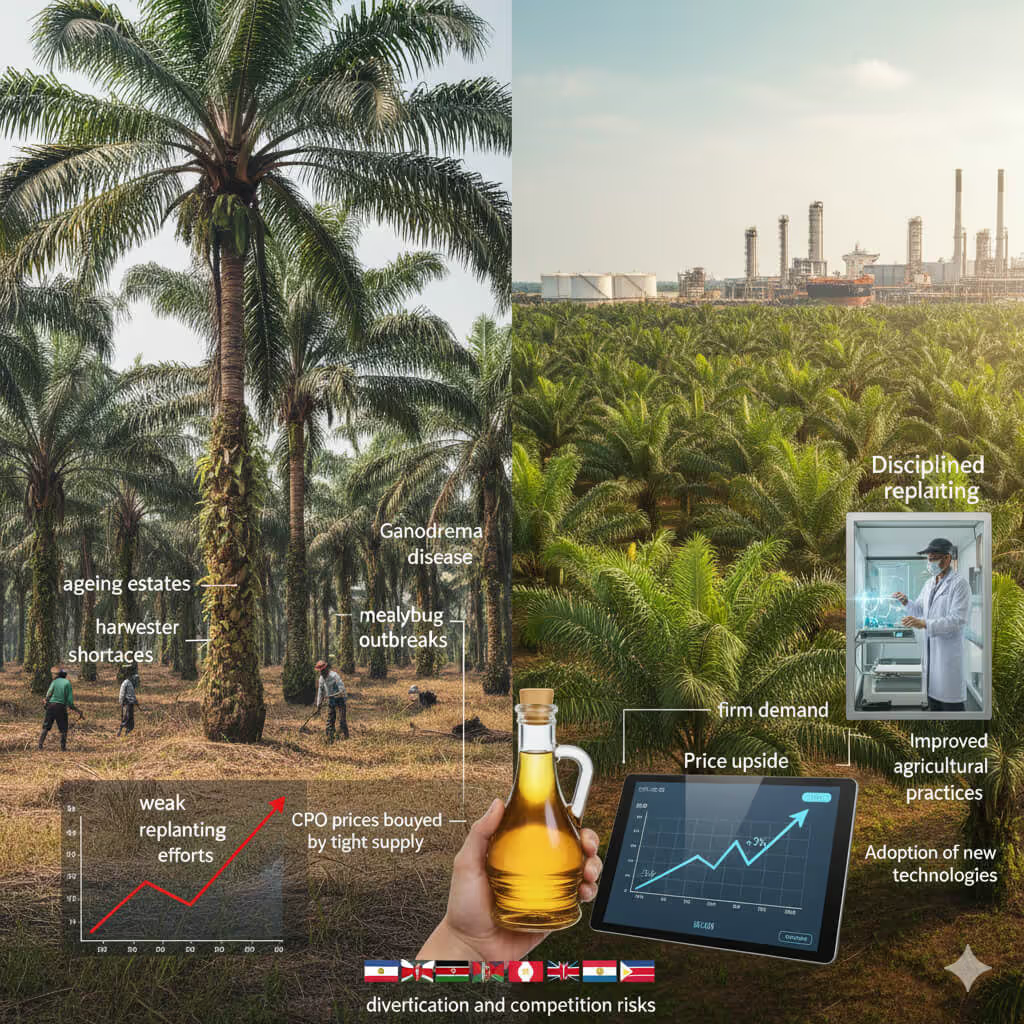
CIMB Securities Research says mounting risks to palm oil supply could help support crude palm oil (CPO) prices going forward.
In a note to clients, the research house said structural issues — such as ageing plantations, sluggish replanting efforts and stagnant productivity — point to limited growth in Malaysian palm oil supply over the coming years.
"These tightening supply prospects, combined with resilient demand, should support CPO prices," it added.
Major plantation companies such as FGV Holdings Bhd, SD Guthrie Bhd, Kuala Lumpur Kepong Bhd and IOI Corp Bhd have maintained discipline in replanting, while other companies have delayed replanting programmes due to cash flow pressures and dividend commitments.
"Those who continue to invest in replanting and productivity improvements will benefit from a tighter supply environment, positioning them to sustain production and capture upside from higher prices," the research house said.
In this regard, CIMB Securities Research said it favours IOI Corp, Ta Ann Holdings Bhd and SD Guthrie, which are committed to replanting in line with the national target of 4%.
During a recent meeting with the Malaysian Palm Oil Council to discuss productivity constraints and rising biological threats facing the domestic palm oil industry, the research house noted that stagnant productivity stems mainly from a shortage of harvesting labour, poor fertilisation practices, ageing plantations, poor management and climate change.
Outbreaks of diseases such as Ganoderma and pest infestations, including aphids, have compounded the downside risks.
With no new planting permitted under Malaysian Sustainable Palm Oil (MSPO) certification rules, future production growth will hinge on replanting discipline, improved agronomic practices and the adoption of new technologies.
The note said: "As such, slowing growth in palm oil supply should support CPO prices, benefiting companies such as SD Guthrie, Ta Ann and IOI Corp, which continue to replant consistently to maintain or increase fresh fruit bunch (FFB) production."
Malaysia's average FFB yield stood at 16.7 tonnes per hectare and CPO yield at 3.28 tonnes per hectare in 2024 — well below the potential yield of 29.56 tonnes per hectare (equivalent to 6.22 tonnes per hectare of CPO) achieved by United Plantations Bhd.
CIMB Securities Research also highlighted weak palm oil exports in the first eight months of 2025, which fell 10.6% year-on-year. Kenya has emerged as a key importer, benefiting from tariff advantages, while the Philippines has boosted palm oil imports amid a shortage of coconut oil.
This reflects both greater diversification and heightened competitive risk.
Another challenge is the push to raise the biodiesel blend from B10 to B20. However, Malaysia's biodiesel mandate remains capped at B10.
"Expanding to B20 would require high infrastructure costs (RM643 million) and a heavier subsidy burden," CIMB Securities Research said.
The research house explained that given current elevated CPO prices, such an expansion would further inflate biodiesel and cooking oil subsidy costs, making it economically unattractive.
Unlike Indonesia, which funds its biodiesel programme through a crude palm oil levy fund, Malaysia relies on government subsidies — a structural disadvantage.
In addition, Malaysia's oil palm planted area peaked at 5.9 million hectares in 2019 but has since declined by 5% to 5.6 million hectares by the end of 2024, reflecting replanting preparations, conversion to alternative crops and non-agricultural development.
With new planting banned since December 2019 under MSPO rules, CIMB Securities Research noted that future production growth will depend entirely on replanting efforts and productivity improvements.
Source: The Star