 Advertise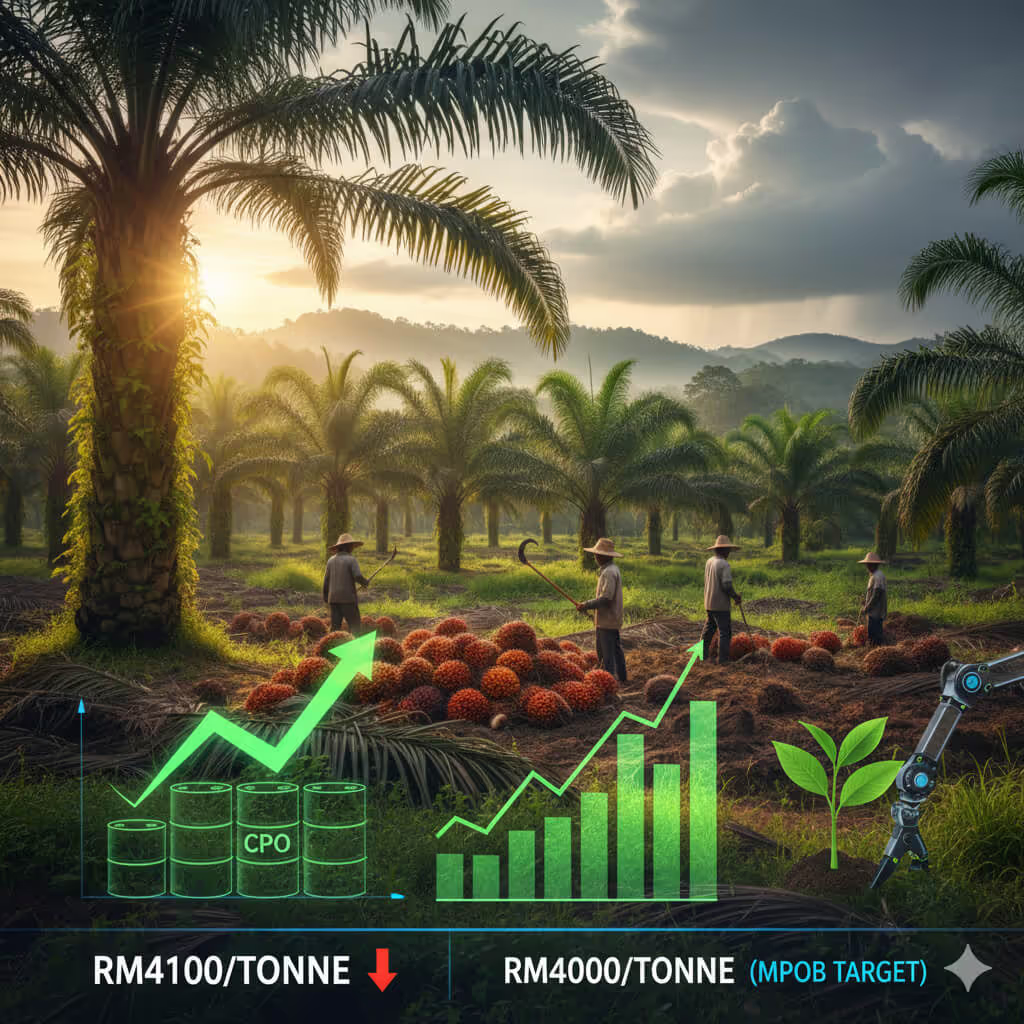
Malaysia's crude palm oil production this year could exceed the earlier forecast of 19.5 million tonnes announced by the Malaysian Palm Oil Board, following unexpectedly strong output in October, according to director-general Datuk Ahmad Parveez Ghulam Kadir.
He said October's output of 2.04 million tonnes – the second-highest monthly production since 2015 – was "slightly above expectations" and was likely driven by better labour availability, improved estate maintenance and sustained rainfall.
"We thought the peak had already passed in August, but October was a bit of a surprise," he told StarBiz. "It looks very likely we will hit the 19.5-million-tonne target this year, and it wouldn't be a surprise if we exceeded that slightly."
This compares with output of 19.3 million tonnes last year. From January to October, total production stood at 16.52 million tonnes, up about 4% from the ten-year average of 15.81 million tonnes. Meanwhile, Malaysia's palm oil stocks at the end of October stood at 2.46 million tonnes, up 4% month-on-month and 31% year-on-year, marking the eighth consecutive monthly increase.
"This is mainly due to higher production. We also saw a significant jump in exports this month as buyers, particularly in China and India, started stocking up ahead of the year-end," he added. Despite the rise in exports, palm oil prices have retreated from their recent highs. Prices fell to around 4,100 ringgit a tonne from 4,500 ringgit a month earlier. At the time of writing, soybean oil was trading at 50.85 US cents a pound, equivalent to about US$1,120 (4,640 ringgit) a tonne – roughly 13% higher than crude palm oil.
On prices, Ahmad Parveez said several factors could influence crude palm oil movements in the coming months, including supplies of other edible oils, biodiesel demand, and production trends in Indonesia. He added that the Malaysian Palm Oil Board (MPOB) views 4,000 ringgit a tonne as a reasonable price level at present. At the same time, the Board is focusing on replanting efforts to maintain yields and ensure adequate long-term supply to meet potential demand growth. "We are pushing the government to help with replanting, especially for smallholders, with some grants or support. We hope this will help us if demand continues to rise," he said.
On next year's outlook, Ahmad Parveez said more data from November and December would provide a clearer picture of production trends. Meanwhile, Kenanga Research said in a recent report on the plantation sector that plantation stock valuations "have risen but are far from excessive," with a price-to-book ratio of 1.1 times and a price-to-earnings ratio of 15 times. In this regard, a fund manager said the sector's outlook had softened despite strong earnings. "Recently, there has been some speculation or expectation of merger and acquisition activity in the sector. But if you look at valuations of around 15 times price-to-earnings, they have fallen a lot, given some environmental, social and governance (ESG) concerns. Also, due to the decline in some crude palm oil prices," adding that these stocks were trading at more than 24 times price-to-earnings ten years ago. She noted that growth is still largely driven by demand from China and India.
Meanwhile, an industry observer said the market still undervalues plantation stocks. "Historically, plantation stocks underperformed the market until late last year. It was only in the second half of this year that some outperformance began to show," she said. She added that supply growth in Malaysia is limited because estates are ageing, there is little new planting, and labour can be an issue. "Supply won't be much higher over the next few years. Keep in mind it takes three years for any new planting to reach maturity." Despite these constraints, she said earnings had been strong, supported by higher crude palm oil prices and Indonesia's biodiesel mandate, which helps sustain demand. The observer also highlighted efforts to improve ESG practices, noting that SD Guthrie Bhd secured first place in the annual SPOTT palm oil assessment. "This shows the industry is improving in transparency and traceability over time," she said. SPOTT, developed by the Zoological Society of London, assesses palm oil, tropical forestry and natural rubber companies annually against more than 100 sector-specific ESG indicators to measure their progress over time. She added that planters are exploring ways to unlock additional value from non-productive land, including leasing for industrial use or solar energy projects, which could boost both earnings and ESG perception. On 2026 production, she said yields are expected to remain stable, with potential low single-digit growth, assuming favourable weather and labour conditions.
Commenting on the outlook, Kenanga Research said the strong October production "points to a possible peak." "Year-to-date, the crude palm oil price has averaged 4,357 ringgit a tonne – still strong but starting to soften in November, and is then expected to ease further in 2026 amid a recovery in European rapeseed and sunflower oil production." It maintained its average crude palm oil price forecast at 4,300 ringgit a tonne for this year and 4,000 ringgit for 2026. The research house maintained a "neutral" stance on the plantation sector, saying that higher selling prices, fixed costs and good harvests should translate into a solid performance this year, although prices may ease next year.
TA Research highlighted the potential impact of US-China soybean trade on palm oil. "Talks between US President Donald Trump and Chinese President Xi Jinping at the APEC summit in Busan pointed to efforts to normalise agricultural trade, with China agreeing to resume purchases of US soybeans," it said, adding that US Treasury Secretary Scott Bessent indicated China had pledged to import 12 million tonnes of US soybeans by the end of 2025 and 25 million tonnes annually between 2026 and 2028. TA Research noted that these commitments remain below pre-trade-war levels, which exceeded 30 million tonnes. It added that China's soybean requirements for 2025 and 2026 have largely been met by South American suppliers, with Brazil and Argentina supplying about 72 million tonnes. "The resumption of US-China soybean trade could increase the supply of soybean oil, a by-product of soybean crushing, which in turn could limit demand for crude palm oil as an alternative vegetable oil, in our view," it said. "However, we believe the near-term decline in crude palm oil prices may be mitigated by Indonesian biodiesel demand and seasonal monsoon-related supply disruptions, which could constrain supply." TA Research maintained a "neutral" stance on the plantation sector, forecasting an average crude palm oil price of 4,000 ringgit a tonne in 2026, with prices easing due to higher production, weaker export demand and competition from other edible oils.
Source: The Star