Olive Oil Science Forum Champions 'World-Class Quality With an Egyptian Soul'
Fats and oils processing
February 11, 2026
·
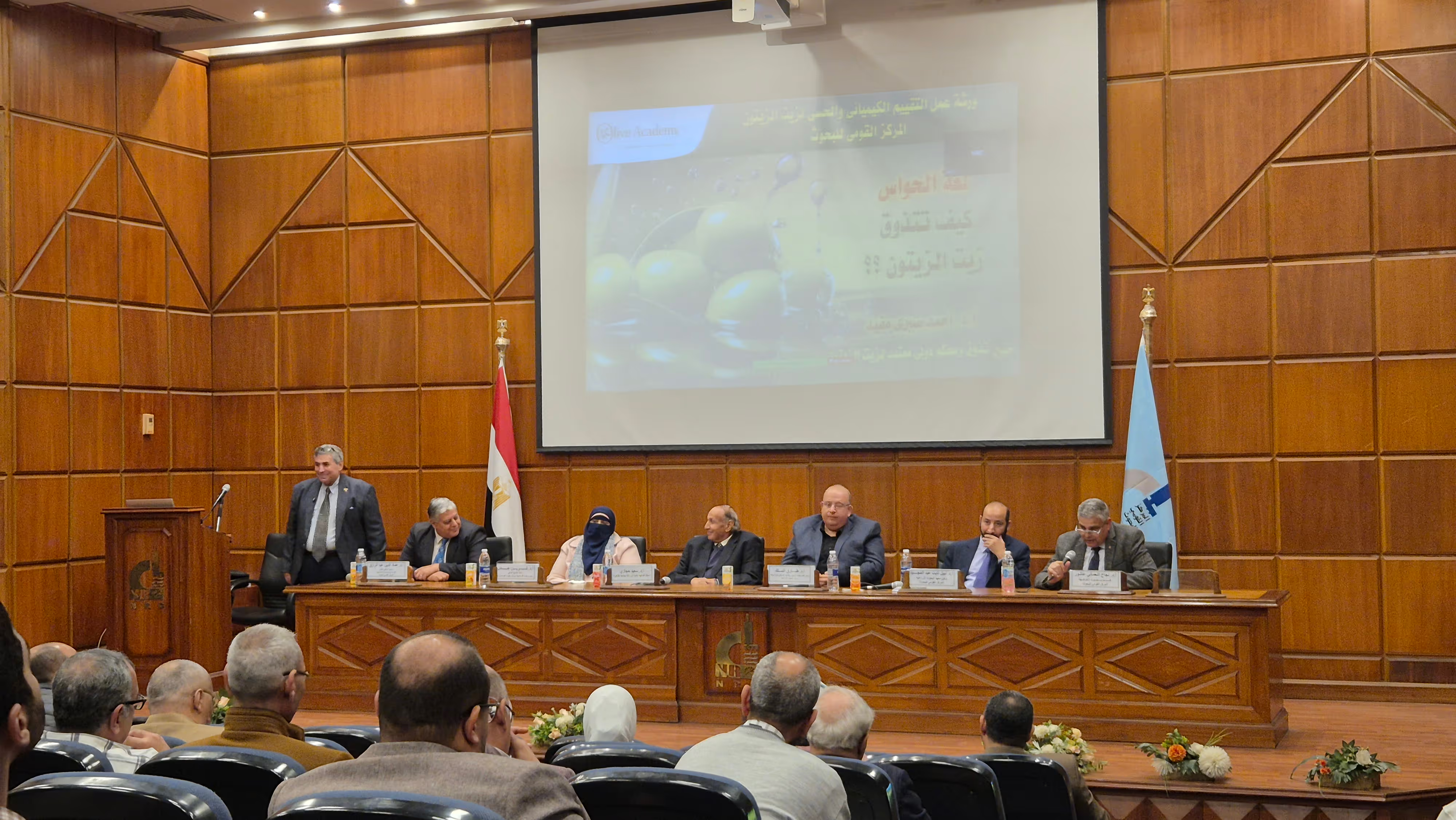
The Olive Oil Scientific Forum, held today under the theme "Olive Oil... From Farm to Table: World-Class Quality with an Authentic Egyptian Spirit", drew a distinguished and highly specialised turnout. The event brought together a wide range of experts and specialists, alongside a select group of prominent researchers in the olive and olive oil sector, representing various leading scientific institutions.
Opening and organisation
Oils and Fats in Arabic attended the forum's opening session, which was noted for its excellent organisation under the supervision and coordination of Prof. Emad El-Din Abdel Razek of the Fruit Research Department at the National Research Centre, who opened proceedings with a recitation from the Holy Quran.
The session was presented by broadcaster Tarek El-Gohary, and opened with welcoming remarks from:
Prof. Naguah El-Naamani Ashour: Fruit Research Department, National Research Centre.
Prof. Nabil Thabet Abdel Meguid: Deputy Director, Agricultural Research Institute, National Research Centre.
Prof. Tarek El-Balk: Head of the Olive and Semi-Arid Fruit Research Department, Agricultural Research Centre.
Prof. Said Hegazy: known as the spiritual father of olives, Professor of Fruit Science, Faculty of Agriculture, Cairo University.
Prof. Shereen Adel: Professor of Plant Production and Head of the Fruit Unit, Desert Research Centre.
Dr Abdullah Yadem Al-Qanashi: Founder and Chairman of Virgina Food Products Company.
Highlights of the scientific lectures
First lecture: the language of the senses and tasting standards for olive oil
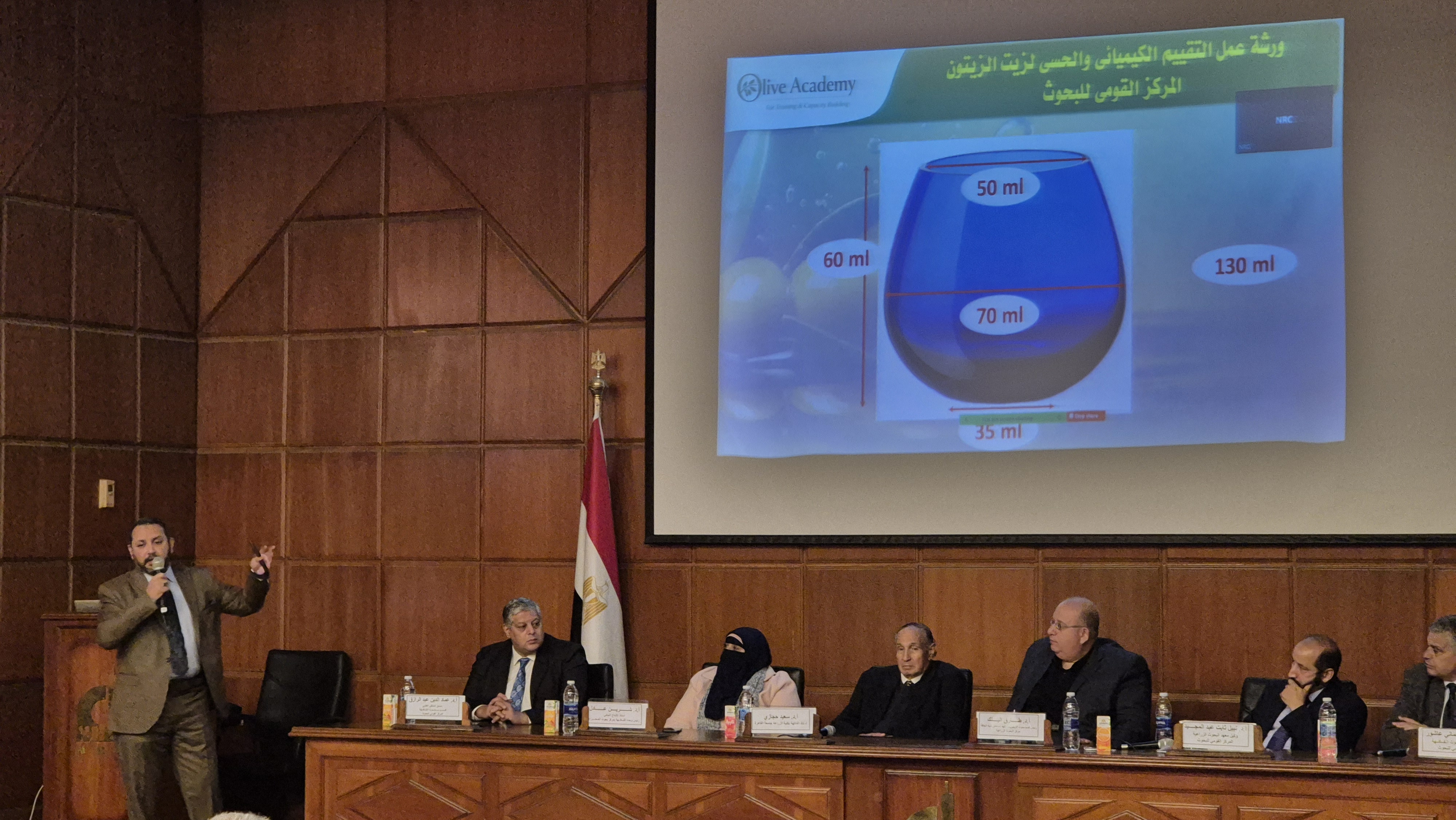
Speaker: Prof. Ahmed Sabry Mofeed, Olive and Semi-Arid Fruit Research Department, Agricultural Research Centre.
Dr Ahmed gave a simplified explanation of the mechanics of olive oil tasting, which relies on two main senses: taste, through the tongue, and smell. He highlighted the following points:
Consumer culture: He noted that Egyptian consumers generally lack a culture of olive oil tasting, due to a number of contributing factors.
Importance of sensory evaluation: He recounted an incident in which an Egyptian shipment was rejected in Italy on the basis of sensory evaluation despite passing all chemical tests, a real threat to Egyptian exports.
Techniques: He pointed to the existence of a retronasal olfaction test as one of the tasting steps, alongside traditional smell assessment.
Tasting panels: He explained that a tasting panel typically consists of 8 to 12 accredited members, noting with regret that Egypt still lacks internationally accredited tasting panels.
Taster requirements: An accredited taster must follow strict instructions, such as refraining from smoking and drinking coffee for a set period before testing.
Quality indicators: He explained the difference between the pungency found in good versus poor-quality oil; in extra virgin olive oil, this sensation appears gradually and leaves no unpleasant taste or smell, unlike the pungency caused by rancid oil.
Second lecture: the effect of variety, environment and management on olive oil quality
Speaker: Prof. Adel Gabr Abdel Razek, Head of the Oils and Fats Department, National Research Centre.
Dr Adel emphasised that the farm bears primary responsibility for oil quality, while the factory's role is limited to preserving that quality, as no factory can correct defects inherent to the variety. He used illustrative analogies to simplify the concept:
The parenting analogy: He compared growing olives to raising children; just as children need to be exposed to challenges and hardships to build resilience, as some businessmen do by assigning their children demanding tasks before handing over the family business, olive trees need certain conditions to produce their best.
The GEM concept: He likened a tree's need for care to a person's need to go to the gym, using the acronym GEM to refer to three influencing factors:
Genotype, or variety.
Environment.
Management.
Third lecture: the importance of sensory evaluation in boosting competitiveness in global markets
Speaker: Dr Mahmoud Hassan, marketing and business development consultant.
He reviewed the importance of marketing for olive oil, raising the following points:
Pricing and value: He presented an example from the Egyptian market of two companies selling the same product, extra virgin oil, in the same size, yet one sells it for double the price thanks to strong marketing.
Producer mistakes: Producers often focus on technical properties, while consumers care about the benefit and experience these properties bring them.
Consumer experience: Simply labelling a product extra virgin is not enough; genuine distinction in taste must be delivered.
Competitions: He stressed the need for continuous participation in competitions, criticising the practice of placing labels for old awards on new-season production, since quality changes from one season to the next.
Accreditation: He pointed to a gap in the Egyptian market, citing an export request that required oil to be certified by an accredited tasting panel and laboratory, something Egypt currently lacks.
Conclusion and recommendations
The annual olive oil gathering serves as a vital platform for exchanging expertise and discussing the sector's challenges. We recommend that representatives from executive bodies, including the ministries of agriculture, industry and trade, attend future editions, in order to address problems and turn proposals into action plans that strengthen the sector and enable Egypt to secure the global standing it deserves. In closing, this forum deserves praise for its excellent organisation and the efforts of its sponsoring companies.
 Advertise