 Advertise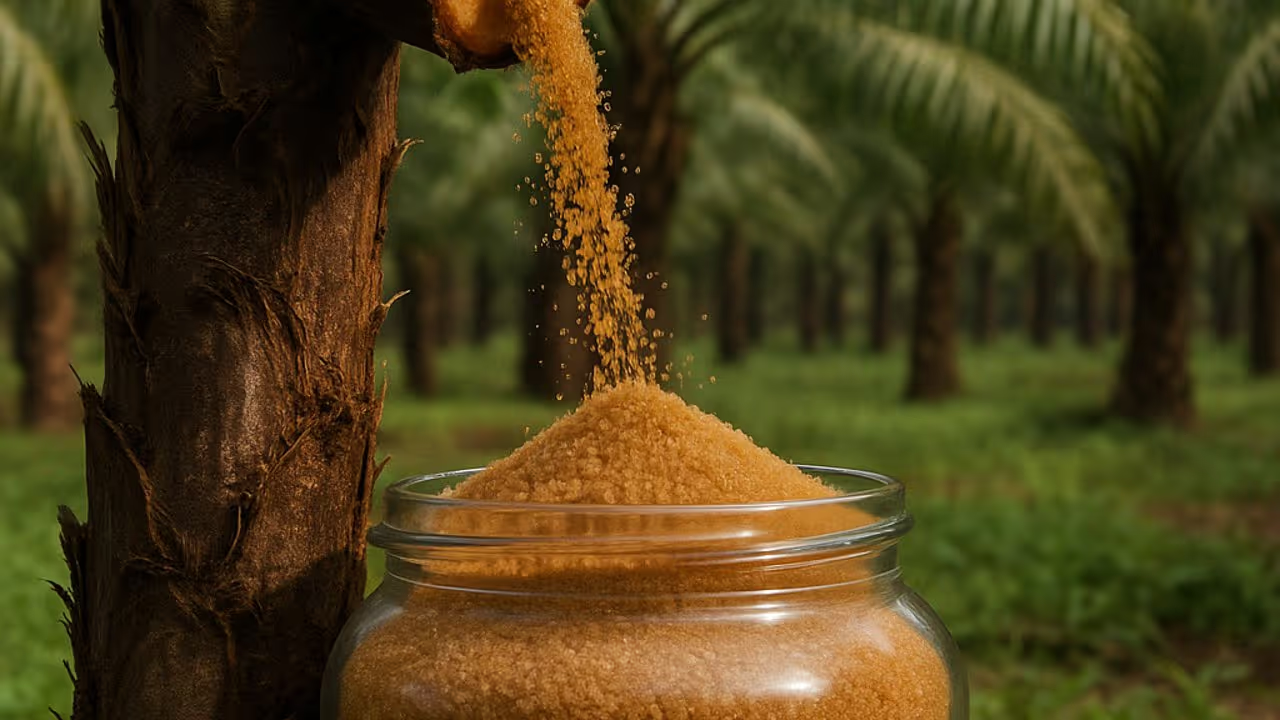
Note: This article was AI-translated from Arabic and is currently under manual review. The author is not responsible for any translation errors. Please refer to the original Arabic text for the most accurate and authoritative information.
Indonesia is increasingly dependent on importing sugar, as domestic production does not cover growing demand internally. To address this problem, the government is pushing for self-sufficiency by relying on brown sugar extracted from palm trees as an alternative to traditional sugar extracted from sugar cane.
This sugar is extracted from the sap of palm tree trunks that are cut while implementing replanting programs for old and unproductive palm trees. From each non-productive palm stem, about 60 kg of brown sugar can be extracted.
According to estimates, Indonesia can produce about 3.7 million tons of brown sugar per year by exploiting only 4% of the areas planted with palm trees that are replanted annually. This figure will help the country achieve self-sufficiency in sugar in a more sustainable and competitive way.
However, to achieve this goal, there must be supportive policies that cover all stages of the industry from agriculture to marketing, such as production incentives and the imposition of progressive tariffs on sugar imports to protect the local market.
The government of President Prabowo Subianto has set a set of strategic goals in the field of food security, including achieving self-sufficiency in sugar due to the country's heavy and increasing dependence on its import.
Ministry of Agriculture data for 2024 indicates that the percentage of dependence on sugar imports (IDR) increases annually, threatening Indonesia's national food security. In 2000, import dependence was 51.5% and rose to 54.4% in 2023.
Sugar consumption in Indonesia increased from 3.3 million tons in 2000 to 7.9 million tons in 2023. In contrast, domestic production rose from 1.69 million tons to just 2.6 million tons over the same period, widening the deficit gap to 4.3 million tons.
To cover this deficit, Indonesia's sugar imports rose from 1.7 million tons to 4.3 million tons over the same period, increasing dependence on abroad.
Due to the limited land available to grow sugar cane, it is not possible to rely solely on sugar from cane to meet demand. Here, brown sugar emerges from palm trees as a practical alternative, as it can be produced without the need to expand the agricultural area.
A palm trunk can produce 5 to 7 liters of sap per day for 30 to 40 days. With an extraction rate of 20-30%, 6.84 tons of brown sugar can be produced per hectare in the production cycle. With the replanting of about 572 thousand hectares per year, an annual production of approximately 3.9 million tons of brown sugar can be reached.
Indonesia is in dire need of sustainable solutions to reduce dependence on sugar imports. Producing brown sugar from palm trees represents a great opportunity to achieve this goal, thanks to the availability of its raw materials, its social acceptance, its low cost, and its environmental sustainability.
To achieve self-sufficiency in sugar, the government should adopt supportive policies that include:
Adopting a national strategy to grow and produce brown sugar from date palms can contribute not only to reducing the gap in sugar supplies, but also to supporting food security and sustainability in Indonesia.
Source: gapki