 Advertise
Note: This article was AI-translated from Arabic and is currently under manual review. The author is not responsible for any translation errors. Please refer to the original Arabic text for the most accurate and authoritative information.
(Technical Pathway for Health Safety and Environmental Sustainability in Egypt and Arab Countries)
Operational Guidelines for Food Establishments, Central Kitchens, and Households
Nature of the Document:
A proposed professional guidance document, subject to development and institutional adoption. This document does not supersede binding Egyptian legislation or approved standard specifications, but rather translates them into actionable operational practices for implementation, monitoring, and awareness.
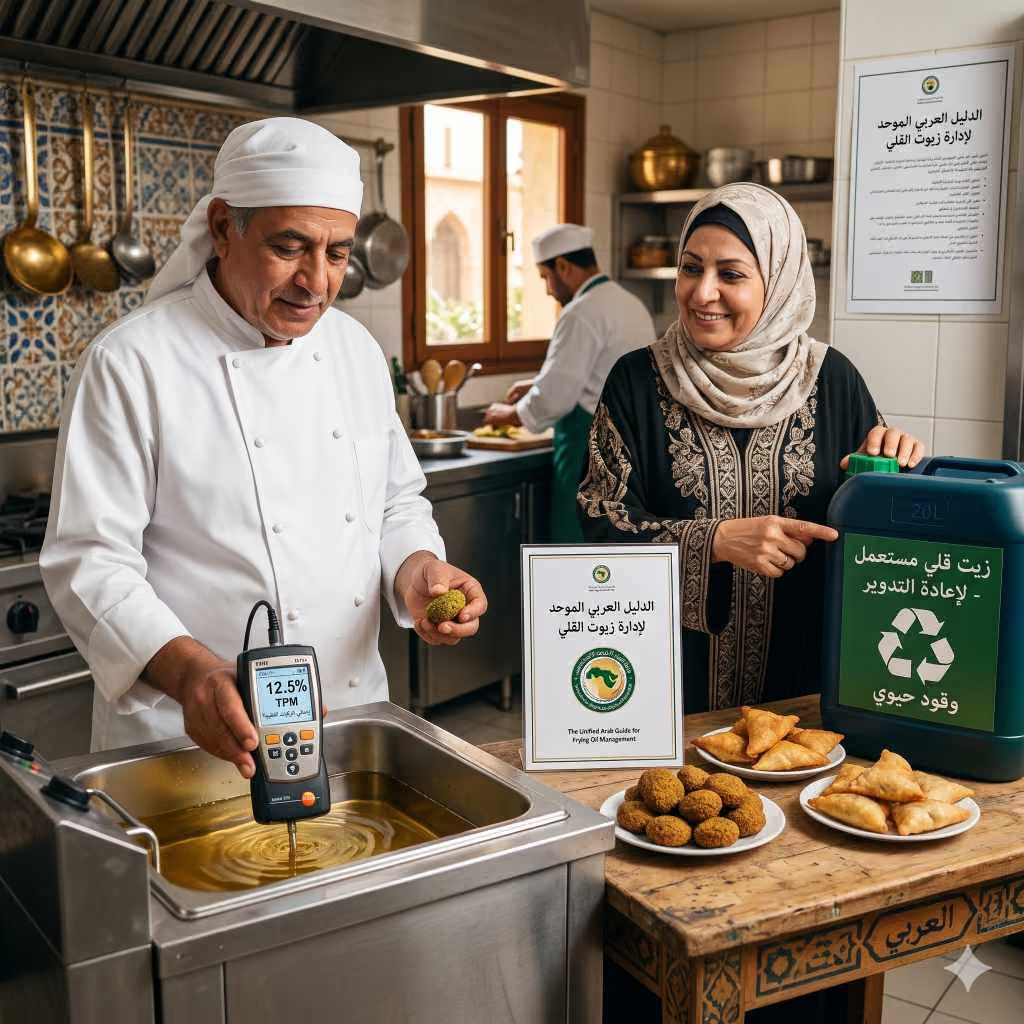
Frying and deep-frying are fundamental pillars in contemporary Arab cuisine and large food establishments. It is not merely a heat transfer medium that gives food its golden color and crispy texture, but a dynamic chemical component that directly impacts food safety and nutritional value. With repeated heating, oil undergoes complex reactions such as oxidation and hydrolysis, leading to the formation of undesirable polar compounds that can harm consumer health even before visible signs of spoilage appear.
This guide provides a comprehensive professional framework consistent with Egyptian legislation (Food Safety Authority Decision No. 1 of 2023) and international references (Codex), to serve as a reference guide in Egypt and Arab countries. These guidelines aim to transform frying practices from "casual improvisation" to a "regulated system" starting with careful oil selection, moving through sound technical operation, and concluding with responsible disposal that supports the circular economy by converting waste into non-food recycling streams such as biofuels.
We present to food establishments, central kitchens, and households across the Arab world a scientific roadmap that balances delicious taste with safety standards, based on three golden rules: Smart Selection, Accurate Measurement (TPM & FFA), and Safe Disposal.
Frying and deep-frying oil is one of the most widely used ingredients in Egyptian kitchens, food establishments, restaurants, factories, canteens, and food preparation units. It is not merely a heat medium that imparts a golden color and crispy texture to food, but a crucial factor affecting food quality, safety, sensory attributes, and health value. With repeated heating and exposure to air, moisture, and food residues, chemical and physical changes begin, including oxidation, hydrolysis, polymerization, and the formation of undesirable polar compounds, and the oil may degrade before all signs of spoilage are evident to the consumer or untrained worker.
This document provides a comprehensive national Egyptian guidance framework for managing frying and deep-frying oils, combining international references, binding Egyptian legislation, specialized technical expertise, and the practical needs of food establishments and homes. It does not aim to prohibit frying or instill fear of it, but rather to rationalize and regulate it so that frying remains a safe food practice when conducted with the appropriate oil, suitable temperature, proper monitoring, and responsible disposal.
This version was developed based on a technical evaluation of the selected draft guidelines, with essential elements added to transform it into a document more suitable for national use; these elements include: separating binding legal requirements from advisory operational procedures, adding a national responsibility matrix, categorizing application levels by establishment size, incorporating printable operational forms, establishing guidelines for sampling, verification, and calibration, and adding a national awareness program targeting consumers and establishments.
This document is advisory and operational in nature, and adheres to the provisions of approved Egyptian legislation and standards. In case of any conflict between an advisory recommendation contained herein and a binding legal text or Egyptian standard, the legal text or binding standard shall take precedence. Furthermore, the suggested advisory limits for fresh oils or fatty acid composition are not a substitute for standard specifications or regulatory requirements, but rather represent an advanced preventive level for establishments striving for higher quality and better control over oil degradation.
| Reference | Area of Use Within the Document |
|---|---|
| Codex Alimentarius | The international framework for food standards, protection of consumer health, and fairness in food trade. |
| Codex CXS 210-1999: Standard for Named Vegetable Oils | Definition of named vegetable oils, compositional indicators, quality characteristics, and limits for certain fitness indicators of oils offered for human consumption. |
| Decision No. 1 of 2023 of the Board of the National Food Safety Authority | Defines the cases in which used edible oil, fat, or grease becomes unfit for human consumption and the mechanism for handling it as waste. |
| Law No. 1 of 2017 establishing the National Food Safety Authority | The institutional framework for food safety oversight in Egypt. |
| Waste Management Regulation Law No. 202 of 2020 | The general framework for handling waste and preventing harm to public health and the environment. |
| German DGF recommendations on deep frying | Optimal frying practices, temperature control, filtration, fryer type, documentation, and training. |
| ISO 660 | Determination of acidity or acid value. |
| ISO 3960 | Determination of peroxide value. |
| ISO 6885 | Determination of anisidine value. |
| ISO 8420 / AOCS Cd 20-91 | Determination of total polar materials/compounds (TPM/TPC). |
| ISO 6886 | Assessment of oxidative stability under accelerated oxidation conditions. |
| GC-FID | Determination of fatty acid composition, linolenic acid, and trans fats. |
Reference Note:
When the document is officially adopted, the full details of each reference must be provided: specification or decision number, year of issue or last amendment, issuing body, and a link or official publication source if available. Any informal, abbreviated references, such as website names or general phrases that are not suitable as legal or technical references, should be removed.
| Term | Practical Definition |
|---|---|
| Frying or sautéing oil | An edible oil, fat, or grease used as a heating medium to fry or sauté food at high temperatures. |
| Total polar materials/compounds (TPM/TPC) | Oil degradation products resulting from oxidation, hydrolysis, and polymerization; one of the most important practical indicators for judging used frying oil. |
| Free fatty acids (FFA) | An indicator of oil hydrolysis, especially with high food moisture, poor storage, or prolonged use. |
| Peroxide value (PV) | An indicator of primary oxidation products, particularly useful for assessing fresh or stored oils. |
| Anisidine value (p-AnV) | An indicator of secondary oxidation products, especially aldehydes, useful for completing the oxidation picture. |
| TOTOX | The total oxidation value, calculated as a guideline from the equation: TOTOX = 2PV + p-AnV. |
| Linolenic acid C18:3 | A polyunsaturated omega-3 fatty acid that is highly susceptible to oxidation at high temperatures. |
| Degraded oil | Oil whose chemical, sensory, or physical properties have changed due to repeated heating, high temperature, moisture, sediment, or prolonged use. |
| Oil unfit for human consumption | Oil that has exceeded legal rejection limits or shows clear signs of spoilage making it unsuitable for continued food preparation. |
To ensure clarity of application, this document distinguishes between two types of limits: mandatory legal limits, exceeding which requires discontinuing oil use and disposal, and internal advisory operational limits aimed at early warning and preventing the rejection stage.
| Indicator | Legal Rejection Limit | Required Action |
|---|---|---|
| Total polar materials (TPM) | Above 25% of the oil or fat weight | Stop food use immediately, isolate the oil, and dispose of it through a licensed channel. |
| Free fatty acids (FFA) | Above 1.25% calculated as oleic acid | Stop food use immediately, isolate the oil, and dispose of it through a licensed channel. |
Any oil exceeding either of these two limits is considered unsuitable for continued food preparation, even if the food's appearance is acceptable or not all sensory signs of spoilage are clearly evident.
Internal operational limits, such as green, yellow, and orange levels, are not a substitute for the law, but rather an early management system that helps the establishment avoid reaching the red limit. The establishment may adopt more conservative limits based on the type of food, operating hours, fryer characteristics, and the sensitivity of the consumer group.
| Type of Oil | Suitability | Practical Notes |
|---|---|---|
| High-oleic sunflower oil | Excellent | Rich in oleic acid and more stable than regular sunflower, provided it conforms and has a clear composition. |
| Refined low-linolenic or high-oleic canola/rapeseed oil | Very good | Suitable for frying with temperature control and monitoring. |
| High-oleic soybean oil where available | Very good | A recent trend toward oils better suited to high-heat uses. |
| Refined or light olive oil | Good | Suitable for sautéing and controlled frying, but not necessarily for long commercial frying in all conditions. |
| Palm olein or refined palm oil | Technically good | Thermally stable, while observing dietary moderation due to its higher saturated fat content. |
| Oil blends formulated for frying | Acceptable | Accepted provided the composition is clear, conforms to specifications, and the label has no misleading practices. |
| Indicator | Preferred Guideline Limit | Interpretation |
|---|---|---|
| Linolenic acid C18:3 | Preferably no more than 2% | To ensure higher stability in long commercial frying. |
| Linolenic acid C18:3 | Up to 3% as a conditionally acceptable limit | Provided the oil is closely monitored during operation and use is not prolonged. |
| Total PUFA | Preferably no more than 15% in repeated commercial frying | To reduce the rate of oxidation and thermal degradation. |
| Oleic acid C18:1 | Preferably high, e.g. 55% or more | A supporting indicator of oxidative stability. |
| Trans fats | In accordance with Egyptian legislation | Any legislative violation is considered unacceptable. |
| Criterion | Proposed Acceptance Limit for Frying Oil | Reference Method |
|---|---|---|
| Acidity (FFA) | ≤ 0.3% calculated as oleic acid for refined oils | ISO 660 |
| Peroxide value (PV) | Preferably ≤ 5 mEq O&sub2;/kg, and not exceeding the specification limits | ISO 3960 |
| Anisidine value (p-AnV) | Preferably ≤ 10 | ISO 6885 |
| TOTOX | Preferably ≤ 20 | 2PV + p-AnV |
| Water content | Preferably ≤ 500 mg/kg | Karl Fischer or a suitable approved method |
| Linolenic acid C18:3 | Preferably ≤ 2% for long commercial frying | GC-FID |
| Total PUFA | Preferably ≤ 15% for repeated commercial frying | GC-FID |
| Trans fats | In accordance with Egyptian legislation | GC-FID |
Fresh oil is rejected before operation if its origin is unknown, if the packaging is damaged or suspected of tampering, if a rancid odor or abnormal taste is detected, if acidity or peroxide value exceeds acceptance limits, or if it is suspected of containing used oils, partially hydrogenated fats, or non-conforming components. The establishment may also reject the oil if it violates the approved internal limits for fatty acid composition in repeated commercial frying.
| Food type | Suggested Temperature |
|---|---|
| Thin or small-sized foods | 160–170°C |
| Potatoes and starchy products | 165–175°C |
| Thick or breadcrumb-coated foods | 170–180°C |
| Upper limit in normal operation | Not exceeding 180°C |
Excessive heat does not result in better cooking; instead, it accelerates oxidation and polymerization, causes smoke, deteriorates taste and odor, and increases the formation of undesirable compounds. For starchy foods, controlling the temperature and avoiding over-frying helps reduce the risk of forming undesirable compounds such as acrylamide.
It is recommended that the amount of food added to the fryer does not exceed an approximate ratio of one part food to ten parts oil. Overloading suddenly lowers the oil temperature, prolongs frying time, increases oil absorption by the food, and leads to poor texture and faster oil degradation.
Timely removal of sediment is one of the most important factors in maintaining oil quality, as food residues, crumbs, and burnt sediment accelerate oxidation and alter color, odor, and taste. However, it must be emphasized that filtration does not restore oil to its original state; it only removes solid particles but does not remove dissolved oxidation, polymerization, and degradation products in the oil.
| Indicator | What Does It Measure? | Significance |
|---|---|---|
| TPM | Total polar compounds | The most important practical indicator for judging used frying oil. |
| FFA | Free fatty acids | An indicator of hydrolysis and the effect of moisture. |
| PV | Primary oxidation products | More useful for fresh and stored oil than for long-used oil. |
| p-AnV | Secondary oxidation products | Completes the oxidation picture together with PV. |
| TOTOX | The overall oxidation picture | A supporting indicator, not an independent rejection limit unless the establishment or specification states so. |
| GC-FID | Fatty acid composition and trans fats | Important for approving the oil and tracking C18:3 and TFA. |
Large food establishments, central kitchens, and restaurant chains are recommended to use portable TPM measuring devices, provided they undergo regular calibration, follow manufacturer's instructions, record readings and measurement temperature, train staff, and confirm results with laboratory tests in case of doubt or borderline situations. Color and odor alone should not be relied upon in establishments with intensive oil use.
| Level | TPM | FFA as oleic acid | Action |
|---|---|---|---|
| Green | Below 15% | Below 0.7% | Normal operation with monitoring. |
| Yellow | 15–20% | 0.7–1.0% | Filtration, temperature review, sediment removal, closer monitoring. |
| Orange | Above 20% up to 25% | Above 1.0% up to 1.25% | Prepare for replacement, repeated measurement, review of the operating plan. |
| Red | Above 25% | Above 1.25% | Stop food use and dispose safely through the licensed channel. |
Reaching the yellow or orange level does not necessarily mean the oil is legally rejected, but it indicates that the establishment is required to implement closer monitoring and prompt operational intervention. The red level, however, is a limit for immediate cessation and removal from service and is not open to negotiation or dilution by mixing.
Used oil can be directed to non-food recycling pathways such as biofuel production, soap manufacturing, or certain industrial applications, provided it is licensed, traceable, and does not re-enter the food chain in any form. At the national level, it is proposed to establish or update a registry of entities licensed for collecting, handling, and recycling used oils, link food establishments with documented collection contracts, and encourage household collection points in neighborhoods and centers.
| Level | Category | Minimum Proposed Requirements |
|---|---|---|
| A | Factories, central kitchens, restaurant chains, large hotels | A written program, approved supplier, conformity certificates, periodic TPM measurement, complete records, documented training, a contract with a licensed company, and laboratory verification when needed. |
| B | Medium-sized restaurants and fixed local establishments | A simplified log, temperature control, daily sensory inspection, TPM measurement where possible or via a third party, and disposal through an approved channel. |
| C | Small establishments, food trucks, limited canteens | A daily checklist, a verified oil source, prevention of degraded oil use, not exceeding 180°C, and isolating used oil and handing it, as far as possible, to a collection entity. |
| D | Homes and homemakers | Simplified guidance on selection, temperature, and disposal, and not pouring it into the drain or reusing it after signs of spoilage appear. |
This categorization ensures fair applicability; a small food cart is not treated with the same detailed requirements as a large factory, while maintaining the core principle: no food use for deteriorated or rejected oil, and no return of used oil to the food chain.
| Entity | Proposed Role |
|---|---|
| National Food Safety Authority | Approving or reviewing the guidelines, inspection, accepting measurement methods, monitoring rejection limits, and regulating the handling of used oil within the scope of food safety. |
| Egyptian Organization for Standardization and Quality | Harmonizing Egyptian standards with the Codex and relevant standard methods, and updating oil and fat specifications. |
| Ministry of Environment / Environmental Affairs Agency | Regulating channels for collecting and recycling non-food used oils, and preventing harm to the environment and drainage networks. |
| Local administration and governorates | Supporting household collection points, monitoring illegal disposal, and facilitating the linking of establishments to licensed collectors. |
| Food establishments | Implementing the oil management program, training, measurement, recording, isolating rejected oil, and handing it to a licensed entity. |
| Used-oil collection and recycling companies | Licensed collection, issuing handover documents, preventing leakage into food use, and adhering to non-food channels. |
| Universities, research centers, and scientific societies | Training, national studies, risk assessment, method validation, and capacity building. |
| Consumers and homemakers | Choosing a suitable oil, using moderate heat, disposing of oil when signs of spoilage appear, and not pouring it into the drain. |
| Item | Required Data |
|---|---|
| Oil data | Type, supplier, batch number, receipt date, opening date. |
| Fryer | Fryer number, the food type assigned to it, oil quantity. |
| Start of use | Date, time, and name of the person in charge. |
| Temperature | Temperature readings during operation and any correction made. |
| Filtration and cleaning | Filtration time, filtration method, fryer cleaning time. |
| Sensory inspection | Color, odor, foaming, smoke, viscosity, food observations. |
| Measurements | TPM, FFA, and any other tests along with the measurement temperature. |
| Top-up | Amount of fresh oil added and the reason. |
| Replacement | Date, reason, final reading, rejected quantity. |
| Handover | Name of the licensed company, quantity, document number, recipient signature. |
If the reading is close to the legal rejection limit, the margin of doubt should not be used to justify continued use. The most conservative professional action is to increase measurement frequency, review operations, and be prepared for immediate replacement. However, if the reading exceeds the rejection limit, the oil must be stopped from food use and isolated, even if some subsequent readings approach the limit.
| Item | Statement/Result |
|---|---|
| Establishment name | |
| Receipt date | |
| Supplier name | |
| Type of Oil | |
| Batch number | |
| Production and expiry date | |
| Packaging condition | Intact / Not intact |
| Odor and appearance | Normal / Abnormal |
| Certificate of analysis or conformity | Present / Not present |
| Acceptance decision | Accepted / Rejected |
| Name and signature of the person in charge |
| Date | Fryer number | Food type | Temperature | Sensory notes | TPM | FFA | Action taken | Person in charge |
|---|---|---|---|---|---|---|---|---|
| Item | Statement |
|---|---|
| Date and time of replacement | |
| Fryer number | |
| Reason for replacement | TPM / FFA / sensory signs / end of usage plan / other reason |
| Last TPM reading | |
| Last FFA reading | |
| Quantity of replaced oil | |
| Method of isolation and labeling | |
| Name and signature of the person in charge |
| Item | Statement |
|---|---|
| Establishment name | |
| Handover date | |
| Quantity handed over | |
| Name of receiving company/entity | |
| License number or accreditation details, if any | |
| Declared non-food purpose | |
| Handover document number | |
| Signature of the establishment representative | |
| Signature of the receiving entity representative |
| Stage | Inspection Points |
|---|---|
| Before frying | Oil from a verified source; packaging intact; fryer clean; temperature controlled; food dry; excess crumbs removed. |
| During frying | Temperature not exceeding 180°C; no overloading; sediment removed; no abnormal foaming, smoke, or odor. |
| After frying | Filter the oil if it is still usable; cover the fryer; record observations; measure TPM when needed; isolate and hand over rejected oil. |
| Stage | What to Verify |
|---|---|
| Before frying | The oil smells normal; the pan is clean; the food is not wet; the heat is moderate. |
| During frying | No heavy smoke; no persistent foaming; the oil does not darken quickly; the food browns without burning. |
| After frying | Filter the oil if it will be used a limited number of times; store it in a clean container; discard it if its odor, color, or taste changes; do not pour it into the drain. |
The management of frying oils is based on an integrated system that starts with oil specifications and source, proceeds through controlled operation, monitoring, and documentation, and concludes with responsible disposal and preventing the return of used oil to the food chain. The following are the concise golden rules:
The management of frying oils is no longer a limited technical matter within the kitchen or production line; rather, it has become an integral part of the food safety, consumer protection, and environmental system. Safe oil starts with clear specifications and compliant oil, proceeds through controlled operation, appropriate temperature, regular filtration, and documented monitoring, and concludes with safe disposal that prevents used oil from re-entering food.
In light of Codex principles and the binding limits established by the National Food Safety Authority in Egypt for handling used frying oils, it becomes essential for frying oil management to transform from individual effort into a national culture based on science, measurement, and documentation. The responsible restaurant, the committed factory, the conscious homemaker, and the aware consumer are all partners in protecting food quality and safety.
Egypt, with its scientific, regulatory, and industrial expertise, is capable of presenting a pioneering national model for frying oil management; a model that balances the enjoyment of fried food with safety requirements, public health protection, environmental preservation, and maximizing the value of waste through safe non-food recycling pathways.