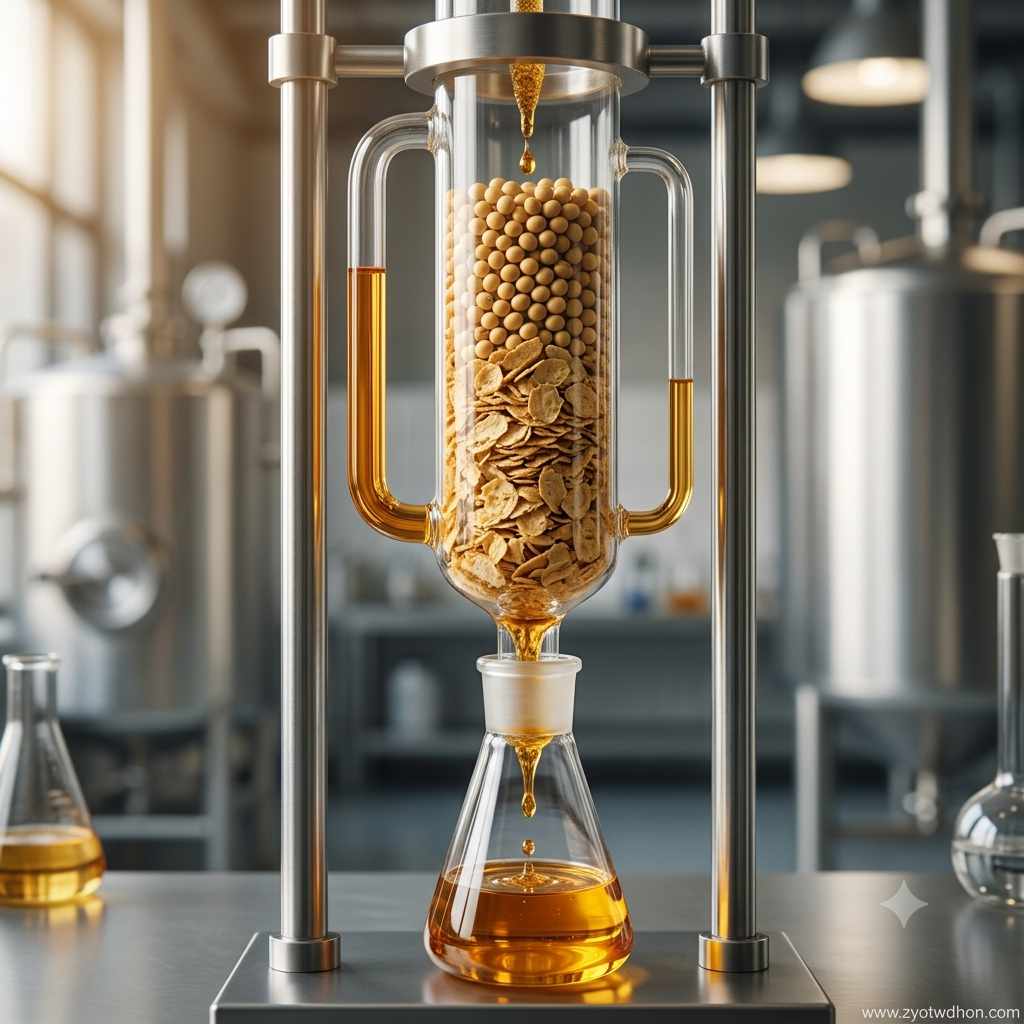
An integrated engineering and operational perspective on solvent extraction processes in modern industrial plants, based on vegetable oil engineering references such as Bailey’s Industrial Oil and Fat Products and Vegetable Oils in Food Technology, as well as safety requirements under the Codex Alimentarius General Principles of Food Hygiene.
First: Why Do We Use Hexane?
- Properties of Hexane: It is a non-polar solvent that dissolves oils with high efficiency, possesses a low boiling point (~65–70°C), is easy to recover, and offers good selectivity for lipids.
- Objective: To extract the maximum percentage of oil with minimal loss and quality degradation.
Second: Process Flow Chart
- Seed Cleaning
- Dehulling
- Cracking
- Heating/Conditioning
- Flaking
- Solvent Extraction
- Desolventizing
- Solvent Recovery
Third: Process Stages in Detail
1. Preparation
- Objective: Increase surface area and improve extraction efficiency.
- Reduce moisture content to ~10–11%.
- Heat to ~60–70°C.
- Convert seeds into thin Flakes.
2. Solvent Extraction
- Mechanism: Hexane dissolves oil from the flakes, forming a mixture known as "Miscella" (oil + solvent).
- Extraction Types: Continuous Extractor and Counter-current system.
- Efficiency: Achieves up to 98–99% oil extraction.
3. Oil Recovery
- Heating the Miscella mixture.
- Evaporating the Hexane.
- Obtaining Crude Soybean Oil.
4. Meal Treatment
- Desolventizing the meal using a DTDC unit (Desolventizer-Toaster-Dryer-Cooler).
- Inactivating anti-nutritional factors (such as Trypsin inhibitors).
- Output: High-protein Soybean Meal.
5. Solvent Recovery
- Condensing solvent vapors.
- Reusing Hexane in a closed loop.
- Objective: Economic and environmental sustainability.
Fourth: Critical Operational Parameters
- Temperature: Excessively high temperatures degrade oil quality, while low temperatures reduce extraction efficiency.
- Flake Thickness: Thin flakes provide better extraction, but extremely thin flakes lead to flow and percolation issues.
- Solvent Ratio: Must be accurately balanced with raw material input.
- Contact Time: Must be sufficient to allow complete oil extraction.
Fifth: Advantages of the Method
- Extremely high extraction efficiency.
- Suitable for large-scale industrial production.
- Ability to recover and recycle the solvent.
- Lower long-term operating costs.
Sixth: Disadvantages and Hazards
- Safety Risks: Hexane is highly flammable.
- Health Risks: Potential solvent residues in end products.
- Environmental Risks: Volatile Organic Compounds (VOCs) emissions; hence, strict safety systems, proper ventilation, and continuous monitoring are mandatory.
Seventh: Food Safety Requirements
- Complete removal of residual Hexane.
- Compliance with globally permitted maximum residue limits.
- Continuous laboratory testing and verification.
- Adherence to Codex Alimentarius General Principles of Food Hygiene.
Eighth: Comparison with Mechanical Pressing
- Efficiency: Very high for Hexane extraction; moderate for Mechanical Pressing.
- Cost: Lower operating cost for Hexane; higher for Mechanical Pressing.
- Quality: Good for Hexane; slightly higher for Mechanical Pressing.
- Production Scale: Large industrial scale for Hexane; limited scale for Mechanical Pressing.
Ninth: Modern Improvements
- Use of alternative Green Solvents.
- Enhanced energy recovery systems.
- Closed-loop zero-emission systems.
- Reduction of environmental emissions.
Tenth: Industrial Example
A soybean processing plant utilizing a Continuous Extractor with 99% Hexane recovery.
- Result: High operational efficiency, low processing cost, and environmental sustainability.
Conclusion
Soybean oil extraction by Hexane remains the backbone of the modern edible oil industry. However, its success hinges on maintaining a delicate balance between efficiency, safety, and quality. The golden rule states: "The highest extraction rate does not always mean the best quality; balance is the key to success."
References
- Bailey’s Industrial Oil and Fat Products
- Vegetable Oils in Food Technology
- Codex Alimentarius General Principles of Food Hygiene
- Handbook of Edible Oil Processing
 Advertise