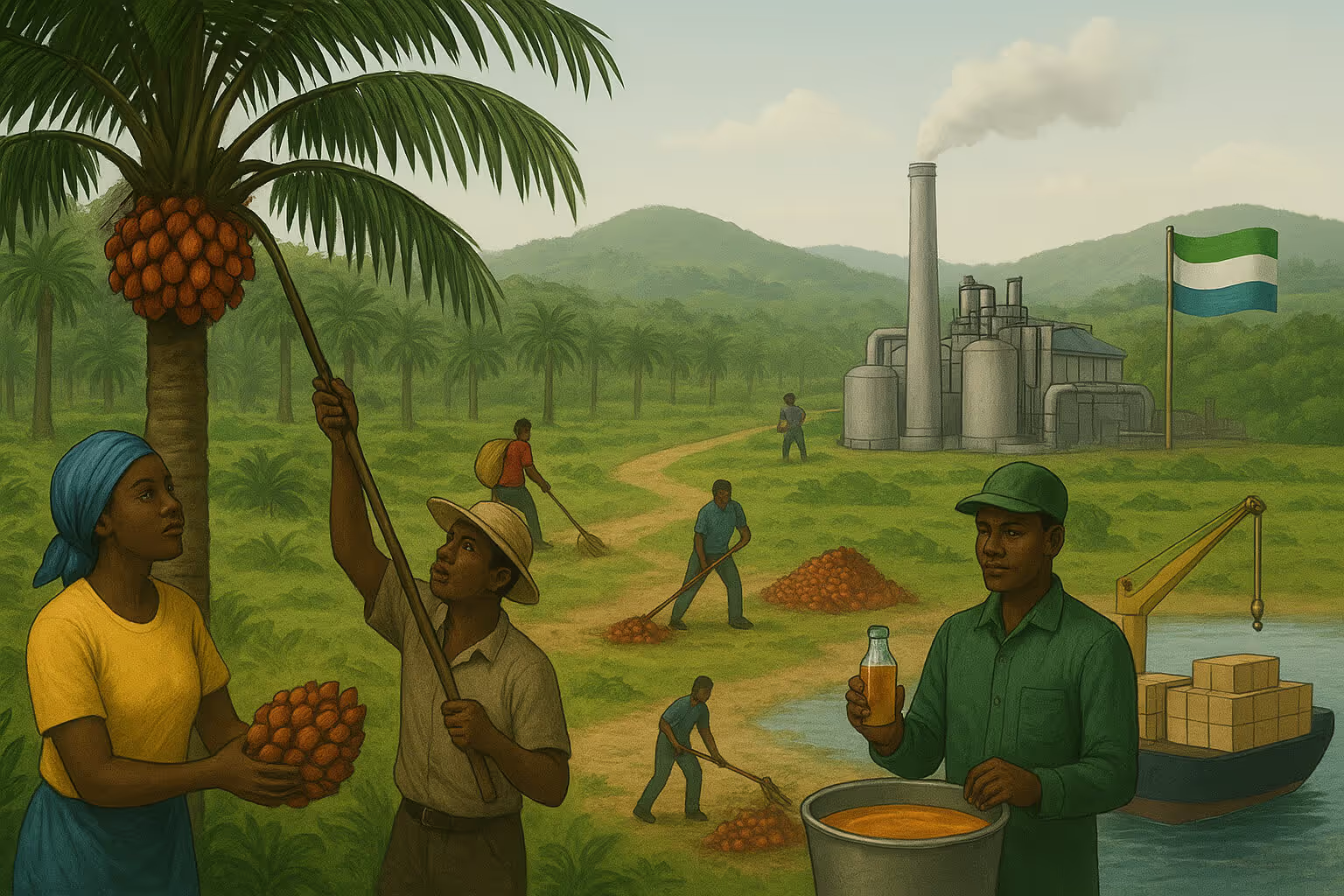
Palm oil is the most widely used vegetable oil in the world. Global production has increased from 10 million tons in 1990 to more than 70 million tons in 2020. With Southeast Asia facing environmental restrictions, investors are turning to Africa for sustainable expansion. Sierra Leone, where oil palm is a native plant, is a fertile land and a growing market for palm oil production. This sector is vital to the livelihood of rural people and contributes significantly to the national economy — the traditional palm oil production sector alone may account for more than 10% of Sierra Leone's GDP.
This comprehensive guide provides a look at the palm oil value chain in Sierra Leone — from cultivation and processing to distribution and export — highlighting key investment opportunities, market size, profitability, risks, incentives, regulations, sustainability, and case studies for potential investors.
The most prominent topics of the article
After reading this article, you'll be able to:
- Learn about the importance of palm oil in the economy and its role in food security, and why this growing sector is attracting the attention of investors.
- Discover key areas of investment, including small and large commercial farms, milling, refining, and biofuel production, and their respective roles in the value chain.
- View local and global demand, export opportunities, and project profitability, including estimates of return on investment and revenue streams.
- Understand government support through tax exemptions, funding, land tenure laws, and environmental regulations that affect investors.
- Find out how certificates such as RSPO organic production and adherence to standards ESG Improve market access and attract sustainable investors.
- Identify potential obstacles such as land disputes, poor infrastructure, and price fluctuations, with strategies to reduce risks and ensure a successful investment.
Sector overview
Its economic importance
Palm oil production is a key element in Sierra Leone's agricultural economy. It is used in cooking and is a major source of income for rural areas. The traditional sector contributes more than 10% of GDP, confirming its economic importance. The government is working to expand this sector to enhance food security and reduce dependence on costly imports.
Traditional versus commercial production
The palm oil industry in Sierra Leone has two main production models:
- Small farmers who use traditional methods, often achieve a low production of no more than one ton per hectare due to poor inputs.
- large commercial farms which achieves a production of more than 20 tons per hectare.
An example of this is a company Socfin Who set up a farm in a county Pujehun With an expected production capacity of 65 thousand tons of crude oil per year, with an estimated value of 45 million dollars, exceeding the country's total production in 2020.
The value chain
- Planting and harvesting:
Palm trees are grown among other crops by small farmers, while large farms rely on monoculture. Trees need 3 to 5 years to mature. - Processing:
Traditional methods rely on manual labor and achieve an extraction of only 11— 16%, while modern factories achieve 20— 22%.
The most prominent recent investments are:- Jolaks With a capacity of 300 tons per day
- Kissy Industry 100 ton per day capacity
- Distribution and export:
Small traders dominate local markets by selling unpackaged oil, while the country started exporting limited quantities of 62,000 tons in 2018. With improved manufacturing and certification, Sierra Leone can expand its exports to regional and international markets.
Market size and demand
The average per capita consumption is about 1 kg per month, which is about 90 thousand tons per year For food use only. The total market size (including industrial use) was estimated at 500 million US dollars In 2017 (14% of GDP).
Despite this high demand, domestic productivity does not cover needs, leading to dependence on imports and higher domestic prices (~6000 leons, or $0.45 per girl).
However, Sierra Leone has great export potential to countries in West Africa and Europe, especially in the field of organic and environmentally certified oils.
Key Investment Opportunities
- Expansion of commercial farms
Sierra Leone has 5.4 million hectares of arable land, 75% of which is undeveloped, providing opportunities to establish highly productive farms. - Improve the productivity of small farmers
By providing improved seedlings, fertilizer and agricultural training, productivity and income can be raised. - Grinding and refining
Increasing processing capacity is a priority, and small plants can be set up near farms to reduce waste. - Specialized export (organic and sustainable)
Global demand for organic and sustainable palm oil has increased, allowing Sierra Leone to enter premium markets at high prices. - Support services and infrastructure
Such as providing agricultural inputs, warehouses, logistics, and bioenergy from palm waste.
Profitability and return on investment
Oil palm is one of the most productive crops in the world (3—4 tons of oil per hectare compared to 0.7 tons of soy).
Internal rates of return (IRR) are estimated between 10-15% For well-managed projects in West Africa, although the payback period is 10 to 15 years.
Risks can be reduced by partnering with existing farmers instead of starting from scratch, while benefiting from the funding of development institutions.
Incentives and government support
- 10-year tax exemption for palm oil projects.
- 5 year customs exemption on agricultural inputs and 3 years on equipment.
- 125% tax rebate on development research and training.
- Support from entities such as SLIEPA undWACOMP To facilitate investment and access to finance.
Laws and Regulation
- Land rights: According to the 2022 law, land is not sold but managed by custom. The consent of the local community must be obtained, while protecting the rights of women.
- Environmental laws: The EPA enforces environmental impact and waste management studies.
- Investment climate: Full foreign ownership is allowed, with free transfer of profits and duty-free access to regional markets.
Risks and challenges
- Land disputes and community relations.
- Poor infrastructure (roads and electricity).
- Lack of technical competencies.
- Fluctuation of world prices.
- Climate and environmental risks.
- Bureaucratic complications and limited funding from local banks.
Sustainability and social responsibility
Sustainability is no longer an option but a necessity.
Investors should adopt practices that preserve the environment and support local communities:
- Using degraded land instead of forests.
- Managing waste to produce vital energy.
- Involve local farmers in value chains.
- Get certificates RSPO undFair trade membership to enhance reliability.
Epilogue
Sierra Leone's palm oil sector is experiencing rapid growth, supported by strong demand, ample resources and encouraging policies.
Responsible long-term investment can generate significant profits and contribute to sustainable development that includes society and the environment.
Companies such as Goldtree undJolaks Successful examples of the possibility of achieving a balance between profitability and responsibility.
Summary: Sierra Leone's palm oil sector presents a unique opportunity for economic growth and social impact for investors seeking sustainable and profitable agricultural projects.
Source: The African Dreams
 Advertise