 Advertise

Note: This article was AI-translated from Arabic and is currently under manual review. The author is not responsible for any translation errors. Please refer to the original Arabic text for the most accurate and authoritative information.
Abu Khaled, an olive oil trader, stood beside a new shipment that had just arrived at the market. He took a small bottle of clear liquid out of his pocket and added a few drops to a sample of the oil. His son watched closely and asked him, and this conversation followed:
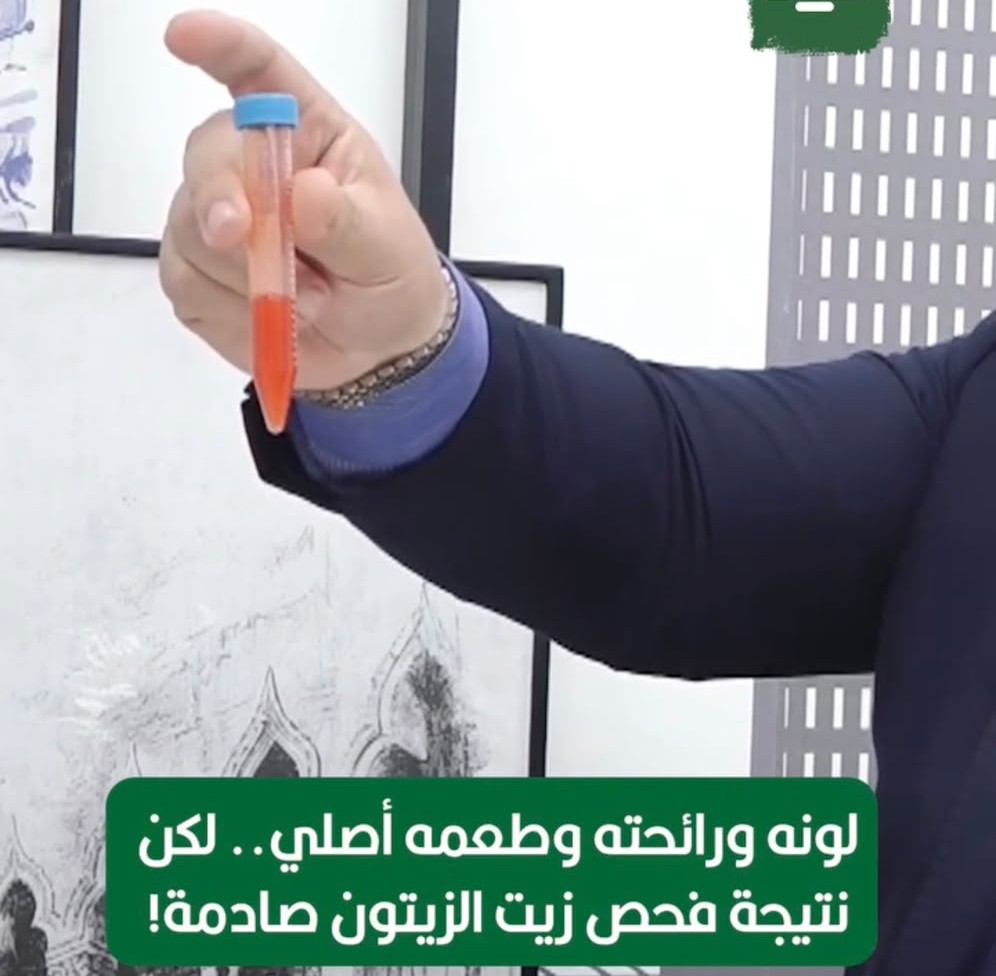
It is a scene that repeats itself often in the markets, and it is not limited to a few traders. It has spread to social media posts and videos that draw thousands of views, promoting the use of nitric or sulfuric acid, popularly known as "fire water" (ماء النار), as a quick way to detect olive oil adulteration through the colour change that follows adding the acid to the oil.
Despite how widespread this practice is and how firmly rooted it has become among some market dealers, the scientific facts confirm that this method cannot be relied on to judge the authenticity of olive oil or to detect its adulteration.
Advocates of this method promote a simple idea: if the oil turns red, it is adulterated, while if it stays green or brown, it is genuine. But oils and fats experts stress that this conclusion is not based on any recognised scientific standard.
Strong acids such as nitric acid and sulfuric acid react with a large number of compounds naturally present in the oil, and the outcome of the reaction is affected by many factors, including the type of oil, its fatty acid composition, its natural pigment content, the age of the oil, its temperature, and the concentration of the acid used.
A change in colour is therefore not conclusive proof of adulteration, and the absence of a change is no certificate of the product's authenticity.
In the past, these tests were passed on by word of mouth among traders. Today, they spread far more widely through social media, where filmed experiments suggest to viewers that oil can be judged within a few seconds.
But these videos often ignore an important fact: modern adulteration methods have become far too sophisticated to be exposed by a simple colour reaction in a glass cup.
Some blends may contain refined vegetable oils or oils whose properties have been modified to resemble olive oil, and detecting them requires specialised laboratory analysis.
The problem is not limited to misleading consumers or traders; it extends to health and safety as well. Nitric and sulfuric acids are highly hazardous chemicals, and handling them unsafely can cause skin burns, eye injuries and the release of harmful fumes.
Using these substances outside properly equipped laboratories is therefore an unjustified risk, especially when the final result is scientifically unreliable.
Unlike the popular tests in circulation, accredited laboratories rely on an integrated system of internationally recognised analyses, most notably:
These methods deliver accurate results that can be relied on to determine oil quality and to detect any blending or adulteration.
As nutritional awareness grows and consumers become keen to buy genuine products, it becomes all the more important to counter the inaccurate information circulating about ways to detect adulteration. Content creators, journalists and specialists also bear the responsibility of verifying information before publishing it, especially when it concerns a food product of such great economic and health value as olive oil.
The "fire water" test may seem a quick and simple way to judge olive oil, but in reality it offers no reliable scientific evidence of either adulteration or authenticity. While some continue to rely on practices handed down for years, modern science confirms that olive oil quality is not judged by a sample changing colour in seconds, but through precise laboratory analyses based on recognised international standards.
At a time when adulteration methods evolve day by day, the laboratory remains the final arbiter, not the colour of the oil after a few drops of "fire water".