Black Seed Oil and Seeds (Nigella sativa):
A Comprehensive Scientific Guide to Health and Immunity
Black Gold: A Journey from Human Heritage to the Horizons of Modern Scientific Research
Black Gold: A journey into the depths of a seed that changed the course of ancient medicine and challenges future laboratories! Can a tiny seed, no bigger than a few millimeters, hold the secret to "healing every ailment"?
From prophetic traditions to modern biochemical laboratories, we unveil the "symphony of healing" inherent in black seed. Discover how it protects your immunity, how to choose authentic oil, and why the world considers it the next "brown gold."
Introduction
At the heart of a seed as black as night lies a vital secret that has puzzled scientists for centuries. It's not just a flavor that adorns baked goods, but a concentrated "divine pharmacy." It is black seed (Nigella sativa), which has stood tall at the crossroads of inherited folk medicine and rigorous scientific research.
In this comprehensive presentation, we will delve beyond the superficial to uncover the true story of its chemistry, uses, and legal identity worldwide. Rarely has a single plant maintained its prominence throughout the ages across three parallel paths: religion, folk medicine, and modern science.
In this article, we do not merely echo tradition or lean towards promotion, but subject black seed to a comprehensive analytical scientific reading: We analyze its physicochemical composition, decipher its oil's fixed and volatile components, clarify its true immune mechanisms, and place it in its proper context as a functional food and intelligent dietary supplement.
Black seed is not just a spice added to bread, but a living example of what can be called The Alignment of Intuition and Science. What ancestors considered a divine secret, modern science has begun to decipher in the language of molecules, enzymes, and immune pathways. This article does not seek to prove a miracle, but to explain why black seed has earned all this historical and scientific prominence.
Chapter One: Botanical Identity and Geographical Origins
Black seed belongs to the plant family Ranunculaceae (the buttercup family), which includes several species; however, the only species recognized nutritionally and medicinally is Nigella sativa.
- Native Habitat: Anatolia and Southwest Asia.
- Historical Distribution: Eastern Mediterranean – North Africa – Indian Subcontinent.
- Current Global Production: Led by India, with distinct varieties from Egypt, Syria, and Ethiopia.
This geographical reach wasn't just about plant distribution; it also fostered chemical diversity in its composition and active compounds.
Chapter Two: Prophetic Documentation and Scientific Recognition
Black seed would not have achieved such prominence were it not for the "supreme endorsement" it received 1400 years ago, when the Prophet (peace be upon him) said:
"Hold fast to this black seed, for in it there is healing for every disease except death." (Narrated by Al-Bukhari and Muslim).
This directive fueled Arab and Indian (Ayurvedic) medicine to adopt it as a fundamental remedy for everything from headaches to asthma. This text was not a mechanical prescription, but rather a cognitive framework that opened the door to research and contemplation.
Today, modern science stands in awe of thousands of peer-reviewed studies confirming that its power lies not in a single substance, but in a "chemical symphony" that operates with astonishing synergy (Synergistic effect), where one component cannot be separated from another without losing part of its miraculous effect.
Chapter Three: The Oil – The Heart of the Miracle and Its Extraction Methods
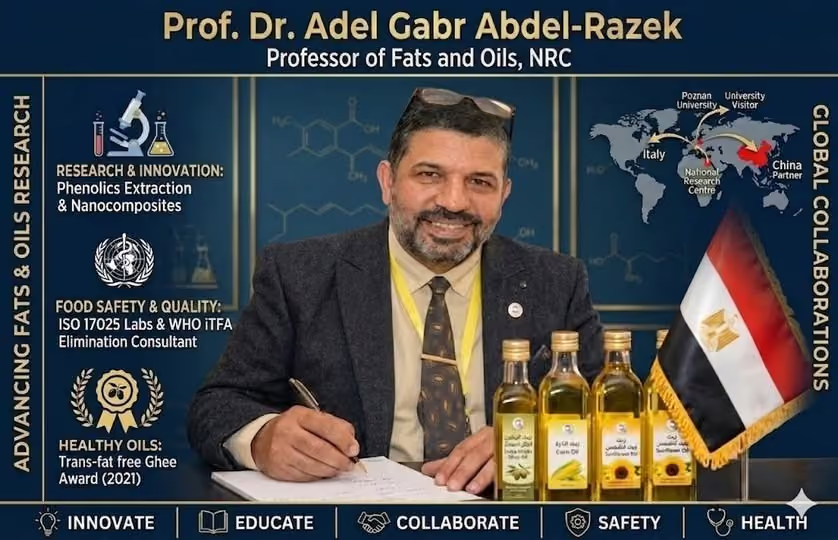
As an expert who has spent decades studying oils, I affirm that the "method" determines the "benefit":
- Cold Pressing: This is the gold standard. It is performed below 50 degrees Celsius to preserve both fixed and volatile oils. This is the oil we recommend for health use. It maintains molecular structure, prevents oxidation, preserves volatile oil, and is the optimal dietary and health choice.
- Steam Distillation: It is used to extract highly concentrated and research-grade volatile (essential) oil.
- Chemical Solvents: This method is scientifically rejected for human consumption, especially in the case of black seed oil. It destroys sensitive compounds, diminishes the oil's therapeutic value, and leaves harmful residues, necessitating refining and purification processes that strip the oil of its most active ingredients and benefits.
Chapter Four: The Complete Physiochemical Fingerprint of Black Seed Oil
The oil's value cannot be understood by reducing it to a single compound, but rather by appreciating its integrated, multi-layered structure.
First: Fatty Acids (Fatty Acid Profile)
- Linoleic Acid (Omega-6): Cell membrane integrity and regulation of immune response.
- Oleic Acid (Omega-9): Heart support and reduction of oxidative stress.
- Saturated Fatty Acids (Palmitic – Stearic): Structural role without disrupting balance.This composition provides the oil with a stable nutritional base capable of safely carrying active compounds.
Second: The Unsaponifiable Fraction – The Silent Functional Core
- Tocopherols (Vitamin E): Natural antioxidants, protection of lipids from oxidation, and support for cellular immunity.
- Phytosterols (Phyto-sterols): Reduced cholesterol absorption, anti-inflammatory effects, and support for immune balance.
Third: Phenolic Compounds and Pigments
- Phenolic Compounds: Suppress free radicals and protect cells.
- Natural Pigments (Carotenoids and Chlorophyll): An indicator of quality and protection of the oil from degradation.
Fourth: Volatile Oil – The Biological Command Center
- Thymoquinone: Anti-inflammatory and antioxidant, immune regulator, and supportive in chronic disease protocols.
- Nigellone: Bronchodilator and antispasmodic.
- Other Volatile Compounds (p-Cymene – α-Pinene – Thymol): Antimicrobial and bioavailability enhancers.
Fifth: Synergistic Action – The True Secret to Superiority
The power of black seed oil lies not in "how much it contains," but in how its components work together:
- Fatty acids prepare the environment.
- Tocopherols protect the structure.
- Phytosterols regulate the response.
- Phenolic compounds inhibit oxidation.
- Volatile oil activates immunity.
The Result: Enhancing immune efficiency without exhausting it, and maintaining its balance instead of randomly stimulating it.
Chapter Five: The Seed or the Oil? A Functional Perspective
I am often asked, "Which is better?" The answer depends on your goal:
- For General Health and Prevention (The Whole Seed): It is the protected "natural package," rich in fiber and minerals. Excellent for daily use with food, but the absorption of its active compounds is slower and less efficient. Therefore, it is recommended to grind black seed fresh as needed to retain its components and active ingredients.
- For a Concentrated Therapeutic Effect (High-Quality Oil): It is the "concentrated extract." It is characterized by rapid absorption and high bioavailability of active compounds like thymoquinone.
Expert Tip: The seeds and oil do not compete; rather, they complement each other. Combining them in your diet is the optimal approach.
Chapter Six: Black Seed as a Smart Immune Modulator
- Activation of T-Cells and NK-Cells.
- Suppressing excessive inflammation.
- Supporting the respiratory system.
- Reducing hypersensitivity reactions.
Chapter Seven: The Press Cake – From Waste to Wealth
The press cake from oil extraction:
- Rich in protein.
- Boosts animal immunity.
- Reduces reliance on antibiotics.
- A model for a sustainable circular economy.
Chapter Eight: Guide to Quality and Safe Use
To ensure you get the true benefits of black seed oil, the authentic oil must have three distinct sensory indicators:
- Pungent Aroma: which reflects the concentration of vital volatile oils.
- Throat Pungency: This is a natural indicator of the presence of the active compound "Thymoquinone".
- Clear Dark Color: which indicates cold pressing and purity from impurities.
Recommended Daily Amount:For maximum safe immune benefit, it is recommended to consume half a teaspoon to a full teaspoon of the oil daily for adults.
Important Note: This amount is approximately equivalent to (1–3 ml), and a specialist doctor should be consulted before starting regular consumption, especially for pregnant women, nursing mothers, or those with chronic diseases.
Chapter Nine: Integrated Family Protocol
Incorporating the oil and seed into the daily diet of children, adults, and seniors, without exposing them to high heat, and with conscious moderation.
Chapter Ten: Legal Identity... Is Black Seed a "Food" or a "Medicine"?
In the realm of food and drug regulations, international bodies classify black seed and its oil into precise categories that determine how they are traded and the permissible health claims associated with them. Here is a summary of the views of the most important of these organizations:
- U.S. Food and Drug Administration (FDA): Black seed is classified on the list of "Generally Recognized As Safe (GRAS)" substances for use as natural spices and flavorings. As for the oil, it is marketed as a "Dietary Supplement"; meaning it is not legally permitted to claim that it "treats" or "cures" specific diseases, but rather is sold to support general health.
- European Food Safety Authority (EFSA): Black seed oil is listed as a "Food Supplement". The Authority adopts a very strict approach to "health claims", as it considers that clinical evidence has not yet reached the conclusive level that would allow "specific medical benefits" to be written on packaging, despite acknowledging research that points to its immune benefits.
- Codex Alimentarius Commission (CODEX): Black seed is classified under "spices and medicinal herbs," with a focus on purity standards, absence of contaminants, and controlling moisture and volatile oil percentages to ensure product quality in global trade.
- Gulf Standardization Organization (GSO): It has established specific technical specifications for black seeds (e.g., GSO 140), classifying them as a high-value traditional food product. The oil, however, falls under "supplementary food" regulations, which mandate compliance with physicochemical specifications (e.g., thymoquinone percentage) to ensure consumer safety.
- World Health Organization (WHO): It includes black seed in its scientific monographs as one of the most important "medicinal plants" with widespread traditional use, and calls for further research to regulate the use of its derivatives in modern pharmaceutical industries.
Summary of Regulatory Bodies: International bodies agree that black seed is an "exceptionally safe food substance" and a "high-value dietary supplement." However, it remains classified outside the scope of "licensed medicines" due to the absence of globally standardized pharmaceutical protocols for treating specific diseases. Therefore, the sound scientific perspective is to consider it a "functional food" that supports the body and helps prevent diseases, rather than a substitute for approved medical protocols in the event of actual illness.
Conclusion: From Seed to System
Black seed is not a magic cure, but an integrated nutritional-immune system that confirms true science doesn't dismantle heritage, but rather explains and establishes its foundations.
Key Findings and Future Recommendations
As we conclude our exploration of this black treasure, we arrive at a firm scientific conviction: black seed is not merely an emotional legacy, but a strategic resource for public health and food security.
Key Findings:
- Strength in Synergy: Black seed's effectiveness lies in the natural "cocktail" of its components (thymoquinone, fatty acids, sterols), not in a single isolated substance.
- Quality First: The gold standard for maximizing benefits is "cold pressing"; heat and solvents are detrimental to the active compounds.
- Integrated Roles: Seeds for daily prevention, oil for targeted immune support, and meal for livestock feed.
Future Recommendations:
- For Consumers: Make Nigella Sativa a part of your preventative lifestyle, not just an emergency treatment, while adhering to safe quantities (half to one teaspoon daily).
- For manufacturers: Invest in advanced extraction technologies and store the oil in dark containers to ensure the stability of the active thymoquinone.
- For researchers: We need more large-scale clinical trials to transform this dietary supplement into a standardized medicine with specific dosages for autoimmune diseases and allergies.
Nigella Sativa will remain the "blessed seed" that daily opens new doors of knowledge and healing for us, and what we have discovered so far is but a drop in the ocean of its secrets. Nigella Sativa remains a living testament to the Creator's greatness in embedding healing secrets within His simplest creations, and a reminder that the greatest solutions... may be closer than we think.
 Advertise