 Advertise
Note: This article was AI-translated from Arabic and is currently under manual review. The author is not responsible for any translation errors. Please refer to the original Arabic text for the most accurate and authoritative information.
In recent years, the food industry has witnessed a clear trend toward utilizing high-value functional natural ingredients. This shift aims not only to improve the sensory attributes of products but also to enhance sustainability and utilize agricultural by-products. Among these ingredients, mango butter has emerged as a significant plant-based fat with distinct chemical and technological properties, making it highly suitable for various food and industrial applications.
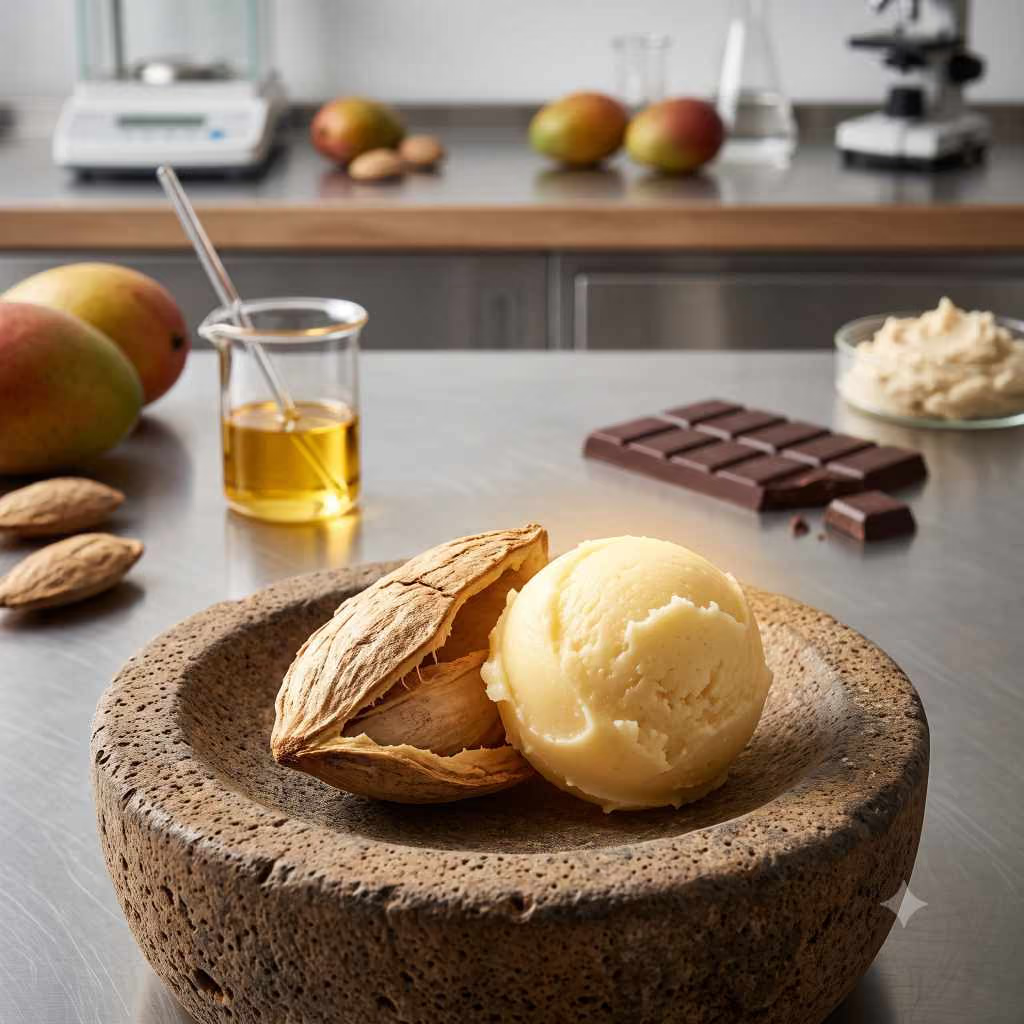
Mango butter is extracted from the kernel of the mango fruit (Mangifera indica), which is the hard core remaining after removing the pulp, representing a significant percentage of the fruit's total weight. The kernel contains a high percentage of extractable fat, making it a rich botanical source of fatty acids and unsaponifiable compounds. This endows it with properties similar to some tropical fats traditionally used in the food industry.
Interest in mango butter is driven not only by its nutritional value but also by its capacity to improve texture, stability, and mouthfeel—key parameters in developing high-quality food products.
Mango butter is primarily composed of triglycerides, where fatty acids are bound to glycerol to form a stable lipid structure. It is characterized by significant proportions of:
The fatty acid composition varies depending on:
This variability makes supplier evaluation and raw material analysis essential steps prior to industrial application.
Mango butter possesses several characteristics that make it a compelling ingredient in food processing.
Fats directly influence the consumer experience by providing smoothness, thickness, creaminess, and improving the product's melt-in-mouth profile. Consequently, its application can be explored in products requiring a balanced fat profile, such as certain confectionery products and compound fats.
The chocolate industry utilizes various vegetable fats to achieve specific properties, such as controlling melting points, enhancing texture, reducing manufacturing costs, and improving shelf-life stability. Mango butter possesses a lipid profile that qualifies it for evaluation as an alternative or co-ingredient for certain vegetable fats in confectionery applications, provided it complies with market-specific regulations. Furthermore, its crystalline properties may aid in developing fats with optimal manufacturing performance, particularly when incorporated into fat blends.
With the rise of plant-based products and alternative foods, there is growing interest in vegetable fats that can mimic the mouthfeel of animal fats. Mango butter can contribute to texture enhancement in certain plant-based alternatives, increasing creaminess and improving the stability of fat emulsions. However, successful application depends on the overall formulation design, as fats do not act in isolation; they interact with proteins, stabilizers, emulsifiers, and sugars.
Mango butter contains unsaponifiable compounds, including phytosterols, tocopherols, and phenolic compounds, in quantities that vary based on the extraction method. While these compounds may be associated with antioxidant properties, their final impact depends on the degree of refining and processing conditions. It is crucial to avoid exaggerated health claims, as dietary application must be supported by scientific evidence and approved regulations.
The incorporation of mango butter can be evaluated in chocolate products, compound fats, fat-based confectionery, bakery products, cream fillings, certain plant-based alternatives, and fat systems designed for texture improvement.
Prior to commercial adoption, essential quality parameters must be tested, including melting point, solid fat content (SFC) thermal profile, oxidative stability, acid value, peroxide value, moisture content, and sensory evaluation.
Extraction and refining methods significantly influence the quality of the final product. Inappropriate extraction can lead to increased oxidation, off-odors, elevated free fatty acids (FFA), and reduced storage stability. Therefore, modern industry relies on precise steps such as refining, deodorization, filtration, and temperature control during processing.
From a food safety systems perspective, mango butter must be evaluated like any other raw food material through supplier audits, microbial risk assessment, chemical contaminant monitoring, pesticide residue tracking, mycotoxin evaluation (where applicable), and verification of storage conditions. Additionally, compliance with the legislative standards of the target country must be ensured.
Despite its manufacturing benefits, several challenges exist:
Mango butter serves as an excellent example of the Circular Economy concept, where a kernel previously discarded as a by-product is transformed into an economically valuable ingredient.
This approach aligns with the modern food industry’s direction toward minimizing waste, utilizing agricultural residues, and developing innovative natural ingredients.
Mango butter represents a promising food ingredient with significant functional properties, particularly within the domain of vegetable fats, texture improvement, and mouthfeel enhancement in food products. However, its successful industrial application depends on understanding its chemical composition, selecting appropriate processing technology, establishing strict quality control, and ensuring alignment with regulatory frameworks.
The true value of mango butter lies not only in its role as a source of vegetable fat but in its capacity to offer innovative manufacturing solutions that bridge functional performance, sustainability, and agricultural resource utilization.