 Advertise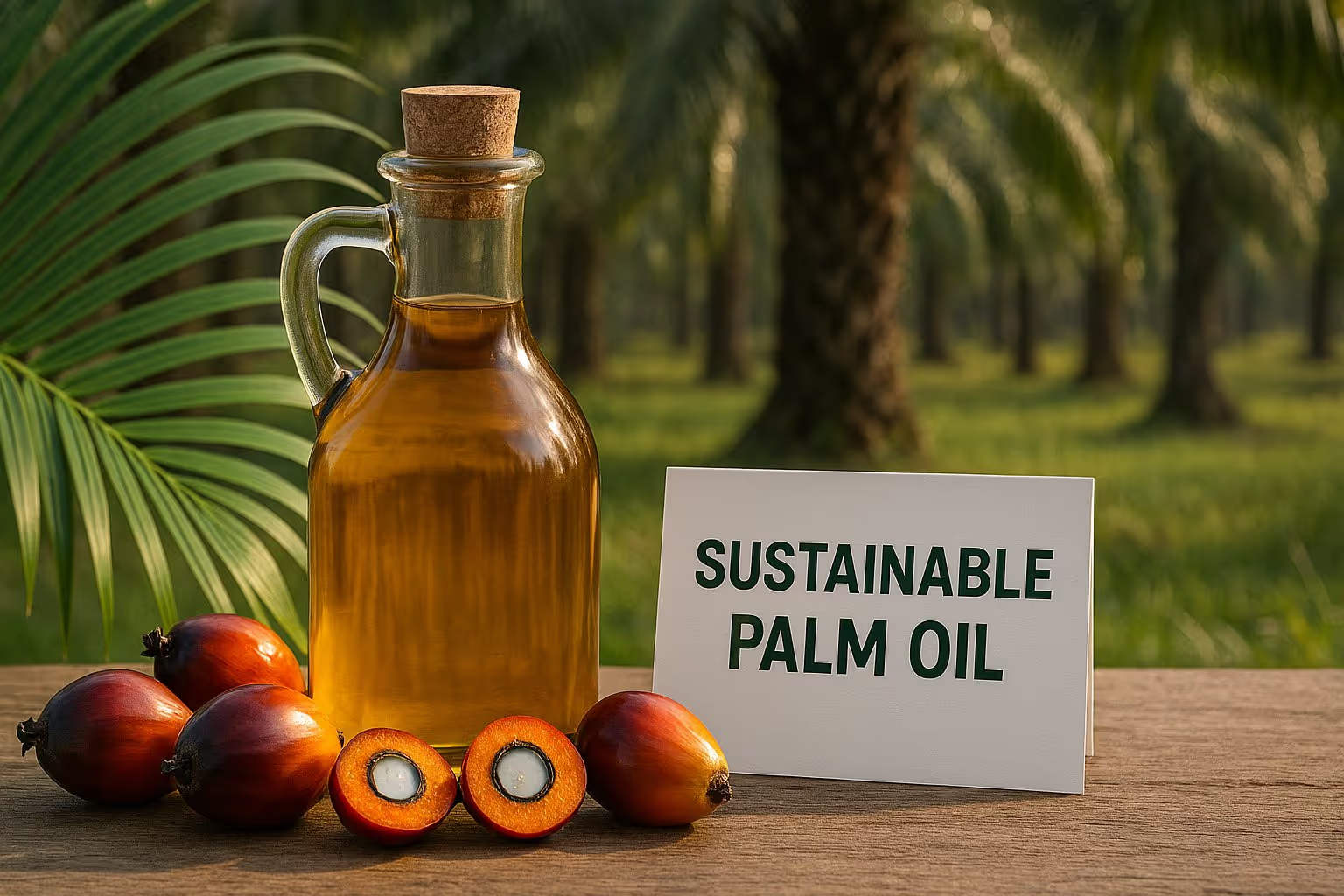
Note: This article was AI-translated from Arabic and is currently under manual review. The author is not responsible for any translation errors. Please refer to the original Arabic text for the most accurate and authoritative information.
A few years ago, several major companies pledged to exclude palm oil from their products due to sustainability concerns. But how have things changed today? In this exclusive article, Ruben Bronsfield refutes who Roundtable on Sustainable Palm Oil (RSPO) Three common misconceptions.
Palm oil is the most widely used vegetable oil in the world and is included in about half of the products offered in stores. Although it is characterized by high productivity and versatility, the public debate about it remains inaccurate and lacking in information.
It is true that global deforestation peaked in the 1980s, but has gradually declined since then. However, new palm plantations are still contributing to the loss of forests and biodiversity. According to the Food and Agriculture Organization of the United Nations (FAO), 10 million hectares of forest are lost annually, equivalent to 40% of the area of the United Kingdom, or more than 38,000 football fields per day. European Commission assessments show that palm oil accounts for 8% of this figure. With 85% to 90% of global production coming from Malaysia and Indonesia, the impact on them is significant.
However, growing oil palm under appropriate conditions can improve livelihoods and preserve high-value environmental areas, as well as contribute to meeting the increasing global demand for food. The U.S. Department of Agriculture (USDA) expects an increase in vegetable oil production of 2.7 million tons per year. So, it's clear that palm oil will play a pivotal role, and we should make sure to produce it sustainably.
One of the most common misconceptions is that palm oil production is based on exploitation. But the reality is that sustainable production enhances the welfare of workers and small farmers.
RSPO certified farms comply with labor rights and ensure fair wages, suitable working conditions, housing and health services that meet or exceed national standards.
Small farmers who obtain sustainability certification have access to international markets that offer better prices and receive support to improve their farming practices, leading to higher yields and income. For example, certified farmers under RSPO programs generate 35% more profits than non-certified farmers, while certified independent farmers earn 89% more than their non-certified counterparts.
It is not the product that is the problem, but the way it is produced. The farming method can harm, preserve or even improve the environment.
RSPO standards prohibit deforestation, oblige to maintain high-value environmental areas (HCV) and protect biodiversity.
In 2023, the Lubbock Larangan River in the Indonesian province of Jambi saw its reopening after a five-year sustainability project led by independent farmers certified by RSPO. They imposed a ban on fishing and pollution, and used the proceeds from the sale of sustainability certificates to rehabilitate river banks, raise fish and support local rangers.
Studies show that RSPO certified palm oil has a 20% lower impact on biodiversity than non-certified oil in Indonesia and Malaysia.
The European Deforestation Regulation (EUDR), which comes into force in December 2025, will also require companies to prove that palm oil (and six other commodities) does not contribute to deforestation and is produced in accordance with the laws of exporting countries. This is a big step towards transparency, supported by RSPO.
Today, 88% of palm oil entering Europe in the food and chemical sector is RSPO certified, exceeding the requirements of a European regulation that focuses only on legality and traceability, while RSPO covers broader elements including biodiversity and the rights of workers and local communities.
It is mistakenly believed that replacing palm oil with other oils such as sunflower, soy, or rapeseed is a more environmentally friendly solution. But the reality is that this may lead to worse environmental and social impacts.
Palm oil is highly efficient; its yield per hectare is much higher than other oils. A study from WWF in Germany showed that replacing palm oil would increase the need for agricultural land five times, to 1.85 million hectares instead of just 397,000. Replacing it with coconut oil alone could lead to an increase in greenhouse gas emissions by 309 million tons.
Sustainably produced palm oil is mostly sold in Europe and North America. If these markets stop using it, production will not stop, but will be sold in other markets with lower sustainability requirements, which will lead to more environmental and social damage.
Therefore, supporting a responsible market and advancing sustainable production is the best way.
Palm oil is not harmful in itself, but the way it is produced determines its effect. Therefore, the focus should be on supporting it only when it is sustainable, by adhering to recognized certifications, improving practices, and collaborating between different entities.
Widespread myths may lead to purchasing policies and consumer behaviors that do more harm than good.
To ensure a sustainable future for the industry, we need real cooperation between NGOs, universities, companies, and governments.
It remains the responsibility of companies to commit to using certified palm oil, especially with the imminent implementation of the European Deforestation Regulation.
Source: edie