
Lang
Note: This article was AI-translated from Arabic and is currently under manual review. The author is not responsible for any translation errors. Please refer to the original Arabic text for the most accurate and authoritative information.
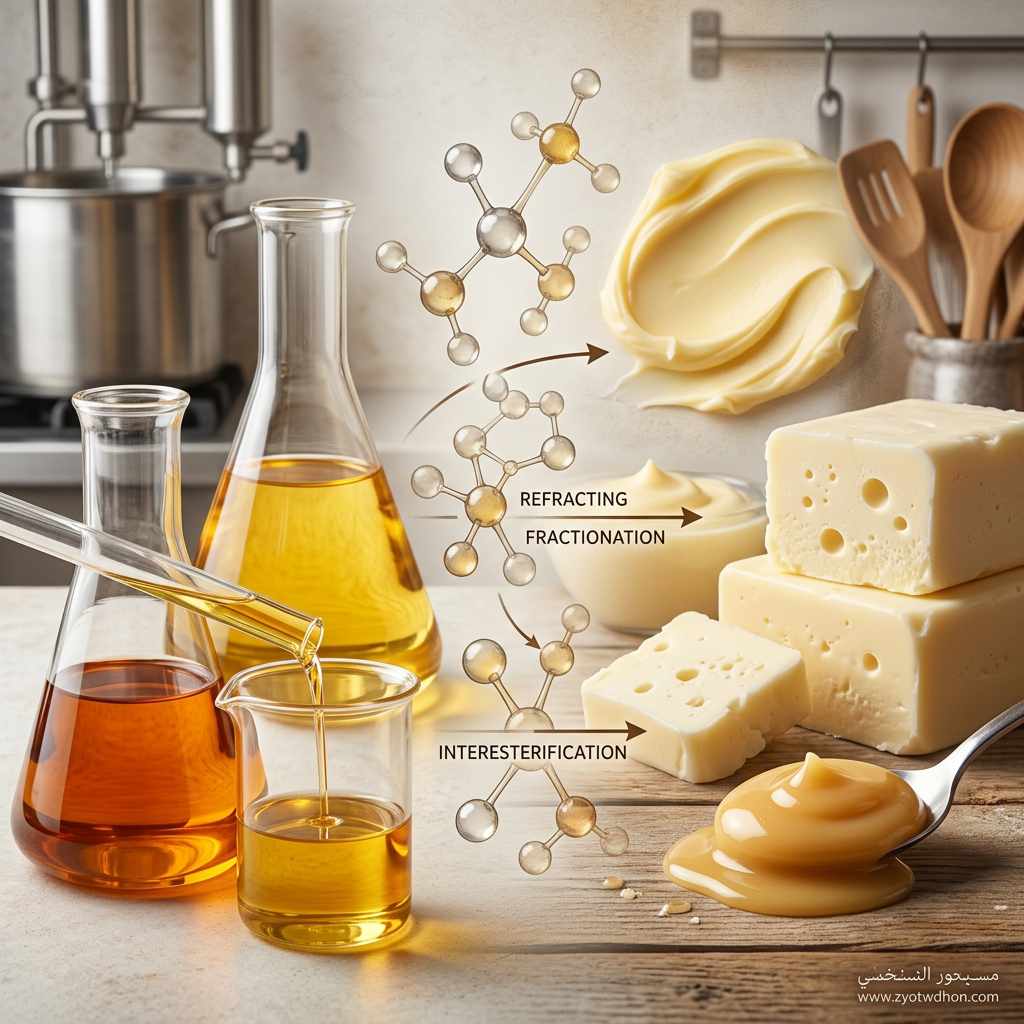
How does a liquid vegetable oil turn into spreadable margarine, bakery shortening that retains air, or a filling that melts in the mouth without melting during storage? Does this process require using partially hydrogenated oils and creating trans fats?
The answer is that the industry does not rely on a single process, but rather uses a range of technologies to modify fat composition, crystallization behavior, and solid content at different temperatures.
In the previous article, we discussed oil oxidation and the factors controlling stability and quality during storage and frying. However, the success of fat within food does not depend solely on stability; it must also possess a texture, melting point, and crystallization behavior suited to the product. Here comes the role of functional fats manufacturing.
The term "functional fats" here refers to technological functionality within food, not necessarily specific health benefits.
A single natural oil does not always provide all the required properties. An oil may be nutritionally good but too liquid for margarine production. Another fat may be solid but leave a waxy mouthfeel or crystallize in an undesirable form.
Different products require varying specifications:
Therefore, fat design begins by identifying the required function, followed by selecting raw materials and processes capable of achieving it.
Refining aims to remove undesirable components and improve color, taste, odor, stability, and safety. The refining process may include steps such as:
Controlled refining helps produce a stable, neutral-flavored oil suitable for food use. However, it may also reduce certain tocopherols, sterols, and natural compounds depending on the intensity of the process.[1,2]
Hence, it is inaccurate to label all refining as harmful or all unrefined oil as superior; evaluation depends on raw material quality, processing objective, control over time and temperature, and the final product.
Fractionation is a physical separation process based on differences in the melting points of fat components.
The fat is first heated to melt crystals, then cooled according to a controlled program allowing certain triglycerides to crystallize. The solid crystals are then separated from the liquid fraction.
One of the most famous examples is palm oil fractionation into:
Fractionation does not chemically alter fatty acids, but it redistributes triglyceride types among the resulting fractions, altering fatty acid ratios and physical properties for each fraction.[2]
Fat does not transform from liquid to solid in a single manner; triglyceride molecules can arrange themselves into multiple crystal forms, known as polymorphism.
The primary forms include:
Cooling rate, agitation, temperature, storage duration, and triglyceride composition affect the final crystal form.
Thus, functional fat or margarine manufacturing does not end with simply mixing oils; it requires precise control of cooling, shaping, and mechanical working to form an appropriate crystal network that traps the liquid oil inside.
Solid Fat Content (SFC) expresses the percentage of fat present in the solid state at a specific temperature.
A single melting point is insufficient to describe fat performance; a fat might be appropriately solid in the refrigerator but too hard during use, or fail to melt completely in the mouth.
Therefore, SFC is measured across multiple temperatures to plot a curve illustrating:
The SFC curve serves as an essential tool in designing margarine, shortenings, bakery fats, and fillings.
Interesterification is a process that redistributes fatty acids among triglyceride molecules or between their positions on the glycerol backbone.
It can be:
The process does not typically alter overall fatty acid ratios, but it changes TAG molecule types, thereby modifying:
Interesterification does not inherently produce trans fats; thus, it has become a major tool for designing alternatives to fats previously dependent on partial hydrogenation.[1,3]
However, the absence of TFA formation does not mean every interesterified fat is nutritionally equal; saturated fatty acid levels, positional distribution, food matrix, and consumed amounts must still be evaluated.
Partial hydrogenation adds hydrogen to some double bonds, increasing hardness and stability. However, it can convert some cis bonds to trans, producing Partially Hydrogenated Oils (PHOs), a major source of industrial trans fats.Consequently, PHOs have become a target for removal or ban in a growing number of regulations.
Full hydrogenation continues until almost all double bonds are converted into single bonds. This yields a highly saturated, high-melting fat, but usually containing negligible amounts of TFA.
This hard fat is rarely used alone; instead, it may be blended with liquid oils or interesterified to produce a fat with an appropriate melting curve and texture.
Therefore:Partial Hydrogenation ≠ Full Hydrogenation ≠ Interesterification.
Design begins by establishing the required SFC curve, followed by selecting a blend of:
The mixture then undergoes controlled cooling, crystallization, and mechanical working to form a network of fine crystals that trap liquid oil and water, providing the product with desired texture and stability.
Product success relies on striking a balance between hardness, stability, melting profile, and nutritional value—not merely increasing solid content.
Fat cannot be judged solely by being "processed." Some processes remove contaminants or enhance stability, others modify texture without forming TFAs, while some processes may yield undesirable components if improperly controlled.
The final product should be evaluated based on:
Furthermore, a "trans-fat free" claim does not automatically imply low saturated fat or suitability for unlimited consumption.
Functional fats manufacturing is a science based on controlling molecular structure, crystallization, and solid fat content, rather than simply turning liquid oil into solid material.
Refining, fractionation, interesterification, and hydrogenation serve different roles. The key lies in distinguishing between partial hydrogenation (which produces TFAs), full hydrogenation, and interesterification (which redistributes fatty acids without forming trans fats directly).
A sound evaluation neither rejects processing entirely nor accepts it unconditionally; it examines the process, objective, composition, quality, and final product.
With the chemical, metabolic, and technological picture complete, we reach the final installment: What are the recommended limits for fats? What is the difference between WHO guidelines, FAO/WHO expert consultations, and Codex standards? And why aren't all circulated figures legal limits? We discuss this in Dietary Fat Recommendations, Trans Fats, and the Role of Codex.