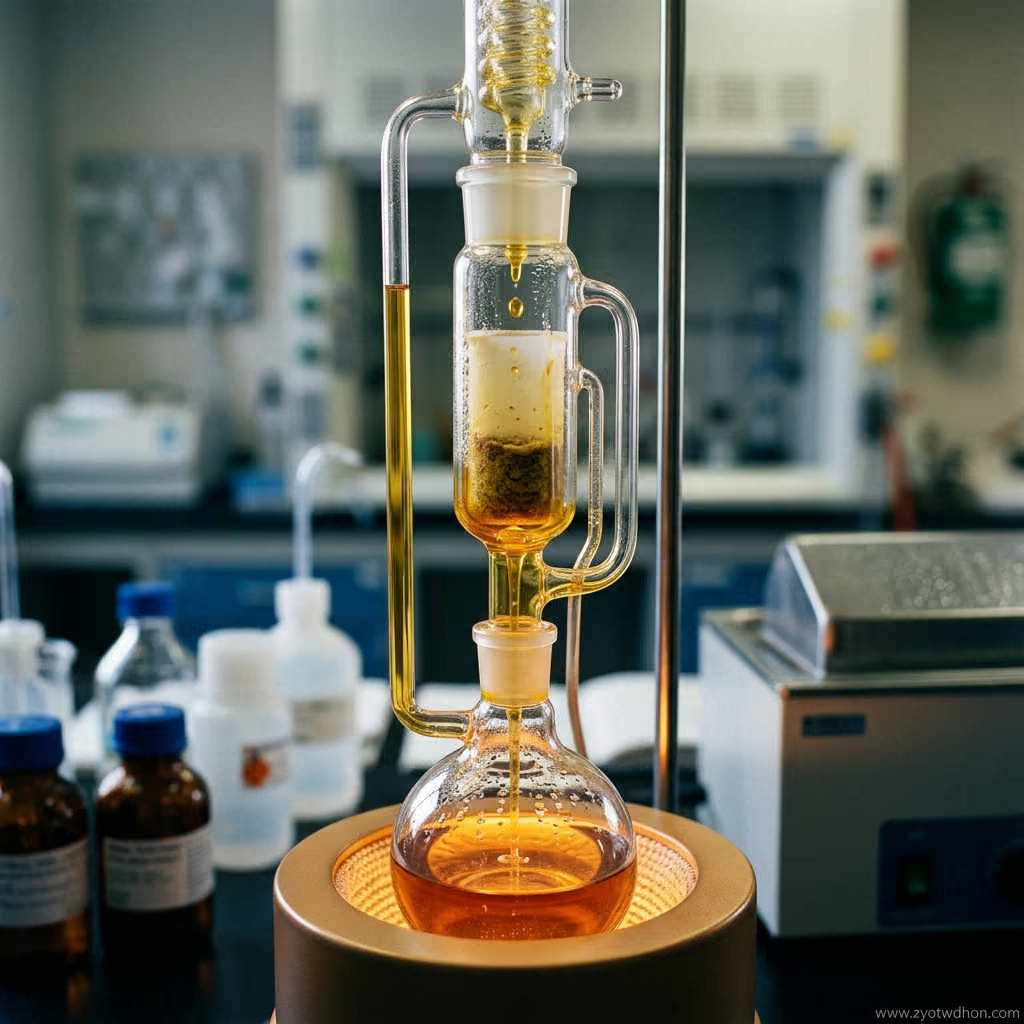
The Soxhlet apparatus was invented in 1879 by Franz von Soxhlet, a German chemist specializing in analytical chemistry.
Discovery Background
- The apparatus was originally developed to extract lipids from solid materials, particularly in foods such as milk and dairy products.
- The objective of this innovation was to provide an automated, repeatable method for extracting solvent-soluble compounds using organic solvents, making the analysis significantly more accurate and efficient compared to traditional maceration or manual shaking techniques.
Evolution and Manufacturing
- Since its invention, the Soxhlet extractor has been manufactured from thermal-shock-resistant glass, such as borosilicate glass, to withstand high temperatures during continuous distillation and reflux.
- Over time, modified variants were engineered—such as automated Soxhlet extraction systems utilizing vacuum or continuous solvent flow—to enhance efficiency and shorten cycle times.
- Today, the Soxhlet apparatus is widely employed across analytical chemistry, notably in lipids determination, pesticide residues, organic compounds, and environmental contaminant testing.
Fundamental Steps of the Assay
This analysis is routinely performed to extract and quantify fat content in test samples. It is widely used to analyze free fat in foods and edible oils. Below are the core operational steps:
Materials and Equipment
- Soxhlet extractor
- Analytical balance
- Organic solvents (such as n-hexane or petroleum ether)
- Suitable collection boiling flask
- Glass beaker and analytical filter paper/thimble
- Heating mantle or water bath
- Vacuum pump (optional)
- Laboratory drying oven
Procedure
1. Sample Preparation
- If the sample contains elevated moisture, dry it in an oven at 105°C for 2–3 hours, then cool in a desiccator.
- Accurately weigh 2–5 g of the prepared sample and transfer it into a dedicated Soxhlet cellulose extraction thimble.
2. Soxhlet Extraction
- Place the thimble inside the Soxhlet extraction chamber.
- Add an adequate volume of organic solvent (n-hexane or petroleum ether) into the bottom boiling flask to support multiple siphoning cycles.
- Heat the solvent to its boiling point; vapor rises, condenses in the condenser, and drips onto the sample matrix.
- Continue the extraction process for 4–6 hours, allowing the solvent to siphon and recirculate continuously through the sample.
3. Solvent Removal and Fat Drying
- Following extraction completion, recover the solvent using a rotary evaporator or gentle water bath evaporation.
- Dry the flask containing the extracted fat in an oven at 105°C for 30–60 minutes to eliminate all residual solvent traces.
- Allow the flask to cool inside a desiccator, then weigh accurately.
4. Calculation of Free Fat Content
Calculate the free fat percentage using the following formula:
$$\text{Fat Content (\%)} = \left( \frac{\text{Weight of Flask After Extraction} - \text{Weight of Clean Dry Flask}}{\text{Weight of Initial Sample}} \right) \times 100$$
Important Notes
- The extraction solvent must be pure and anhydrous to guarantee analytical accuracy.
- n-Hexane or petroleum ether can be selected depending on the matrix profile, as extraction efficiencies vary across lipid classes.
- For laboratory safety, always conduct extraction procedures inside a certified fume hood to prevent inhalation of flammable solvent vapors.
- If only free fats are targeted, apply direct extraction without preliminary acid hydrolysis.
 Advertise