
Lang

Note: This article was AI-translated from Arabic and is currently under manual review. The author is not responsible for any translation errors. Please refer to the original Arabic text for the most accurate and authoritative information.
"The technological requirements of a food product are not a luxury."
Before a piece of chocolate touches your tongue, it has passed a silent test no one sees: Will it shine? Will it snap elegantly? Will it melt in the mouth without a waxy feel? And before a croissant reaches your hand, it has fought a delicate battle between dough, fat, steam, and heat; a battle where taste alone does not win, but science does.
A shiny piece of chocolate is not just a mixture of cocoa and sugar, nor is a golden croissant just dough that went through a hot oven, nor is a brittle biscuit a coincidence born of a successful recipe. Behind this daily pleasure lies an exact science working in silence; the chemistry of oils and fats, the engineering of texture, and manufacturing safety.
When chocolate snaps with a clean sound and melts in the mouth without a waxy texture, when croissant layers unfold like successive thin leaves, and when a biscuit crunches without leaving a bothersome greasy residue, the real question is: What created this sensory experience?
The short answer: Fats.
But it's not just any fat, and it's not merely a source of energy or calories; it is a structural and technological component that determines the shape, texture, stability, shine, brittleness, and the final feel of the product.
Hence the question that might surprise the consumer: Why doesn't the sweets and baked goods industry always rely on liquid oils, despite their better health image in the public consciousness? And why do some industries resort to more solid or highly saturated fats, such as cocoa butter, palm oil, palm olein, coconut oil, palm kernel oil, and some dairy or animal fats or their controlled industrial alternatives?
The answer is not a defense of excessive saturated fat intake, nor an invitation to consume them unchecked, but a clarification of an important scientific fact: not all fats perform the same function within food. Liquid oil might be suitable for salads or some types of cooking, but it cannot necessarily create croissant layers, give chocolate its shine and texture, give biscuits their brittleness, or hold up long under deep-frying conditions.
In food factories, oils and fats are not chosen solely based on brand name or price, but according to overlapping physical, chemical, and sensory specifications.
Therefore, it can be said that fats in the sweets and baked goods industry are not just a raw food ingredient, but an engineering tool that creates the product's identity and determines its final image in the consumer's eyes, mouth, and memory.
It is important to note here that some animal fats (such as butter, natural ghee, and controlled food-grade tallows) and some tropical vegetable oils or fats (like palm oil, palm kernel oil, coconut oil, and cocoa butter) are characterized by a relatively high melting point or the presence of a significant percentage of solid fat at room temperature. This property gives them special technological importance in the industries of sweets, baked goods, fillings, creams, coatings, laminated products, and frying.
In many food applications, a single type of fat is not used alone; rather, calculated blends or mixtures are designed between animal fats and some tropical fats or oils, or between different fractions of vegetable oils after fractionation. The aim is to reach specific properties that each component alone cannot achieve. Blending can help adjust the melting point, improve plasticity, modify texture, increase oxidative stability, reduce oil separation, improve mouthfeel, and maintain the desired flavor.
Here, the decisive condition becomes transparency: the quality of raw materials, the absence of industrial trans fats in the product, the clarity of the label, and not presenting the blend to the consumer as an ingredient different from its reality.
Cocoa butter is a clear example that fat is not an inert substance. It is a highly sensitive crystalline system that can crystallize in more than one form, and each form has a different impact on shine, texture, and stability. The desired crystalline form in good chocolate is often the fifth form known as Form V (or βV). This form gives chocolate its shine, clean snap, relative stability at room temperature, and a pleasant melt at mouth temperature.
However, if the tempering process is not controlled, or the product is exposed to inappropriate temperature changes during storage and transport, the crystalline structure may shift to less organized forms. This results in a dull or white layer on the surface known as Fat Bloom. This bloom does not necessarily mean the chocolate is spoiled, but it means its fat system has lost its order.
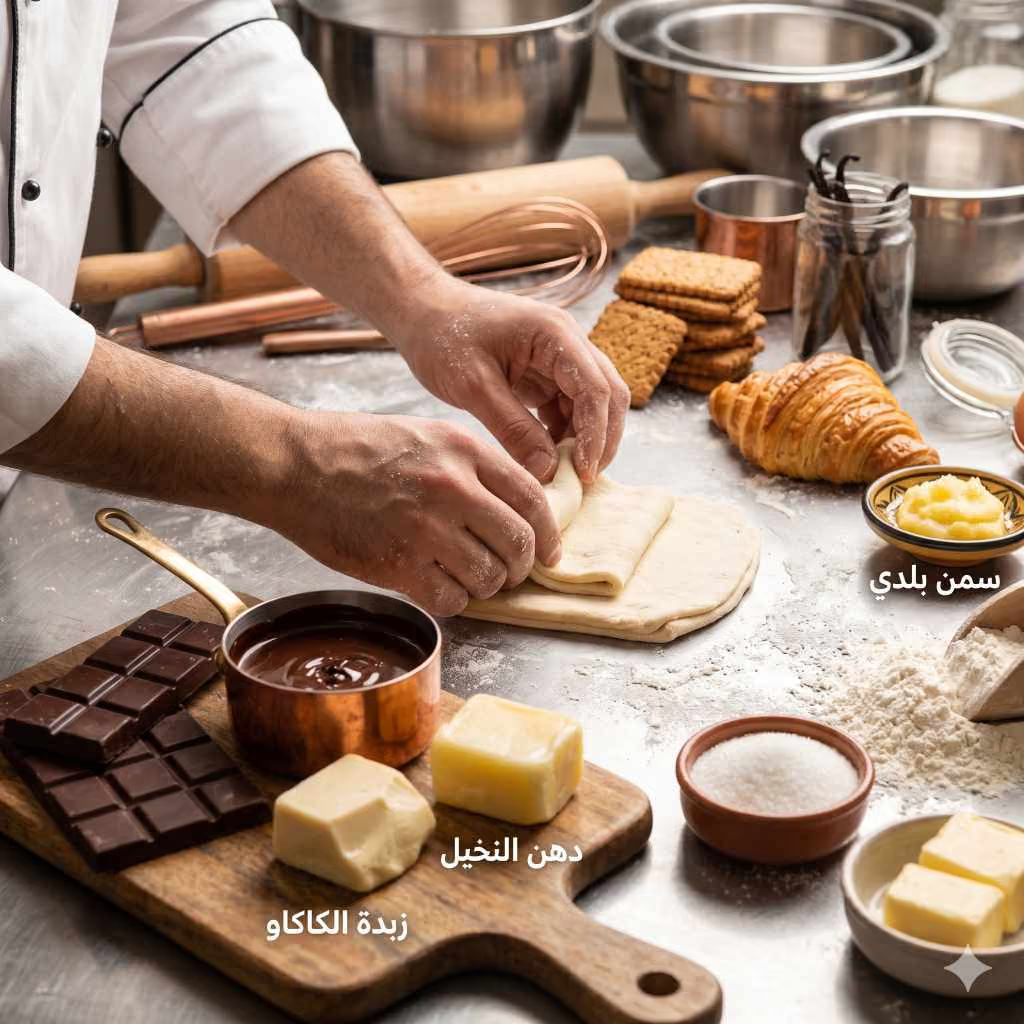
In croissants and puff pastries, it is not enough for the fats to be edible; they must have specific plasticity. Lamination or roll-in fats must be firm enough to separate the dough layers, and flexible enough not to break during rolling. Upon baking, water turns into steam, lifting the layers, while the fats act as thin dividers that help form the flaky, leafy structure characteristic of croissants, pâtés, and puff pastries.
If we want an example close to Egyptian memory, the traditional Feteer Meshaltet provides a wonderful practical lesson in the role of fats in baked goods. This ancient popular product does not gain its value from flour alone, nor solely from the skill of rolling it out, but from the nature of the fat used between the dough layers. Cow or buffalo butter, as well as natural ghee (Samna Baladi), give the Feteer its distinctive flavor, rich aroma, and luxurious mouthfeel.
In biscuits, fats affect crunchiness, spread during baking, mouthfeel, and shelf life. In creams and fillings, the industry needs fats that control texture, prevent oil separation, and aid stability during storage and transport. Many fillings require what can be described as a "smart texture": not annoyingly solid, not a separated liquid, and not waxy in the mouth.
In deep frying, the rules of selection change. The main issue is no longer crystallization or layer formation, but thermal and oxidative stability under harsh conditions: high heat, oxygen, moisture coming out of the food, fine particles, and repeated use. Here, we can understand why palm olein is used in many commercial frying applications; due to its good balance in resisting oxidation and thermal degradation.
When Does Frying Oil Become Unfit?It is a common mistake to judge frying oil during use by its peroxide value alone. More comprehensive indicators must be looked at, such as total polar compounds (TPC), polymers, acidity, and secondary oxidation products, in addition to obvious sensory signs like a change in smell, darkening of color, increased foaming, and the appearance of smoke.
When we talk about refined oils and fats, we must not stop at the technological function alone. Food safety dictates monitoring potential contaminants that may arise during refining at high temperatures, including 3-MCPD esters and Glycidyl esters (GE). A responsible industry looks not only for a fat that gives a beautiful texture but for a raw material that achieves the required function with the highest possible degree of safety and quality.
The common mistake is turning the subject into a simplified battle: saturated fats are always bad, and liquid oils are always good. The scientific truth is more precise; the issue is not the presence or absence of these fats, but their type, quantity, method of use, the extent to which they are free of industrial trans fats, their manufacturing quality, and the clarity of their data to the consumer.
The consumer wants a product that looks beautiful, has a stable texture, tastes enjoyable, is safe, has a clear label, and is appropriately priced. The factory wants a product that can withstand manufacturing, transport, and storage. Between the two parties, science steps in to set the difficult equation: How do we achieve texture, shine, brittleness, and stability without sacrificing safety or transparency?
The secret of success in sweets and baked goods does not lie in sugar alone, nor in flour alone, nor in flavor alone. It lies in understanding the complete structure of the food, and in choosing the right fat for the right function. The technological requirements in food products are not an industrial luxury, but the conditions that make the product manufacturable, stable during storage, suitable for transport, and sensorially acceptable.
Just as a professional shooter fixes his eye on the target before releasing his arrow, we must direct the discussion accurately: we must not confuse what the product needs to succeed in the factory with what humans need to live healthier lives. This is why this article was about technological requirements, while the next article will be about nutritional requirements... so the picture is complete.