 Advertise
Note: This article was AI-translated from Arabic and is currently under manual review. The author is not responsible for any translation errors. Please refer to the original Arabic text for the most accurate and authoritative information.
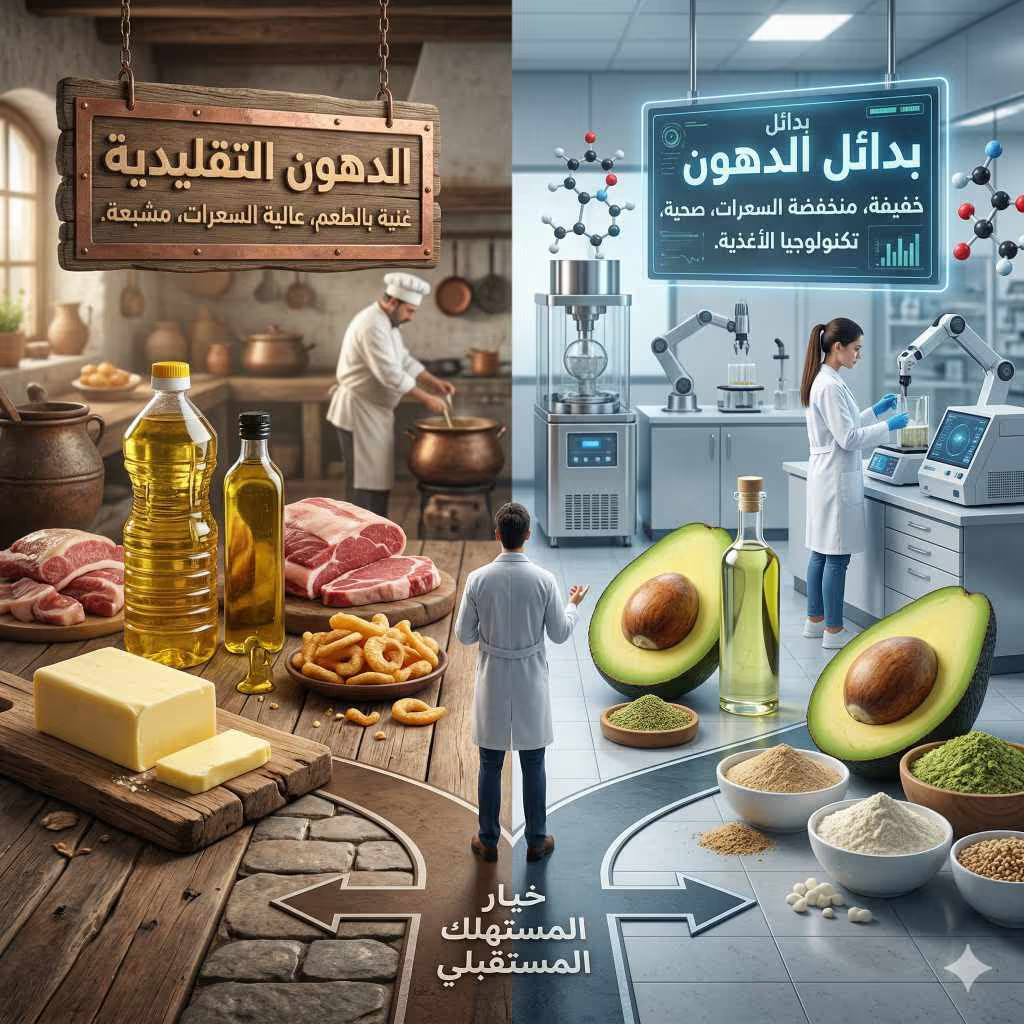
A comprehensive Arabic reference for understanding fat alternatives and modified fats, and their healthy and technological applications in modern foods.
Introduction: When Fat Isn't Just Fat
In the food industry, fats are more than just ingredients that boost caloric value or enhance flavor; they play a deeper, more complex role. They are structural components, flavor carriers, texture builders, oral sensation engineers, and a key factor in consumer acceptance of a food product. For this reason, reducing or replacing fats has never been a simple calculation. What is removed from a product isn't just a number on a nutrition label, but an entire system of sensory and technological properties that define its final character.
This complexity gave rise to one of the most fascinating and expanding fields in food science: fat alternatives. This area isn't just about creating lower-fat foods; it delves into understanding the precise functions of fats, then attempting to mimic, reconstruct, or replace them with various alternatives, all while balancing sensory quality, technological efficiency, economic viability, and the product's health profile.
Over decades, this field has evolved from simple solutions based on thickening and increased viscosity to more sophisticated systems involving fractionated proteins, functional carbohydrates, fat mimetics, and structured fats. Today, it's even approaching the frontiers of molecular design, artificial intelligence, and personalized nutrition. This highlights the need for a robust Arabic reference that combines scientific accuracy, editorial clarity, and bridges the gap between the lab, the factory, and the market – precisely what this material aims to deliver in a comprehensive, encyclopedic format.
Some might assume that discussions about fats in food are limited to their role as an energy source or a nutrient enhancer. However, the reality is far more profound. Fats are a highly influential sensory, functional, and technical component; they contribute to taste formation, texture creation, flavor release, and impart smoothness, flow, and richness to products, in addition to their role in stabilizing many food systems.
Consequently, reducing or replacing fats has never been a straightforward or simple process. Removing fats doesn't just eliminate calories; it can also strip away the creamy mouthfeel, structural integrity, desirable melt, and the overall sensory impression that connects consumers to a product. Thus, research into fat alternatives has evolved beyond a mere health trend into an advanced scientific and industrial challenge, integrating chemistry, food technology, sensory analysis, nutrition, and regulatory considerations.
Scientific Definition and Technological Concept
Fat alternatives refer to substances or food systems used to partially or completely replace fats in food products. The goal is to reduce calories, decrease fat content, improve the product's health profile, modify its functional properties, lower its cost, or respond to consumer and market trends.
These alternatives can be non-fat materials like certain carbohydrates, proteins, or fibers. They may also include fat mimetics or functionally designed compounds that mimic some fat behaviors in terms of sensation or performance, albeit with differences in digestion, absorption, or caloric value. Modified fats, however, are not always fat alternatives in the strict sense; many remain true fats whose properties have been altered to enhance performance, structure, or health suitability.
In scientific literature, a crucial distinction is made between two main terms:
This distinction is not merely a terminological detail, but a fundamental key to understanding the mechanism of action, practical suitability, health implications, and regulatory status of each category.
Because fat isn't just one function
The challenge of fat replacement lies in its multidimensional role in food. Fat doesn't perform a single, easily replicable function; instead, it carries out a complex system of sensory, physical, and chemical roles simultaneously.
Fats impart creaminess, smoothness, flow, and a full mouthfeel to products. They also serve as a crucial medium for carrying aromatic compounds and gradually releasing flavor, while contributing to texture development and structural stability in baked goods, sauces, dairy products, ice cream, processed meats, and snacks.
Furthermore, fats influence melting, crystallization, aeration, shortening, plasticity, and oxidative stability—all essential technological properties. In cakes, for instance, fats help limit gluten formation, aid in air entrapment, and improve tenderness. In ice cream, they contribute to creaminess and structural homogeneity. In sauces, they play a pivotal role in texture and stability. Consequently, any fat substitute is assessed not merely by its composition but by its capacity to replicate this intricate system of functions.
From Health Concerns to Food Reformulation
Interest in fat substitutes became prominent during the latter half of the 20th century, as concerns grew regarding the link between excessive fat consumption—particularly certain saturated and trans fats—and cardiovascular diseases, obesity, and various metabolic disorders. With increasing calls to reduce dietary fat, the food industry faced a critical dilemma: how to produce lower-fat foods without sacrificing their sensory and technological attributes?
This spurred scientific and industrial efforts to develop various replacement systems, leveraging abundant agricultural raw materials like corn, potatoes, soy, and dairy derivatives. Solutions evolved from simple methods for increasing viscosity and binding water to advanced systems, including fractionated proteins, hydrocolloids, modified carbohydrates, fat mimetics, and multifunctional emulsifiers, and further to more sophisticated approaches involving food microstructure engineering.
However, this history is not without critical review; many low-fat products achieved commercial success but didn't always deliver true nutritional balance, particularly when fat reduction was offset by increased sugars, refined starches, or flavor enhancers. Thus, the study of fat substitutes is not merely an examination of new ingredients but also a re-evaluation of an entire food philosophy.
Scientifically, this field can be divided into three main categories of fat substitutes, alongside a fourth category closely related in terms of reformulation and functional enhancement, even if it's not always a direct fat replacement.
This category relies on the ability of certain carbohydrates to bind water and form gel systems or viscous networks, imparting a fuller texture and a mouthfeel relatively closer to higher-fat products. Key examples include maltodextrin, modified starches, pectin, inulin, cellulose, food gums, and some soluble fibers.
These substitutes are effective in various applications, including sauces, dairy products, desserts, and some baked goods, as they provide body, moisture, and density. However, they cannot always fully replicate the melting properties or the complete lubricating mouthfeel that real fats offer.
This category utilizes proteins, often derived from whey, egg, milk, or certain plant sources, which are processed into fine micron-sized particles that impart a smooth, slippery mouthfeel. A notable historical example is Simplesse technology.
These substitutes are more successful in chilled or semi-solid products like yogurt, dairy desserts, sauces, and ice cream, but are less suitable for high-heat applications or systems requiring complex crystallization and shortening properties.
These are compounds of a fatty or semi-fatty nature, yet they differ from traditional fats in structure or in digestibility and absorption. A prominent example is Olestra, commercially known as Olean, which consists of sucrose esters of long-chain fatty acids designed to impart the sensory properties of fats in certain products while having limited intestinal absorption.
This type represented a significant conceptual leap, but it also sparked extensive debate regarding its digestive effects and its impact on the absorption of certain fat-soluble vitamins.
This category is not always considered fat substitutes in the strict sense, as their primary goal is often not to reduce fat or calories, but rather to redesign the properties of the fats themselves to be more technologically or health-wise suitable. They include:
This category is of great importance because it allows for improving the actual lipid behavior in terms of hardness, crystallization, stability, and plasticity, without relying on partial hydrogenation, which produces trans fats.
| Property | Carbohydrate-Based Replacers | Protein-Based Replacers | Fat-Based Replacers | Modified/Structured Fats |
|---|---|---|---|---|
| Source | Starches, fibers, gums | Milk, whey, soy, and egg proteins | Engineered fatty compounds such as sucrose esters | Vegetable oils and fats, or rearranged or structured lipid systems |
| Calories | Low to moderate | Low to moderate | Very low in some cases | Often high, like conventional fats |
| Mechanism of action | Water binding, gel formation, increasing viscosity | Fine particles that mimic a creamy sensation | Mimicking some of the sensory and thermal behavior of fats | Modifying melting, crystallization, stability, and structure |
| Strengths | Low cost, flexible, good for moisture retention | Provide a smooth mouthfeel in chilled products | Closely approximate the sensory properties of fats | Preserve true fat behavior and help avoid trans fats |
| Weaknesses | Do not fully replicate lubrication; sensitive to certain processing conditions | Limited in heat-based applications | May be associated with digestive effects or regulatory restrictions | Do not usually reduce calories and may be higher in cost |
| Key applications | Baked goods, sauces, dairy products, confectionery | Yogurt, ice cream, chilled desserts | Some snacks and specialty applications | Shortenings, plastic fats, infant formula, cocoa butter substitutes |
One of the most common areas of confusion in this field is the overlap between fat substitutes and modified lipids. Modified lipids are real lipids whose structure, fatty acid arrangement, or physical and functional properties have been altered by various means, with the aim of improving technological performance, stability, melting behavior, nutritional value, or reducing some undesirable effects.
Examples include:
As for fat substitutes, their primary goal is to mimic the role of fats or partially or completely replace them with substances that may not be fatty in origin. Therefore, not every modified fat is a fat substitute, as many modified fats remain true fats with full caloric value, but with improved performance or greater suitability for health or industrial applications.
The essential conclusion here is:
| Criterion | Fat Replacers | Modified Fats | Trans Fats |
|---|---|---|---|
| Primary objective | Reducing calories, lowering fat, or mimicking function | Improving performance or modifying physical or nutritional properties | Historically used to improve stability and texture |
| Composition | Often non-fat or non-conventional fat | Modified real fats | Unsaturated fats partially converted to the trans form |
| Caloric value | Low or lower than conventional fats | Often high | High |
| Health impact | May be positive with balanced use | May be more suitable than some conventional systems | Associated with clear adverse cardiovascular effects |
| Regulatory status | Varies by substance and use | Varies by type and application | Restricted or banned in many markets |
| Examples | Olestra, Simplesse, inulin, modified starches | Structured lipids, rearranged oils, fractionated oils | Partially hydrogenated oils and the old vegetable margarines based on them |
When discussing this field comprehensively, it is essential to highlight some prominent examples that have played a significant role in the history of fat substitute development.
The most prominent of these examples was Olestra, which was developed to provide some sensory characteristics of fats with limited absorption. The U.S. Food and Drug Administration (FDA) approved its use as a direct food additive in specific applications, with requirements for the addition of fat-soluble vitamins, and with a unique regulatory history that, in its early stages, involved some label warnings.
Technology also served as Simplesse a prominent example of protein-based alternatives capable of imparting an acceptable creamy mouthfeel to products in some low-fat applications.
Among carbohydrate alternatives, materials like:
All of these played significant roles in improving texture, increasing viscosity, enhancing product water retention, and perceptually reducing the impact of fat loss.
In modern trends, there has been increased interest in using:
Today, products based on inulin are appearing in some markets for ice cream and low-fat dairy products. Resistant starches are used in baked goods to support texture while increasing fiber content, while DAG oils are being introduced in some Asian markets as functional oils with different metabolic properties.
No single fat replacer is suitable for all applications; the appropriate substance varies depending on the product's nature, heat treatment, shelf life, target price, and desired functionalities.
Fat alternatives have also made significant inroads into:
In principle, fat alternatives can help reduce the energy density of some products, which may contribute to reducing calorie intake for certain groups when used as part of a balanced diet.
They can also:
However, the true benefit is not measured merely by the presence of a "low-fat" label on the packaging, but by the extent of improvement in the product's overall nutritional composition, and whether fat reduction was achieved without undesirable nutritional trade-offs.
One of the most important lessons learned from past decades is that reducing fat does not automatically improve the nutritional value of food. Many industries sometimes compensated for fat reduction by increasing sugars, fast carbohydrates, or intense flavor enhancers, which led to products that were ostensibly low-fat but not necessarily metabolically superior.
This trend is known as the Fat-Sugar Seesaw or the seesaw between fat and sugar; meaning that reducing fat might prompt food designers to increase sugar to maintain sensory appeal. Therefore, the success of a fat substitute is not measured solely by its ability to reduce fat, but by its capacity to maintain sensory and nutritional balance without resorting to harmful compensations.
Furthermore, some alternatives, particularly low-absorption fatty ones, may be associated with undesirable digestive effects or impacts on the absorption of certain fat-soluble compounds such as vitamins A, D, E, K, and some carotenoids. In other instances, the texture might improve while sensory satisfaction diminishes, or an unfamiliar mouthfeel emerges.
There is also a crucial aspect: fat substitutes do not function in isolation from the rest of the formulation. Instead, they interact with proteins, carbohydrates, salts, pH levels, heat treatment, and storage, making their testing within the complete food system an indispensable necessity.
The full picture of fat substitutes is incomplete without addressing the regulatory dimension, as the acceptance of any substitute is based not only on its technological efficacy but also on safety assessment, anticipated consumption levels, nutritional impact, and clear label disclosure.
Modern markets have moved towards what is known as the Clean Label, meaning the use of simpler, clearer, and more consumer-acceptable ingredients. This trend has driven the industry to develop alternatives that align more closely with the concept of "perceptually understood" food, rather than merely technically modified food.
In the Arab world, national regulatory bodies tend to leverage international standards, particularly Codex, while adapting them to local frameworks.
One of the most notable recent shifts in this field is the transition from a philosophy of "creating complex alternatives" to a more balanced approach that seeks natural or semi-natural solutions, achieving reasonable functionality without overburdening the ingredient list.
This has led to increased interest in:
Furthermore, some traditional practices in popular cuisines have been re-examined through a modern scientific lens, such as the use of:
Recent examples following the clean label trend include:
First: Plant-Based Meat and Dairy Alternatives
With the significant expansion of the plant-based alternatives market, mimicking the fatty mouthfeel of traditional meat and dairy has become a major challenge. In this context, oils like coconut oil, cocoa butter, and structured fats are used to simulate the fatty texture and melt during cooking. Additionally, blends of vegetable oils, proteins, and gums are employed in plant-based dairy alternatives to achieve the desired creamy texture.
Second: Functional Foods and Targeted Nutrition
In diet and weight loss products, carbohydrate and protein alternatives are used to reduce energy density while maintaining sensory satisfaction. For some products aimed at the elderly or diabetics, alternative or fat systems may be used, designed according to specific functional or metabolic goals.
Third: Medical Foods and Clinical Nutrition
In clinical nutrition, structured fats are used for patients with burns, malabsorption, or premature infants, with fatty acid distribution on glycerol modified to improve absorption and metabolic utilization.
The success of a fat replacer is not only measured by its safety, but also by its ability to meet multiple criteria:
Sensory Criteria:
Technological Criteria:
Economic Criteria:
Consumer Acceptance:
A successful alternative is not just what works in the lab, but what succeeds in the factory, is accepted in the market, and proves itself in circulation.
The future of this field is moving towards a more complex and intelligent stage, where the following intersect:
We are also likely to see an expansion in:
Interest is also expected to grow in what can be termed functionally customized fats; that is, fats designed according to the specific needs of certain groups. Success in this path will remain contingent on combining four governing conditions: safety, sensory acceptance, label clarity, and economic feasibility.
Scientific and industrial experience reveals that fat substitutes are not a single magic bullet, nor a homogeneous category that can be judged universally. In some applications, they represent an important tool for improving nutritional composition, reducing energy density, or developing products more aligned with contemporary health trends. However, in other applications, their effectiveness may be limited, or they may be burdened by sensory, digestive, or regulatory constraints, or be part of a formulation that only superficially achieves the desired health benefit.
The sensible conclusion here is that the problem is not with fats themselves, nor with fat substitutes themselves, but rather with:
Good natural fats, within a balanced dietary framework, are not necessarily the enemy. Similarly, an artificial substitute does not become a virtue simply because it's "lower fat" on paper. The right path is not to declare war on fats, nor to be captivated by every new substitute, but rather to gain a deeper understanding of fat functions, make a more precise distinction between genuine alternatives and superficial improvements, and strike a mature balance between health, sensory experience, technology, and cost.
Ultimately, fat substitutes are not just a technical chapter in the food industry's book, but a broad window into a larger question: How do we design food that reconciles pleasure and the body? And perhaps this is the essence of true science: it does not seek to deceive the senses, but rather to refine the relationship between them and health.
| Term | Brief Explanation |
|---|---|
| Fat Replacers | Non-fat substances that mimic some functions of fats |
| Fat Substitutes | Fat-like compounds that replace fats with differences in absorption or energy |
| Modified Fats | Real fats whose composition or properties have been modified |
| Interesterification | Rearranging fatty acids on the glycerol backbone |
| Structured Lipids | Fats engineered for a specific functional or nutritional performance |
| Trans Fats | Fats produced by partial hydrogenation and associated with health harms |
| Mouthfeel | The tactile and sensory experience while eating food |
| Clean Label | A trend toward simple, natural, understandable ingredients |
| Fat-Sugar Seesaw | Compensating for reduced fat by adding sugar to maintain sensory acceptance |
| Diacylglycerol (DAG) | A type of functional fat with properties differing from some conventional oils |
| Sucrose Polyesters | Poorly absorbed fatty compounds such as Olestra |
| Microparticulated Proteins | Processed proteins that mimic a creamy sensation |
| Inulin | Soluble fiber used to improve texture and reduce fat |
| Hydrocolloids | Natural or modified thickening and stabilizing agents |
| Personalized Nutrition | Dietary design tailored to individual needs |
Regulatory References:
Scientific References for Further Reading:
Concluding Editorial Remarks:
This article offers a specialized, comprehensive Arabic overview of one of the most complex and vital topics in oil and fat sciences. It targets researchers, students, specialists, food industry professionals, and anyone seeking a deeper understanding of the relationship between fats, their functions, their alternatives, and their future in modern human nutrition.