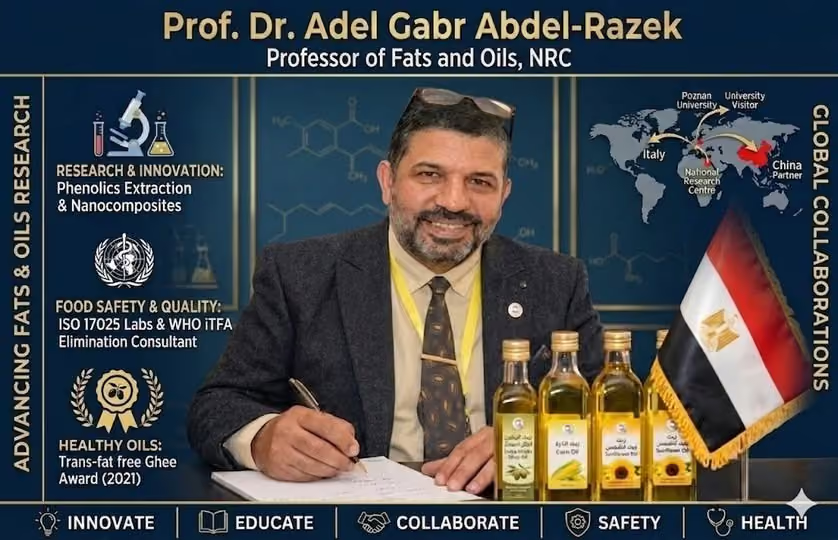
Professor of Oils and Fats at the National Research Centre; Vice-President of the Egyptian Food Safety Association; WHO National Consultant for the iTFA programme.
Publication Date:
January 28, 2026
·
—
Note: This article was AI-translated from Arabic and is currently under manual review. The author is not responsible for any translation errors. Please refer to the original Arabic text for the most accurate and authoritative information.
Black Seed Oil: How Does Origin Determine Usage?
A Comprehensive Guide for Professionals, Manufacturers, and Consumers
Following up on our previous article, "Black Seed Oil and Seeds: A Comprehensive Scientific Guide to Health and Immunity," and based on the growing interest this topic has received from specialists and those interested in practical applications, we present this advanced guide as a deeper step towards the applied and industrial aspects.
It focuses on the chemical-geographical engineering of black seed oil, and how differences in origin (place or country of cultivation) translate into selection criteria and design decisions for more precise and effective products in the food, pharmaceutical, and cosmetic industries.
🎯 Operational Executive Summary
Black seed oil (Nigella sativa) represents a biochemical system that varies according to geographical origin. While black seed oil generally possesses exceptional biological properties and health benefits, each variety gains greater specificity and distinctiveness depending on its type and cultivation region. Although its essence as a vital health-supporting force through antioxidants and functional compounds remains consistent, its effect is not a "one-size-fits-all" in every bottle.
The Reason: Each origin forms a unique chemical fingerprint (fixed oils + volatile oils) that elevates a specific variety in one pathway over another:
• Ethiopian Black Seed Oil: The "Therapeutic Champion" for its superiority in thymoquinone index and phenolic compounds.
• Egyptian Black Seed Oil: The "Food Safety Guardian" for its clear advantage in combating toxin-producing fungi (such as aflatoxin).
• Syrian Black Seed Oil: A unique "Functional Flavoring" due to its strong aromatic fingerprint.
• Turkish/Indian Black Seed Oil: Balance and daily use with higher sensory acceptance.
This guide therefore aims to provide a practical roadmap that links the composition of each origin with its optimal applications, offering tools for selecting and developing actionable products.
✅ Quick Visual Summary
Black Seed Oil = Two Harmonious Layers:
Fixed Oil Fatty Structure (Fatty Acids) = Nourishment + Stability + Blendability and Enhancement of Other Oils.
Egypt ← Food Safety/Antifungal, Mycotoxin Control, and Food Preservation.
Syria ← Strong Functional Flavor for Foods.
Turkey/India ← Balance and daily use with higher sensory acceptance.
Important Scientific Note (For Clarity): The percentages of some volatile compounds, such as thymoquinone and p-cymene, are often presented as percentages within the volatile fraction according to chromatographic analysis, and are not necessarily a weight percentage of "the entire oil."
1. Molecular Dissection: Pillars of Bioactivity
To understand why black seed oil excels, it must be broken down into its harmoniously working components.
1.1 Major Components: The Core Structure
• Dominant fatty acids: Linoleic acid (omega-6, 45–60%) and oleic acid (omega-9, 20–25%) dominate the composition.
• Technological Significance: Its importance extends to oxidative behavior and stability. A study by Rudzińska et al. (2016) shows that blending black seed oil with rapeseed oil at 5–20% reduces the PUFA/SFA ratio, resulting in a more stable hybrid oil (blend) suitable for the food industry with improved health properties.
1.2 Minor Components: Drivers of Efficacy
Thymoquinone: The primary "therapeutic star," responsible for antioxidant and anti-inflammatory activity.
Tocopherols: Especially γ-Tocopherol and α-Tocopherol; natural oxidation inhibitors that preserve the oil and extend its shelf life.
Phytosterols: Most notably β-Sitosterol and its role in regulating cholesterol levels.
Active Aromatic Compounds: Such as p-Cymene and Thymol; they define the aromatic fingerprint and participate in biological functions.
2. Geochemical Atlas: Classification by "Distinct Function"
Soil, climate, genetics, and extraction methods create chemical "fingerprints" that translate into specific applications.
2.1 Ethiopian Variety: The "Therapeutic Gold Standard"
2.2 Egyptian Variety: The "Advanced Guardian of Food Safety and Security"
Strong antimicrobial and antifungal role.
Functional Feature: Superior efficacy against toxin-producing fungi such as aflatoxin, according to Abdel-Razek et al. (2024).
Application: As a natural preservative in foods susceptible to fungal and microbial spoilage, and within smart packaging technologies.
2.3 Syrian Variety: "The Smart Functional Flavorant"
Elevated p-Cymene: up to 38.8% coupled with α-Thujene.
Application: Desirable woody-spicy flavor; a "functional flavorant" for baked goods and sauces, supporting shelf life through its antioxidant activity.
2.4 Balanced and Everyday Use Varieties: Turkish and Indian
Balance between thymoquinone, thymol, and p-cymene → less intense flavor.
Application: Daily use and topical care with higher sensory acceptance.
3. Smart Encapsulation Revolution: Breaking Traditional Boundaries
To overcome taste intensity and rapid oxidation, technologies emerged that elevated the oil to the level of a "designed ingredient."
3.1 Nano- and Micro-encapsulation Technologies
Objective: Transforming the oil into micro/nano particles within a protective shell.
Benefits: Protection from light and heat, reduction of bitter taste, increased bioavailability, and controlled release.
3.2 Remarkable Application in the Food Industry
When adding nano black seed oil capsules to yogurt:
Result: A reduction in aflatoxin levels in yogurt by up to 66.4% according to Badr et al. (2019), along with improved texture—transforming it into a highly safe functional product.
3.3 Advanced Applications and Smart Formulations: From "Oil" to a Nutraceutical-Pharmaceutical Functional Platform
Applications are no longer limited to direct use; instead, they have become targeted solutions based on final product design:
Nutraceutical applications: Using the oil as a (Functional Ingredient) in dairy products, sauces, baked goods, and functional foods, either directly in calculated doses or in encapsulated/microencapsulated form to control release and reduce intensity, thereby supporting "active packaging" and protecting products susceptible to fungal contamination.
Pharmaceutical applications: Transforming the oil into (Standardized) preparations targeting the stability and concentration of active compounds, especially thymoquinone, whether in traditional Soft gels or delivery systems (Micro/Nano carriers) to improve bioavailability and reduce the degradation of sensitive components.
The most advanced rationale: Sources (various black seed oil varieties) should not be treated as competing options, but rather as raw materials that can be engineered through smart (Blends) and formulations that combine advantages: Blending the "therapeutic potency" of Ethiopian with the "defensive role" of Egyptian and the "aromatic signature" of Syrian varieties could yield a balanced performance in terms of functionality (Bioactivity), sensory attributes (Flavor profile), and technical properties (Oxidative stability), with the potential to incorporate Turkish/Indian varieties to mellow the intensity and improve palatability for daily use.
Key to success: Clear batch specifications (Batch COA) and a "Fit-for-purpose" design, followed by adjusting ratios to achieve the desired function without overpowering the taste or sacrificing stability.
Consistent practical advice: Cold pressing without heating is best, and a dark container away from heat and light.
6. From Chemistry to Market: Sector-Specific Selection Protocols
6.1 Functional Chemical System (for Development and R&D)
Explanatory Note: The variation in thymoquinone ranges is attributed to differences in the assay method (quantitative measurement/volatile fraction/Area%) and extraction conditions.
6.2 Pharmaceutical Industry and Dietary Supplements
Criterion 1: Thymoquinone content (>25%).
Recommended Variety: Ethiopian (purity ≥98%).
Extraction Technique: Supercritical CO₂ to preserve sensitive compounds.
9. Precautions and Safety (brief overview without exaggeration)
Potential drug interactions:
Anticoagulants: May increase bleeding time.
Diabetes medications: May enhance blood sugar-lowering effect.
Pregnancy and lactation: Avoid high doses without medical consultation.
Safe usage limits (as stated in the draft):
Maximum daily amount: 3 ml (for adults).
Duration of continuous use: 3 months with a one-week break.
Before surgical procedures: Discontinue two weeks prior.
Important professional advisory: These figures are presented here as practical information from the draft, but they are not to be considered a "general prescription"; the final decision must be based on the individual's health condition, the approved leaflet, or expert consultation.
10. Conclusion and Future Directions: Towards Smart Investment in Diversity
Black seed oil—despite its consensus as a vital health-supporting force—is not a single product for all circumstances, but rather a chemical-functional system whose value changes with its origin. This difference represents an "advantage," not a "confusion," when translated into a conscious choice of variety and technology, and then into a product designed for its function (Fit-for-Purpose).
The future aims to transform it into a scalable and developable technological platform through:
Smart Breeding and Hybridization: Combining the therapeutic potency of the Ethiopian variety with the defensive capabilities of the Egyptian variety.
Advanced Nanotechnology Applications: Nanocapsulation for controlled release and improved stability and bioavailability.
Functional Blending (Functional Blending): Designing smart blends with other oils or between different origins and sources.
And then every drop—when understood, measured, and designed—transforms into tangible value in health, quality, and safety.
Cited Scientific References (as appeared in the article)
Abdel-Razek et al. (2024). Molecules, 29(21). [Quality analysis of black seed oil by origin].
Abdel-Razek et al. (2018). Bioscience Research, 15(3). [Nanocapsulation techniques for oil].
Rudzińska et al. (2016). J Food Sci Technol, 53(2). [Stability of black seed and rapeseed oil blends].
Badr et al. (2019). Pak. J. Biol. Sci., 22(1). [Applications of encapsulated oil in yogurt safety].
 Advertise