 Advertise
Note: This article was AI-translated from Arabic and is currently under manual review. The author is not responsible for any translation errors. Please refer to the original Arabic text for the most accurate and authoritative information.
Between Hot Air, Crispiness, and Acrylamide: What You Actually Gain, and What the Appliance Doesn’t Change
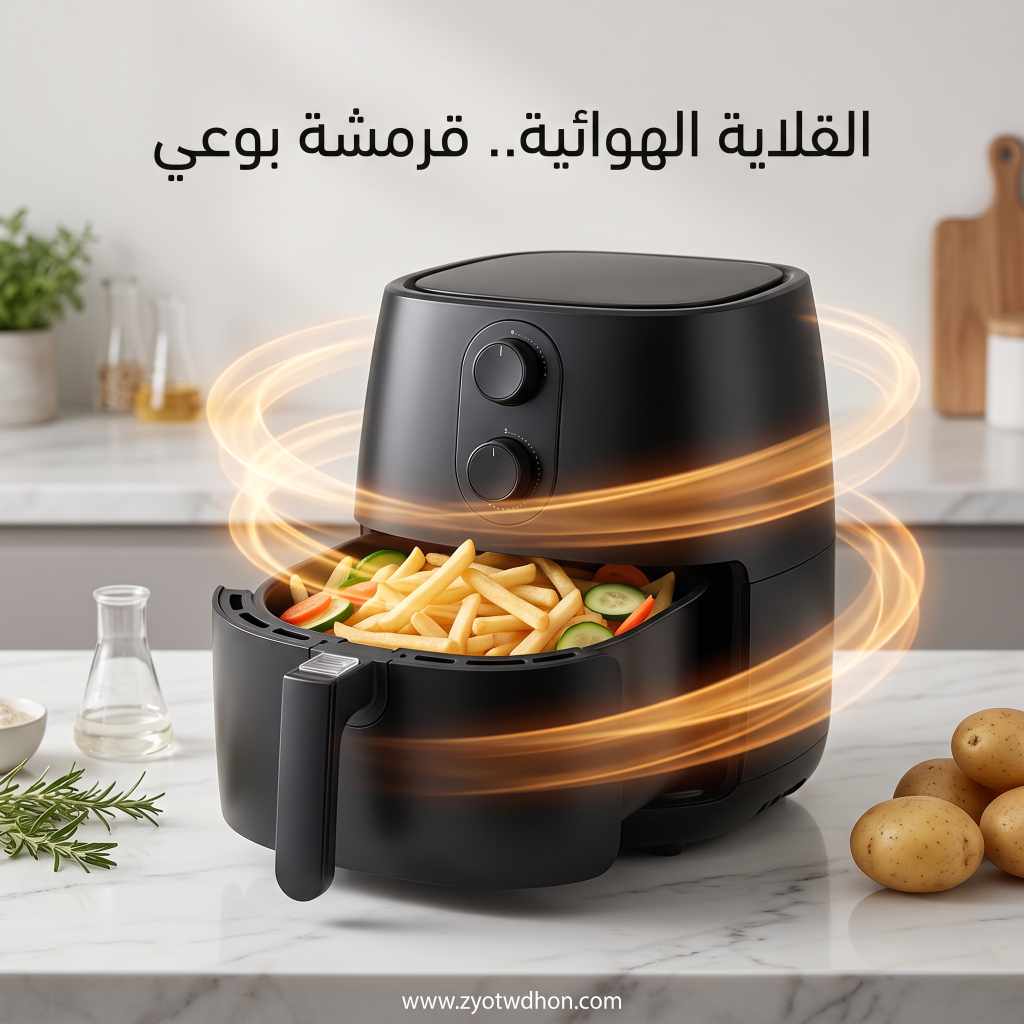
French fries emerge from the air fryer basket golden and crispy, making it seem as though technology has settled an old debate: guilt-free crispiness without oil, and unrestricted healthy food! However, science does not grant any appliance such an open-ended promise.
The air fryer can indeed help reduce added oil and final fat content in many foods compared to deep frying. Yet, it does not erase the fats naturally present in the product, nor does it eliminate calories, sodium, or the nature of breading and batter, and it does not automatically prevent acrylamide formation. The final outcome is not determined by the name of the appliance, but by a formula that encompasses food type, oil quantity, temperature, time, cut size, load capacity, and final color.
Following the previous two parts on selecting, managing, replenishing, and discarding frying oil, this article puts the air fryer into its proper perspective: a useful tool for altering cooking methods, not a blanket health certificate granted to whatever goes inside it.
Technically speaking, an air fryer is not a miniature deep fryer; it is closer to a compact, highly efficient convection oven. An electric heating element warms the air, which a fan then circulates rapidly around the food. This high-speed airflow evaporates surface moisture, forms a crust, and triggers the browning reactions responsible for color and flavor.
Deep frying, by contrast, submerges food in a hot oil bath that transfers heat with high efficiency and contacts virtually the entire surface area. Hence the differences in speed, crust formation, oil uptake, flavor, and texture.
Thus, while "fryer" is an understandable marketing term, the actual scientific process is high-velocity hot air cooking, often accompanied by a thin layer of oil or the inherent fats within the food itself.
It is not enough to claim that the appliance operates without oil, as there are three potential sources of fat:
Consequently, outcomes vary depending on the product:
Comparative studies on potatoes have shown that air cooking can produce an acceptable crust with markedly lower fat absorption than deep frying. However, turning this into a marketing slogan like "always 80% less fat" is unscientific, as the reduction percentage varies with the product, calculation method, baseline oil amount, appliance model, and degree of doneness.
Its benefits are most apparent when replacing deep frying in routine home-cooked meals, particularly when preparing fresh potatoes, vegetables, and select cuts of chicken or fish with minimal oil. It reduces the need for large oil baths and spares households the hassle of storing, reusing, and properly disposing of used frying oil.
However, a fair comparison must be made between the same food cooked via both methods. Fresh air-cooked potatoes are not the nutritional equivalent of highly processed, high-sodium chicken nuggets simply because both came out of the same device. Furthermore, increasing portion sizes under the assumption that the food is "unconditionally healthy" can offset expected benefits.
The air fryer helps decrease added oil, but it cannot single-handedly fix an entire diet. Ingredient quality, portion control, meal balance, and the frequency of consuming ultra-processed foods remain just as vital as the cooking technique.
Acrylamide is a thermal process contaminant that forms in starch-rich plant foods cooked at high temperatures with low moisture, primarily when reducing sugars react with the amino acid asparagine during the Maillard reaction. This exact reaction is what imparts desirable flavor and color to potatoes and bread.
Some studies on potato slices have observed a substantial reduction in acrylamide when air cooking compared to deep frying under specific experimental conditions. However, this is neither an absolute rule nor a built-in guarantee. Formation can rise if cooking time is extended, temperatures are too high, the surface dries excessively, or the color turns dark brown. The outcome also depends on potato cultivar, sugar content, storage conditions, slice thickness, and air distribution within the basket.
Therefore, the most reliable rule is:
Cook until light golden, not dark brown; the air fryer does not grant food immunity from over-browning.
To minimize acrylamide formation in homemade potatoes:
Guidelines from the US FDA and the European Food Safety Authority (EFSA) emphasize that prolonged heating, elevated temperatures, and increased browning correlate with higher acrylamide levels in potato products, affirming that golden is preferable to dark brown.
Using a small amount does not render oil choice trivial; the oil spreads into a thin layer with high surface area exposure to heat and air. It is best to use fresh, high-quality oil suited for thermal applications, using the minimum amount required to achieve desired color and texture.
Good quality olive oil, standard refined cooking oils, high-oleic oils, or purpose-formulated cooking blends can be used depending on flavor, food type, and cooking temperature. Smoke point alone is not the sole deciding factor; baseline quality, chemical composition, oxidative stability, and exposure time are interconnected variables.
Delicate extra virgin or cold-pressed specialty oils may lose subtle aromatic compounds under high heat, making them better suited for post-cooking finishing or low-temperature applications when flavor is paramount. Furthermore, there is no rationale for saturating food with oil in an appliance purchased specifically to minimize oil usage.
Practically, evenly distribute a measured amount of oil onto food before basket loading—via tossing, brushing, or using a food-safe oil sprayer per manufacturer instructions. Do not reuse fats and drippings collected at the bottom of the basket as fresh cooking oil, as they are often mixed with moisture, crumbs, and raw meat juices.
Preheating is not universally required for every recipe or model; following manufacturer guidelines and adjusting times based on food volume and thickness is superior to applying a blanket rule across all devices.
While color helps gauge over-browning in potatoes, surface color is insufficient to determine microbial safety in chicken, meat, and fish. Rapid convection can brown the exterior while leaving the internal core below safe pasteurization temperatures, particularly if the basket is overcrowded or cuts vary in size.
Always use a calibrated food thermometer inserted into the thickest part, away from bone. According to US food safety guidelines, poultry must reach 74°C (165°F), ground meats 71°C (160°F), and whole cuts of fish and meat 63°C (145°F) with recommended rest times for whole meat cuts. Always adhere to packaging instructions—especially for frozen, raw breaded, or stuffed products that may appear cooked on the outside while remaining raw inside; if packaging advises against air frying, follow that directive.
Reducing oil volume is a notable benefit, but it does not eliminate chemical degradation. Heat, oxygen exposure, and time can oxidize a portion of added or inherent dietary fats, particularly polyunsaturated fatty acids in fatty fish and select products.
A study on sardines showed that air cooking, under specific experimental parameters, increased certain cholesterol oxidation products (COPs) and decreased some polyunsaturated fatty acids. While a single study should not be generalized to all foods and appliances, it serves as a reminder that "less oil" does not automatically mean "fewer thermal reactions" in every scenario.
The practical approach is not device avoidance, but avoiding unnecessarily high temperatures and protracted durations, preventing food from over-drying or charring, using fresh ingredients, and clearing accumulated fat residues between cycles.
Not all fryer baskets share the same material makeup; always refer to manufacturer documentation. Regarding PTFE-based non-stick coatings, the German Federal Institute for Risk Assessment (BfR) notes that intended use is not expected to cause adverse health effects, whereas extreme overheating of empty vessels poses risks that must be avoided.
Practically:
Fats, juices, crumbs, and seasonings collect at the bottom of the drawer. If left uncleaned, they can smoke, scorch during subsequent cycles, impart off-flavors, and present fire hazards. Allow the appliance to cool, clean the basket and drawer after use or accumulation, and thoroughly dry parts before reassembly.
Position the unit on a stable, heat-resistant countertop with ample clearance around exhaust vents, keeping it away from curtains and heat-sensitive cabinetry. Never submerge or pour water into the electrical base unit.
The accurate question is not "Is the air fryer healthy?", but rather: What are we cooking in it, how much are we eating, at what temperature, and to what color?
When used to prepare fresh potatoes, vegetables, or minimally processed proteins with minimal oil, alongside careful control of heat, time, and portioning, it serves as an efficient tool that reduces added fats compared to deep frying. However, if consistently loaded with ultra-processed foods high in sodium and saturated fats, cooked to a dark brown, and consumed in excessive portions, circulating hot air will not transform them into a balanced meal.
This is not a contest between the frying pan and the air fryer, nor an exercise in praising or demonizing any single appliance. The fundamental principle remains constant:
The tool alters heat transfer and oil volume, but it does not replace the responsibility of ingredient selection, moderation, and proper culinary execution.
With this installment, the "Crispy with Awareness" series concludes: from selecting oil and mastering deep frying, to managing used cooking oil, and finally applying air fryers grounded in science rather than marketing hype.