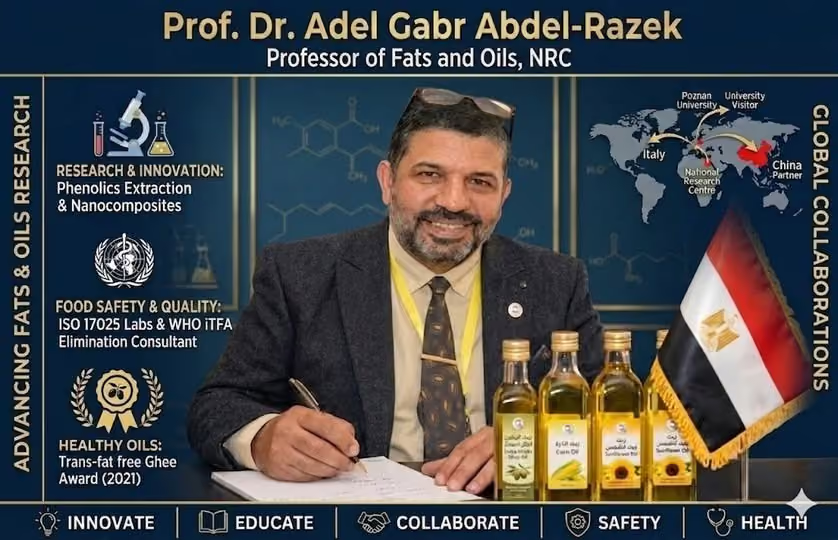
Professor of Oils and Fats at the National Research Centre; Vice-President of the Egyptian Food Safety Association; WHO National Consultant for the iTFA programme.
Publication Date:
January 2, 2026
·
—
Note: This article was AI-translated from Arabic and is currently under manual review. The author is not responsible for any translation errors. Please refer to the original Arabic text for the most accurate and authoritative information.
A scientific vision for a sustainable bioeconomy
🎬 A small journey reveals a global system
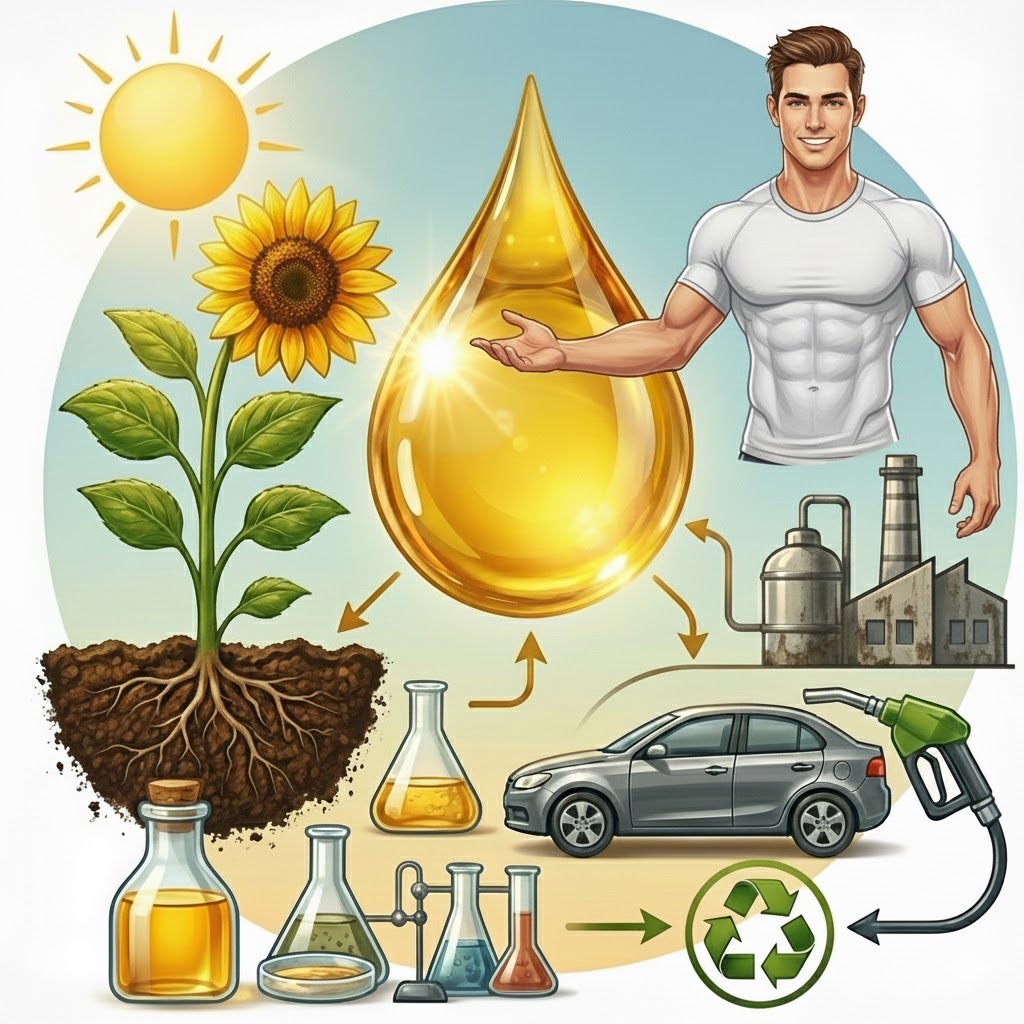
The story starts with a small oily seed that settles in fertile soil, absorbing sunlight, water and minerals, and turning them into concentrated chemical energy.
This energy does not stop at table limits, but extends to nourish the human body as one of the most important sources of vital energy and provide machines and engines with renewable fuel when they enter into the chain of industrial and environmental transformation.
Between a bite of bread with olive oil and a motor powered by a biodiesel extracted from vegetable oils, a drop of oil lives a unique journey of vital transformation:
from living plant tissue,
to physiological dietary oil,
into an industrial raw material,
Then to sustainable fuels that reshape the relationship between man, machine and environment.
It is a practical picture of what today is called Circular bioeconomyWhere agriculture, industry and energy are integrated to produce a system that does not waste resources and supports the sustainability of the Earth and human welfare at the same time.
🌱 First: oil crops - productive and sustainable ecosystems
Oil crops such as olives, canola, sunflower, soybeans, sesame are among the most efficient biosystems in converting solar energy into chemical energy.
Its vital environmental role includes:
Soil stabilization: Through deep roots that prevent their drift and increase their cohesion.
Regulation of the local climate: They absorb CO₂ and release oxygen, supporting ecological balance.
Water efficiency: Some crops are drought tolerant and consume little water, such as olives.
Improve soil fertility: Harvesting and juicing waste are transformed into effective organic fertilizers.
These characteristics make oil crops a renewable environmental resource in line with the Sustainable Development Goals.
🏗️ Second: from seed to drop of oil — extraction techniques between quality and efficiency
1️⃣ Cold PressingA technique based on mechanical compression without heat or solvents.
Its advantages:
Preserving active compounds such as polyphenols.
Producing high quality oil with a high nutritional value.
Its waste is usable as feed or fertilizer.
low energy consumption.
2️⃣ Advanced Industrial Extraction: Includes: solvents (such as hexane), enzymes, ultrasound, and supercritical carbon dioxide.
Its advantages:
Extraction efficiency of more than 95%.
Suitable for mass production and full exploitation of the crop.
Its challenges:
The need to treat chemical waste and waste water to ensure environmental protection.
🔬 Third: oils as a source of human energy - the vital physiological role
Oils are not just a nutrient, but an integrated vital system within the human body:
It has the highest energy value among nutrients (9 kcal/g).
Enables absorption of vitamins A, D, E, K.
Provides essential fatty acids (omega-3 and 6).
It is involved in the synthesis of cell membranes and hormones.
It is a key element in brain and nervous system function.
These facts make oils an essential part of human health and vital functioning.
🧪 Fourth: From food to industry — oils as a versatile chemical platform
Due to their molecular flexibility, oils are involved in a variety of industries:
food industries.
The pharmaceutical industry and drug delivery systems.
cosmetics and skin care products.
Manufacture of soap and detergents (saponification).
vital lubricants.
Biofuel and Biojet Fuel are produced through transesterification.
Thus, a drop of oil is transformed into a multifunctional industrial building block.
⚠ Fifth: the environmental challenge — when used oil becomes contaminated
Improper disposal of used oil leads to:
Environmentally:
The formation of solid fat masses inside drainage systems (Fatbergs).
Low oxygen levels in surface waters.
long-term pollution of water bodies.
Economically:
High maintenance and treatment costs.
A waste of a resource that can be recycled and turned into fuel.
Therefore, collecting used oil is an essential step in the sustainability path.
♻️ Sixth: recycling — from used oil to clean fuel
Through the transesterification reaction Transesterification Used oil can be converted to biodiesel Biodiesel.
Advantages of biodiesel:
Reduce CO₂ emissions by up to 80%.
biodegradability.
The possibility of using it in diesel engines.
Producing valuable by-products such as glycerol.
Other recycling products:
Soaps, lubricants, candles, and organic fertilizers.
This oil is transformed from a dangerous contaminant to a clean vital energy source.
🌍 Seventh: leading global experiences - lessons in sustainability
The European Union: It relies on highly productive canola within legislation that reduces emissions throughout the life cycle.
United States: Boosting biodiesel production from soybeans through the RFS program that supports renewable energy.
Brazil: Bioenergy policies are integrated with support for small farmers within the “Social Biofuels” program.
Malaysia and Indonesia: Advanced models in the palm oil chain with sustainability trends and RSPO certifications.
These models show the possibility of integrating oil crops into national clean energy policies.
⚖️ Eighth: solving the food-feed-fuel dilemma through an integrated approach
To achieve a balance between Food—Feed—Fuel, scientific policies are adopted:
Non-food crops for energy: Jatropha and microalgae.
Exploitation of by-products: Protein meal used as animal feed.
Raising agricultural productivity: Through precision agriculture and genetic improvement of varieties.
This is how “competition” becomes integration that serves food, energy and the environment.
🧬 Ninth: The future - oils are at the heart of the green energy system
Scientific research is directed towards innovative solutions, including:
Algae oils are highly productive.
Smart crops that tolerate drought and salinity.
Solvent-free extraction based entirely on green chemistry.
Decentralized recycling units close to used oil sources.
These trends make oils an essential part of the global renewable energy system.
🔚 Conclusion — A drop between man, machine and environment
The oil drop journey shows how a single resource can link:
human life and health,
the operation of machinery and industry,
environmental protection and emission reduction,
Supporting the circular bioeconomy.
When a drop of oil is managed knowingly and responsibly, it transforms:
From a nutrient to a basic physiological element,
From used waste to clean biofuel,
From a simple agricultural product to a strategic resource for sustainable energy.
Thus, a drop of oil becomes... energy for humans and sustainable fuel for machines, a living model for the possibility of compatibility between human needs and environmental limits, and a clear message that a circular bioeconomy is capable of building a balanced green future.
 Advertise