 Advertise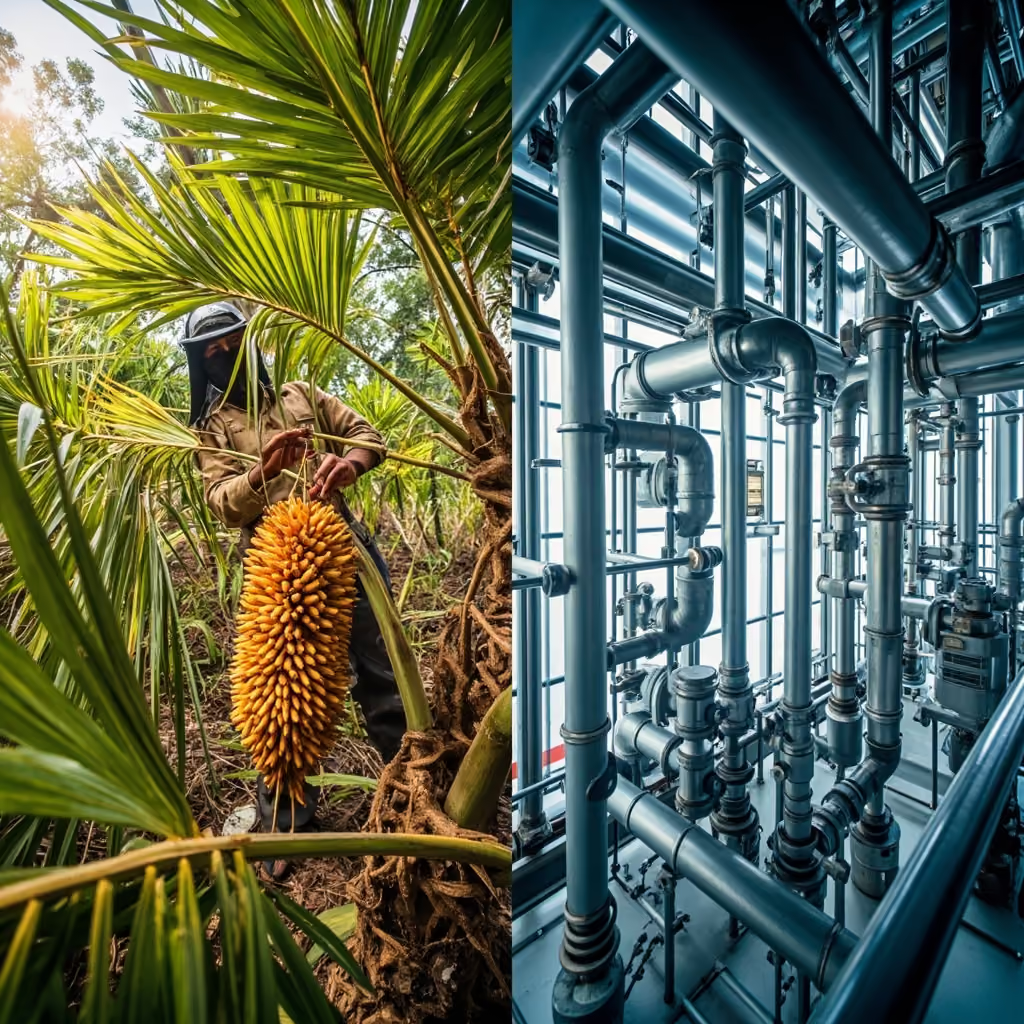
The global oleochemical industry faces critical questions regarding key raw material availability, particularly palm kernel oil (PKO), amidst profound shifts in feedstock dynamics. A recent analysis reveals that decades of focus on crude palm oil (CPO) production have inadvertently led to supply challenges for specific oleochemicals derived from the palm kernel, elevating the humble kernel to an increasingly strategic component for the future.
Nearly two decades ago, the oleochemical sector was already grappling with concerns over new fatty alcohol capacity and dramatically higher PKO prices. Today, as another wave of production expansions nears its completion, similar anxieties persist, yet the fundamental supply environment behind these factories has transformed. In 2008, Indonesia’s oil palm industry was relatively young and rapidly expanding, promising more new trees, fruit, and eventually kernels. Now, the plantation base is much more mature, with growth shifting from expansion to rejuvenation and replanting, a significant challenge for an industry dependent on future PKO supply.
Oleochemicals are broadly defined as chemicals derived from natural fats and oils. In Southeast Asia, palm oil, and particularly palm kernel oil, along with coconut oil, serve as crucial renewable feedstocks. Their derivatives form the building blocks for numerous downstream products, including detergents, shampoos, cosmetics, pharmaceuticals, lubricants, plastics, and coatings.
Bringing together manufacturers from Malaysia, Indonesia, and the Philippines, the Asean Oleochemical Manufacturers Group (AOMG) recently hosted an executive dialogue. During this event, Dr. Julian Conway McGill of Glenauk Economics highlighted that the market not only addresses 'what' can be done chemically to a molecule but 'why' it is chosen economically – and increasingly, whether enough of that molecule will be available.
The discussion also touched upon chemicals like Linear Alkylbenzene Sulphonic Acid (LABSA), a petrochemical-derived surfactant widely used in detergents. Despite its strong cleaning and foaming characteristics, LABSA is not a direct substitute for surfactants made from natural fatty alcohols, which often serve personal care applications. While the two chemical routes can overlap in the broader cleaning market, they are not simply interchangeable molecules. Users may turn to natural alcohol alternatives when petrochemical surfactant inputs become constrained, underscoring that substitution isn't always about finding something cheaper, but rather something available.
Each oil palm fruit yields two chemically distinct oils: CPO from the familiar orange-red mesocarp (flesh) and PKO from the whitish seed (kernel) hidden inside the hard nut. PKO holds particular importance for much of the oleochemical industry due to its unique fatty acid composition, rich in shorter-chain, lauric-type fatty acids, making it especially valuable for fatty alcohols and downstream surfactants. The natural lauric oil world essentially relies on these two tropical oils: palm kernel and coconut.
Historically, palm and PKO expansion helped overcome natural oleochemical feedstock constraints, as previous sources like tallow and coconut oil did not expand at the same rate. However, this era of abundant feedstock growth cannot be projected indefinitely into the future.
Dr. McGill's analysis further suggests that some newer oil palm planting materials may exhibit lower kernel extraction rates. This observation prompts re-evaluation of historical assessment formulas, such as the 'Total Economic Product' (TEP = Oil Yield + (Kernel Yield × 0.6)) used in the 1980s for breeding material. While oil palm breeders have understandably spent decades pursuing higher mesocarp oil yield, this progress might inadvertently lead to relatively scarcer kernel availability for downstream lauric industries. 'Nobody got the breeding wrong. The economics moved,' McGill implied, suggesting that yesterday's secondary trait can become tomorrow's strategic one when economics shift significantly.
Furthermore, weather introduces another layer of uncertainty. While climate indicators like the El Niño–Southern Oscillation provide important data, what ultimately matters to the palm is actual rainfall distribution, duration of dry periods, and soil moisture depletion. Dr. McGill also raised haze as a possible concern for fruit set and kernel recovery. The tiny oil palm pollinating weevil, 'elaeidobius kamerunicus', is crucial for successful pollination. Anything that seriously interferes with pollination and fertilization can affect fruit set and kernel formation, becoming more economically important if kernels gain strategic value downstream, though a direct causal link between haze and weevil suppression/parthenocarpy requires stronger evidence.
The central message extends beyond today’s PKO price: the structural context has fundamentally changed. Rapidly expanding oil palm acreage is now maturing, and replanting does not automatically replicate previous kernel growth trajectories. Other natural lauric sources are limited, while fatty alcohol capacity has increased. Genetics, weather, and fruit set introduce additional uncertainties. For decades, palm liberated natural oleochemicals from feedstock scarcity. Now, feedstock supply may once again become the strategic question – but this time, with many more claimants: oleochemical producers, food manufacturers, Indonesia seeking domestic processing, China desiring derived molecules, and regulators demanding origin transparency. The crucial question is no longer merely how much oleochemical capacity the world can build, but rather 'who gets the molecule — and who captures the value after getting it?'
Source: The Star