
Lang
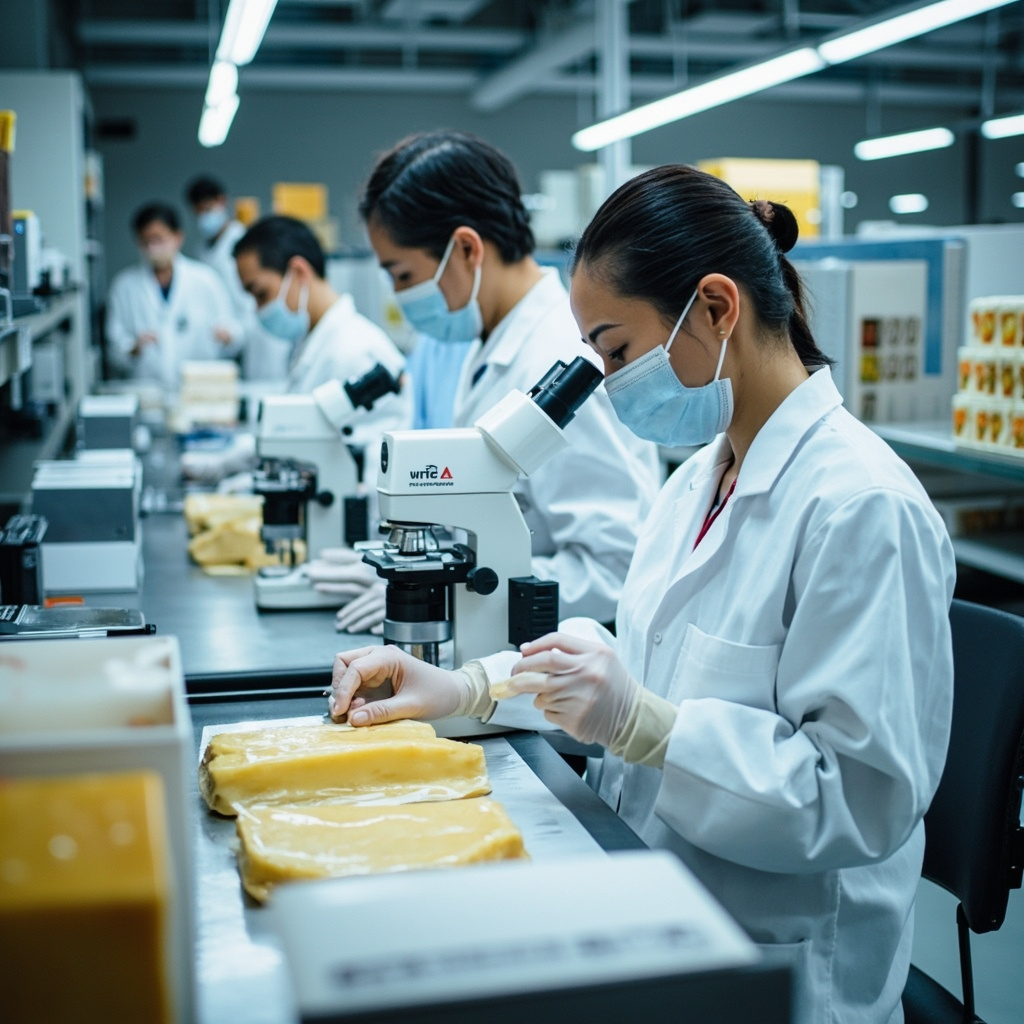
Manorama Industries is strategically reinforcing its market leadership in the specialty ingredients sector, cultivating a significant competitive advantage through a multi-faceted approach. This includes securing blue-chip customers, offering highly customised specialty fats, investing heavily in research and development (R&D), expanding global sourcing networks, and robustly increasing manufacturing capacity. The company reported impressive financial results for Q1 FY27, with consolidated revenue soaring 39.5% year-on-year to Rs 404 crore, and profit after tax (PAT) growing 67.6% to Rs 79 crore. These figures underscore the company's strengthening integrated model, supported by a planned capital expenditure of Rs 460 crore for future growth initiatives.
Building a competitive edge in the specialty ingredients industry is a long-term endeavor, achieved through years of dedicated product development, strategic material sourcing, stringent quality control, and earning the trust of major global clients. Manorama Industries exemplifies this growth trajectory by developing bespoke specialty fats and butter solutions. These are primarily utilized in chocolate and confectionery products, alongside applications in the cosmetics and personal care sectors.
The company has cultivated strong, enduring relationships with prominent global brands such as Nestlé, Ferrero, Mondelez International, Mars, The Hershey Company, Barry Callebaut, Slavyanka, Cargill, EFKO Group, Bunge, and Loders Croklaan in the food and confectionery segments. Its presence also extends significantly into personal care, with clients like The Body Shop, L'Oréal Paris, and Lush. These partnerships with blue-chip customers are a cornerstone of Manorama's strategy, further enhanced by developing a comprehensive ecosystem encompassing sourcing, innovation, advanced manufacturing capabilities, and internationalisation.
Manorama Industries has honed its expertise in specialty fats and butters over nearly two decades. Its raw material sourcing strategy is extensive, covering sal seeds, mango seeds, and other resources from various parts of India, in addition to shea nuts and shea butters from West African nations. The company also leverages vital tribal community sourcing channels and village-level aggregators to procure raw materials closer to their origin points, ensuring reliability and traceability.
These meticulously sourced raw materials are then processed into products like stearin fractions, olein fractions, and MILCOA CBEs, which find applications across diverse sectors, from chocolates and confectioneries to personal care. As per its Q1 FY27 financial results, Manorama boasted a fractionation capacity of 47,500 MTPA. The stearin and Cocoa Butter Equivalent (CBE) segments collectively contributed 71.4% to its revenues in FY26, highlighting their strategic importance.
A key aspect of Manorama's customer relationships is its product customization. Management emphasizes that value-added products are developed precisely according to specific customer requirements and recipes. This approach means Manorama does not offer a single homogeneous product but rather numerous variations tailored to individual formulations, enhancing customer stickiness and linking supplier capabilities directly to client needs. This also explains why the company chooses not to disclose a single 'realisation per tonne' figure for its value-added range.
The company's strategy involves simultaneously increasing sales volume and expanding its range of value-added products. This dual focus was identified by management as a critical factor behind the strong success achieved in Q1 FY27. Furthermore, R&D plays an increasingly strategic role, with Manorama's MILCOA Research & Development Centre, recognized by the Department of Scientific & Industrial Research, continuously driving product innovation. The R&D capabilities are also instrumental in initiatives for both backward and forward integration.
An example of such innovation is the creation of ECBE (Enzymatic Cocoa Butter Equivalent). This technology involves converting softer fraction oils into harder fraction oils using enzymes, thereby producing a cocoa butter substitute suitable for applications in chocolates, confections, and the HoReCa sector. Management views this as a significant forward integration opportunity, enabling the deployment of existing raw material inputs alongside new ones.
To support its globally diverse customer base, Manorama has built a robust supply chain, particularly vital given its reliance on agricultural and forestry-based materials. This has led to an extended sourcing reach into Africa, where Manorama currently owns subsidiaries and is developing additional sourcing capacity in Chad and Burkina Faso. In Q1 FY27, it established Manorama Savannah Agro Chad Sarl as a wholly-owned subsidiary and acquired approximately 10 hectares (24 acres) in Burkina Faso for a shea nut and mango nut processing unit. These strategic moves aim to enhance sourcing reliability, traceability, and resilience within its supply chain, while also improving proximity to its customer base. Management also highlighted that diversifying sourcing across geographies and suppliers mitigates risks associated with over-dependency.
Significant capital expenditure is planned for the next phase of growth, totaling around Rs 460 crore. Of this, Rs 120-130 crore is allocated to the Burkina Faso plant, with the remainder dedicated to domestic plants. The plan includes establishing solvent fractionation/refinery capacity domestically and extraction/expelling capacity in Burkina Faso. These projects are tentatively slated for completion and operation in Q3 FY28. Concurrently, the firm is undertaking debottlenecking exercises at existing facilities with minimal costs, estimated at Rs 5-6 crore, targeting a full-year capacity utilization of 80-85%. Management anticipates a payback period of roughly three years for the Burkina Faso project, deeming it highly efficient and profitable.
On a consolidated basis, Q1 FY27 saw Manorama Industries report Rs 404 crore in revenue, marking a 39.5% increase year-on-year. This growth was primarily driven by a richer mix of value-added offerings and increased traction from its expanded fractionation capacity. EBITDA rose 42.2% to Rs 106 crore, with the EBITDA margin expanding to 26.3%, while PAT climbed 67.6% to Rs 79 crore, resulting in a PAT margin of 19.5%. The export-to-domestic revenue mix stood at 60:40, reflecting the sustained strength of its global customer base alongside healthy domestic demand.
From an investor's perspective, Manorama Industries shares, with a market capitalization of Rs 12,250 crore, are currently trading at Rs 1,943 and a PE ratio of 46, significantly higher than the industry average of 19. The shares have delivered a return exceeding 800% since July 2022. The completion of a Rs 500 crore Qualified Institutional Placement (QIP) issue has further bolstered capital resources, enabling increased spending on manufacturing, sourcing, and the development of higher value-added offerings.
Manorama's competitive 'moat' appears to be strengthening across multiple layers rather than relying on a single product. Long-standing ties with clients like Nestlé, Ferrero, and L'Oréal Paris provide an access advantage, while custom formulations ensure customer loyalty. Beneath these strategies lies a robust sourcing footprint spanning India and Africa, advanced R&D capabilities, growing fractionation capacity, and increasingly integrated manufacturing operations. These efforts are further supported by the current Rs 460 crore capital expenditure program, African expansion, vertical integration initiatives, and new product launches such as ECBE. If the company successfully executes its capacity and integration plans, the combination of blue-chip customers, specialized formulations, deep sourcing capabilities, advanced R&D, and integrated manufacturing operations could establish a competitive advantage that is increasingly difficult for rivals to replicate.
Source: Trade Brains