 Advertise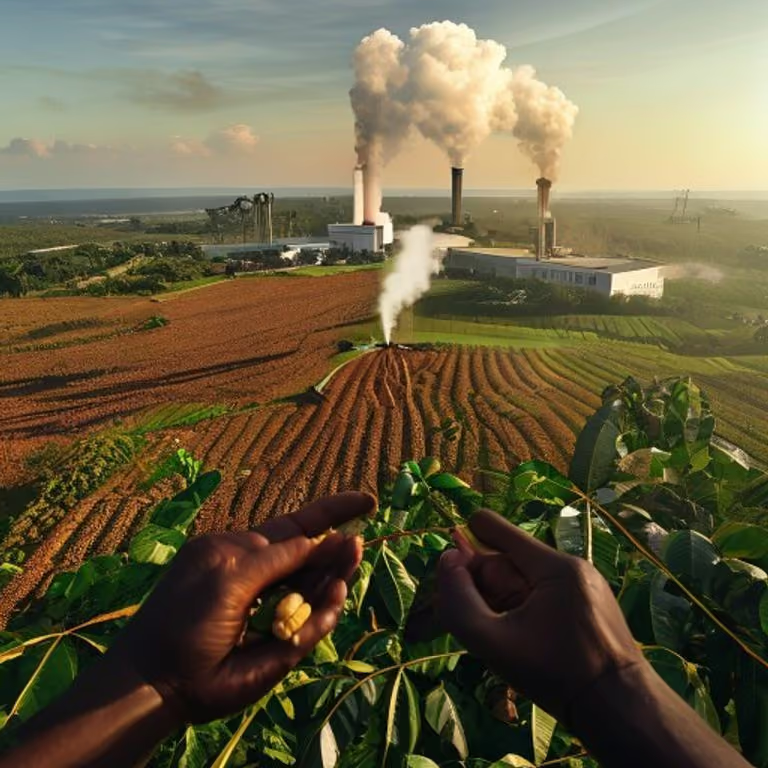
Nigeria, Ghana, Côte d'Ivoire, and Cameroon, collectively responsible for two-thirds of global cocoa production, have formally committed to ending raw cocoa bean exports. This significant move was formalized through the signing of the 'Abuja Declaration' on July 15, 2026, at the Cocoa Value Addition Summit. The declaration binds these four nations to cease raw bean exports, coordinate processing policies, harmonize industry standards, and negotiate with international buyers as a unified bloc.
This expanded initiative evolved from an earlier bilateral pact between Ghana and Côte d'Ivoire, which together supply nearly 60% of the world's cocoa. They renewed their joint cocoa initiative on June 16, 2026, during a summit in Abidjan, where Presidents Mahama and Ouattara agreed to open the pact to other African producers. The Abuja summit on July 15 saw the inclusion of Nigeria and Cameroon, expanding the alliance to four countries. The summit, themed 'From Bean to Brand,' was convened by Nigeria’s Federal Ministry of Industry, Trade and Investment, with the Bank of Industry acting as co-convener. The ambitious undertaking is financially supported by an €85 million (US$97 million) long-term loan facility from the European Investment Bank.
Despite Africa producing approximately 70% of the world's cocoa, the continent captures less than 10% of the value from the US$130 billion global chocolate sector. The vast majority of cocoa beans leave Africa unprocessed, destined for value-adding transformation in Europe and North America. The four signatory countries also adopted a common position on the EU Deforestation Regulation (EUDR), set to take effect for large and medium-sized operators on December 30, 2026. They are seeking recognition for their national traceability systems and opposing the transfer of compliance costs to smallholder farmers.
Ghana is proactively addressing the demand side of this shift. Prior to the Abuja summit, on July 7, Ghana’s Cocoa Marketing Company (CMC) secured off-take commitments with buyers in the UAE and Saudi Arabia for semi-finished cocoa products, including cocoa liquor, butter, cake, and powder. This strategic move aims to guarantee Gulf demand for Ghanaian processed cocoa even before the political declaration takes full effect. President Mahama has set an ambitious target to process 50% of Ghana's cocoa domestically. While Ghana possesses considerable grinding capacity, much of it remains underutilised due to a lack of guaranteed buyers. The CMC's Gulf deals are specifically designed to bridge this gap, locking in demand ahead of increased production. This focus on the Gulf market also represents a deliberate diversification away from Europe, mitigating Ghana's exposure to the EUDR and to European grinders who have historically commanded significant processing margins.
Nigeria is pursuing a different strategy, emphasizing the supply side. At the summit, President Tinubu declared Nigeria’s intention to cease exporting raw cocoa beans. Annually, Nigeria produces between 250,000 and 350,000 tonnes of cocoa, yet its grinding capacity is a mere 120,000 to 150,000 tonnes. Investors are, however, developing a new 70,000-tonne facility in Sagamu, Ogun State, slated for commissioning in 2027, with capital commitment from the Bank of Industry. Nigeria also signed a domestic 'Cocoa Value Addition Accord' at the summit, obligating the federal government, cocoa-producing state governors, farmer organizations, and development financiers to meet measurable annual targets.
However, Nigeria has a cautionary precedent regarding export bans when domestic processing capacity is insufficient. In August 2025, a ban on raw shea nut exports led to a 33% price crash within three days. Processing facilities proved incapable of absorbing the surplus, resulting in mounting stockpiles, exporter defaults on bank loans, and women farmers losing up to half their income. The government extended the ban in February 2026, arguing that short-term pain was necessary to force investment into processing, an investment that has yet to materialize at scale.
Cocoa, a larger crop, faces a similar capacity shortfall. There is very little indigenous chocolate manufacturing across any of the four West and Central African growers. Consequently, the pledge to end raw cocoa exports is unlikely to achieve immediate success and is probably not intended to. It is best interpreted as a powerful statement of intent, a clear policy position, and a direct message to major chocolate manufacturers: unless they relocate production closer to where cocoa is grown, Africa's four largest cocoa producers are prepared to disrupt the status quo and prioritize deals that retain greater value locally.
While Barry Callebaut maintains major processing operations in Côte d'Ivoire, Ghana, and Cameroon, Ferrero, through its IMSOFAR subsidiary in Cameroon, is the only major chocolate manufacturer with operations in any of these four primary cocoa-growing nations. Other industry giants like Mars (which owns Kellanova and has a major JV in Nigeria with Tolaram), Nestlé (whose West African manufacturing hub is in Côte d'Ivoire), and Mondelez (which has a local subsidiary in Nigeria with Cadbury Nigeria) all possess potential pathways to more localized chocolate manufacturing but have not yet fully embraced this strategy.
Source: Trendtype