 Advertise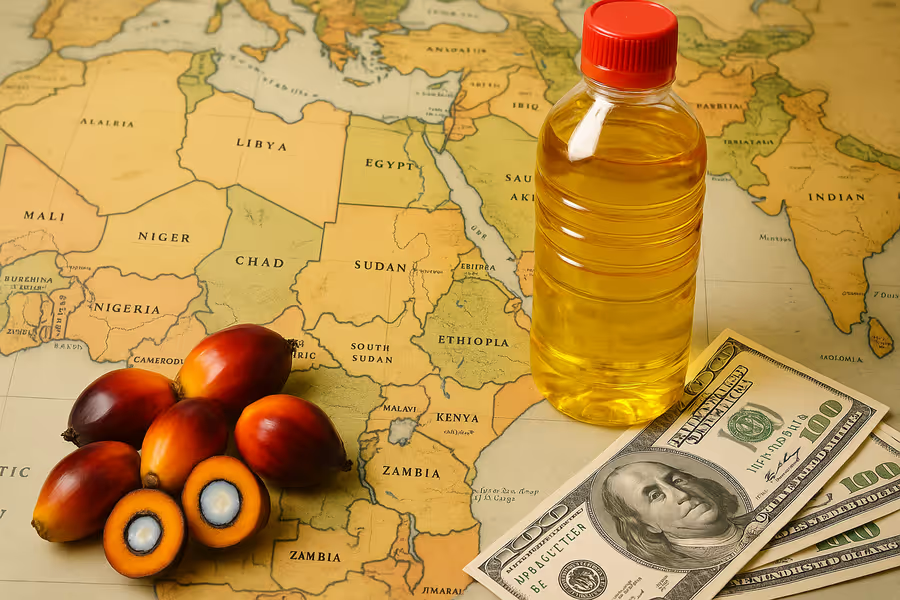
Indonesia's decision to raise its crude palm oil (CPO) export levy from 7.5% to 10% is set to have a significant impact on global markets, particularly in Africa. Many African countries rely heavily on palm oil imports from Southeast Asia and are likely to face higher costs once the new levy comes into effect.
According to 2024/2025 global palm oil export figures, Indonesia retained its position as the world's largest exporter with roughly 24.2 million tonnes, followed by Malaysia with about 15.9 million tonnes, according to Business Recorder.
In 2023, the top four importers of Indonesian palm oil were India, at $4.86 billion; China, at $3.79 billion; Pakistan, at $2.56 billion; and the United States, at $1.71 billion.
Although African countries are not among the world's largest palm oil importers, the continent plays an important role in consuming and utilising Indonesian palm oil. The leading importing countries in Africa include Nigeria, Kenya, Tanzania, Angola and South Africa. With Africa's population now exceeding one billion, local producers are struggling to meet domestic demand.
According to the "2023 Global Agricultural Production" report, Nigeria produced 1.4 million tonnes of palm oil, making it Africa's largest producer and the world's fifth largest.
Côte d'Ivoire produced 600,000 tonnes of crude palm oil, while Cameroon's output stood at 465,000 tonnes. Ghana and the Democratic Republic of Congo (Congo-Kinshasa) each recorded 300,000 tonnes.
This substantial supply shortfall is offset through imports from major oil-producing countries such as Indonesia, Malaysia, Brazil and the European Union. Nevertheless, Malaysia and Indonesia remain the primary suppliers of palm oil to sub-Saharan Africa.
However, domestic production in Africa remains insufficient to meet demand, leaving consumers with no choice but to pay more for imported products.
Importers are expected to pass on the cost increases resulting from higher export levies—particularly those imposed by the Indonesian government—to consumers, ultimately driving up palm oil prices in the region.
Note: With more than 30 years of experience in agricultural markets, UkrAgroConsult has built an extensive database that now underpins its digital platform, AgriSupp, a multifunctional platform offering daily intelligence on Black Sea and Danube markets, along with analytical reports and historical data on grains and oils.
Source: OleoScope