 Advertise
Note: This article was AI-translated from Arabic and is currently under manual review. The author is not responsible for any translation errors. Please refer to the original Arabic text for the most accurate and authoritative information.
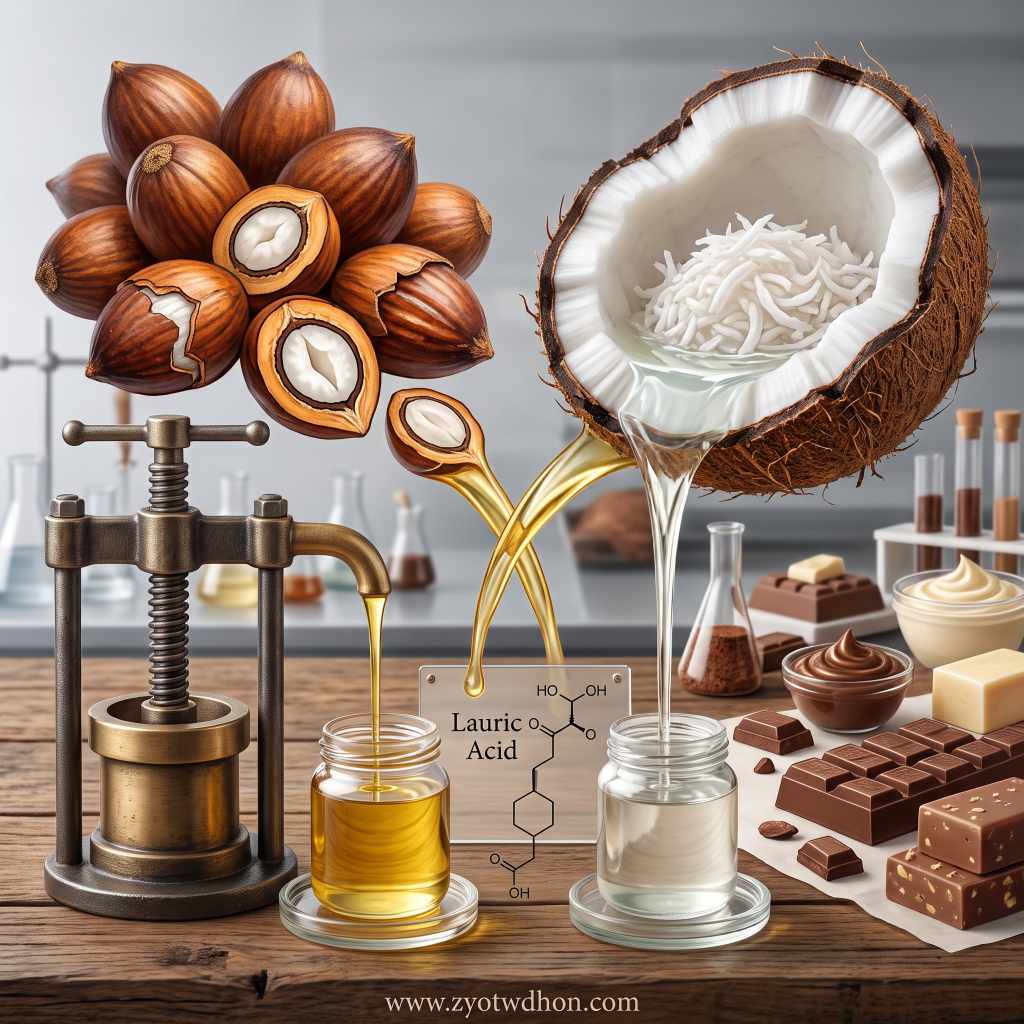
Palm Kernel Oil (PKO) is not merely another grade of standard palm oil; it is a lauric oil with an independent composition and properties. It closely resembles coconut oil without being identical in every application.
When the oil palm tree is mentioned, thoughts usually turn to palm oil extracted from the fleshy mesocarp of the fruit. However, the fruit itself yields a second, fundamentally different oil: Palm Kernel Oil (PKO). Extracted from the hard seed (kernel) inside the fruit, PKO differs significantly from standard Palm Oil in its chemical composition, physical characteristics, and industrial applications.
While standard palm oil, palm olein, palm stearin, and low-temperature crystallization phenomena are discussed in separate articles, the critical questions here are: Why is palm kernel oil routinely compared to coconut oil? Can it be considered a functional substitute or equivalent? And what gives it special value across food, confectionery, detergent, and oleochemical industries?
Palm kernel oil belongs to the lauric oils group because Lauric Acid (C12:0) represents the largest proportion of its fatty acid profile. According to Codex Alimentarius standards, palm kernel oil typically contains approximately 45–55% lauric acid, 14–18% myristic acid, and 6.5–10% palmitic acid, along with minor amounts of caprylic (C8:0) and capric (C10:0) acids, plus a portion of oleic acid (C18:1).
This profile contrasts sharply with standard palm oil, which is dominated by palmitic and oleic acids. Consequently, sharing part of a name does not imply chemical similarity, and categorizing palm kernel oil under generic "palm oil grades" without clarifying its origin and structure is an inaccurate oversimplification.
Coconut oil and palm kernel oil are the two primary commercial sources of lauric oils. Both are exceptionally rich in lauric acid and saturated fatty acids with relatively shorter chain lengths than those predominant in most other fats. As a result, they share several functional attributes: good oxidative stability, relatively quick melting profile, solid consistency at lower temperatures, and high suitability for producing fatty acids, fatty alcohols, and surfactants.
However, similarity does not mean identity. Coconut oil typically contains higher proportions of caprylic (C8) and capric (C10) acids, whereas palm kernel oil tends to carry a higher relative content of oleic acid. This difference directly impacts their Iodine Value, triacylglycerol (TAG) distribution, crystallization behavior, and melting properties.
According to Codex standards, the Iodine Value of palm kernel oil ranges between 14.1 and 21.0, whereas coconut oil exhibits a lower range of 6.3 to 10.6. The Saponification Value for palm kernel oil falls roughly between 230 and 254 mg KOH/g oil—a relatively high figure that reflects the presence of shorter-chain fatty acids.
Data published by the Malaysian Palm Oil Board indicates that the melting point of Malaysian palm kernel oil falls within approximately 27.3–28.0°C. Despite its high saturation level, the presence of shorter-chain fatty acids and their distribution within the triacylglycerol structure explain this moderate melting temperature.
Key Technical Insight: High saturated fat content does not automatically result in an excessively high melting point; carbon chain length and triacylglycerol architecture play a decisive role in thermal behavior.
The most accurate answer is: Yes, in many applications, but not universally. In oleochemicals, soap manufacturing, and detergent formulations, both oils can be treated as functionally close lauric sources, though differences in minor component ratios may subtly influence final product specifications and process economics.
In specialized food applications, a 1:1 direct replacement cannot be assumed to yield identical performance. When a product relies on a specific Solid Fat Content (SFC) profile, exact melting temperature, crystallization velocity, or mouthfeel, variations in triacylglycerols between the two oils become evident in texture, stability, and shelf-life performance.
Technical Summary: Palm kernel oil is a potential functional substitute for coconut oil across numerous applications, but it is not a complete chemical or technological equivalent. Proper substitution requires precise product specifications and empirical trial testing, rather than relying solely on naming similarities or total saturation levels.
Palm kernel oil contains a high percentage of saturated fatty acids, yet its melting range remains close to the high twenties (°C). This occurs because lauric acid and shorter fatty acids form triacylglycerols that behave differently under thermal shifts compared to fats rich in long-chain fatty acids like stearic and palmitic acids.
This physical property gives the oil and its fractions key importance in applications requiring firm room-temperature stability coupled with a rapid, clean melt-in-the-mouth sensation during consumption—explaining its strong presence in confectionery fillings, coatings, and specialty fats.
PK Olein is the liquid fraction obtained from the fractionation of palm kernel oil. It exhibits higher relative unsaturation compared to the crude oil; Malaysian Palm Oil Board metrics show a higher Iodine Value than whole oil, corresponding to greater softness and lower solid fat content. It is widely used in fat blends, specialty creams, fillings, margarines, and applications requiring softer textural profiles.
PK Stearin is the harder fraction, enriched in higher-melting triacylglycerols. Analyses by the Malaysian Palm Oil Board demonstrate a marked increase in lauric and myristic acid content relative to olein, accompanied by a low Iodine Value. Its primary technological value lies in its steep Solid Fat Content curve and sharp melting point, properties highly sought after in confectionery fats and coatings.
Palm Kernel Stearin is primarily utilized in manufacturing lauric-type Cocoa Butter Substitutes (CBS). It is critical not to confuse CBS with Cocoa Butter Equivalents (CBE).
CBE fats are engineered to match cocoa butter closely in chemical composition and polymorphic crystallization behavior. Conversely, lauric CBS fats perform a functional alternative role in specific coatings and compound formulations without being chemically identical to natural cocoa butter.
Advantages of lauric CBS include high hardness, excellent snap, and a clean, rapid melt profile, while often bypassing the complex tempering protocols required for cocoa butter. However, lauric CBS fats are highly incompatible with high levels of natural cocoa butter; improper blending triggers eutectic softening, altered crystallization behavior, and structural degradation.
In short: Palm Kernel Stearin is a vital raw material for CBS production, but it is neither "cheap cocoa butter" nor an automatic CBE. Fat selection depends strictly on the final formulation, cocoa solids percentage, textural requirements, and melting characteristics.
The economic and industrial significance of palm kernel oil extends well beyond food processing. Its high lauric acid concentration makes it a primary feedstock in the global oleochemical industry. From PKO and its derivatives, manufacturers synthesize fatty acids, fatty alcohols, esters, amines, and surfactants—essential ingredients for soaps, laundry detergents, shampoos, cosmetics, personal care items, and industrial chemical processing.
This dual utility underpins the ongoing market comparison between palm kernel oil and coconut oil. Both supply the global lauric feedstock market; thus, substitution dynamics are frequently driven by relative pricing, raw material availability, and required derivative specifications, rather than chemical composition alone.
The high proportion of saturated fatty acids provides palm kernel oil with strong oxidative stability relative to oils high in polyunsaturated fatty acids—a key advantage for products demanding extended shelf life.
However, lauric oils are notably susceptible to hydrolytic rancidity. In the presence of moisture or active lipase enzymes, free fatty acids are released, which can impart soapy off-flavors even at low concentrations. Maintaining raw material quality, low moisture content, controlled storage conditions, and enzyme inactivation is essential.
Palm kernel oil is not inherently cheaper than coconut oil at all times, as global lauric prices fluctuate based on supply-demand cycles, seasonality, and international trade dynamics. However, palm kernel oil possesses a structural economic advantage: it is produced within the integrated oil palm processing ecosystem, where the fruit mesocarp yields palm oil and the inner kernel provides an independent, value-adding raw material.
Published data from the Malaysian Palm Oil Board indicates that palm kernels yield roughly 45–50% oil by weight in analyzed samples, while the remaining Palm Kernel Meal (PKM) serves as an animal feed ingredient. Furthermore, refining and fractionation yield co-products with high value in chemical synthesis, strengthening the overall economic integration of the processing refinery.
No. Although palm kernel oil contains shorter-chain fatty acids relative to many liquid vegetable oils, it is not equivalent to concentrated Medium-Chain Triglyceride (MCT) oils used in specialized nutritional and medical applications. Commercial MCT oils are concentrated fractions consisting primarily of caprylic (C8:0) and capric (C10:0) acids, whereas lauric acid (C12:0) remains the predominant component in full-spectrum palm kernel oil.
Technological functionality must be distinguished from dietary recommendations. Both palm kernel oil and coconut oil contain high levels of saturated fats. The fact that they are lauric-rich or contain shorter-chain fatty acids than long-chain fats does not make unlimited consumption nutritionally advised. Global health guidelines, including those of the World Health Organization (WHO), advise limiting overall saturated fat intake and replacing saturated fats with unsaturated fatty acids within a balanced diet.
Consequently, the core strength of palm kernel oil rests in its functional properties—crystallization, melting dynamics, stability, and fractionability—rather than positioning it as an inherently superior health oil.
Palm kernel oil is a lauric oil distinct from standard palm oil, sharing strong functional similarities with coconut oil without being chemically identical. It serves as an effective functional alternative across numerous sectors, particularly in oleochemicals and specialty food formulations. However, substitution in texture- and melt-sensitive food applications requires empirical trial formulation. Its industrial value peaks through fractionation into PK Olein and PK Stearin, with stearin serving as a cornerstone for lauric CBS fats, coatings, and fillings, alongside its massive footprint in detergents and surfactants.